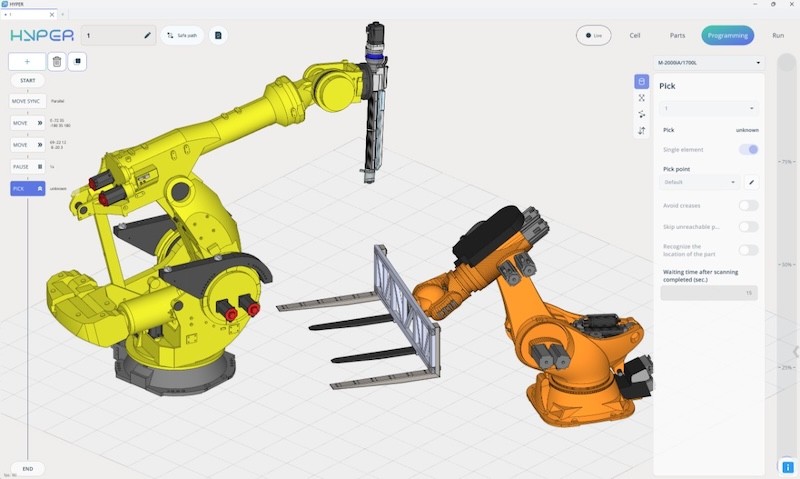
According to roboticsandautomationnews.com, Ency Software has released a major update to its ENCY Hyper hybrid robot programming platform, introducing multi-brand robot compatibility, integrated 3D vision, and enhanced workflow tools for industrial automation teams.
Expanded Robot Brand and Architecture Support
The April 24, 2026 update significantly broadens hardware interoperability. The source states the platform now supports mixed-brand robot cells across ABB, Fanuc, Kuka, Yaskawa, Universal Robots, and others — explicitly positioning ENCY Hyper for facilities operating heterogeneous robot fleets rather than single-vendor environments. New support for SCARA robots extends applicability into high-speed pick-and-place and compact handling applications, areas critical in electronics assembly, pharmaceutical packaging, and small-part logistics.
Real-Time Adaptation via 3D Vision Integration
Integrated 3D vision enables surface detection and part localization, allowing robot motion to adapt dynamically to real-world geometry instead of relying solely on predefined paths. According to the report, support for Intel RealSense cameras is already included, providing an off-the-shelf option for depth sensing and spatial awareness in bin-picking, palletizing, and irregular part handling — functions increasingly vital in e-commerce fulfillment and aftermarket parts distribution.
Hybrid Programming and Operational Efficiency Gains
ENCY Hyper continues its hybrid programming approach, combining offline simulation with real-time interaction on physical robots. Users can prepare and verify programs digitally before refining them on the shop floor — a workflow designed to reduce downtime and speed up deployment. The source states the release targets common bottlenecks in automation projects, particularly where multiple robot brands, machine vision, and continuous production workflows must be managed simultaneously.
Workflow and Usability Enhancements
New features include a tab-based interface enabling users to run a live robot session while preparing another project in parallel. The system can manage multiple robots within a single session, reducing interruptions between tasks. It also allows configuration and operation of robots from different manufacturers within a single project environment — addressing a longstanding challenge in mixed-brand automation cells. Additional usability improvements cited include automatic software updates and simplified licensing via QR code activation.
For global supply chain professionals, this update signals growing maturity in cross-platform robotic orchestration — especially relevant amid rising labor constraints, facility modernization initiatives, and the need to integrate legacy equipment with newer collaborative and vision-guided systems. As more Tier 1 contract manufacturers (e.g., Flex, which recently expanded its Teradyne Robotics partnership) adopt heterogeneous automation strategies, tools like ENCY Hyper help standardize programming logic, shorten changeover times, and improve line flexibility without vendor lock-in. Unlike proprietary OEM software, such platforms reduce retraining needs when adding new robot models or upgrading vision subsystems — directly supporting resilience in dynamic production environments.
Source: Robotics & Automation News
Compiled from international media by the SCI.AI editorial team.