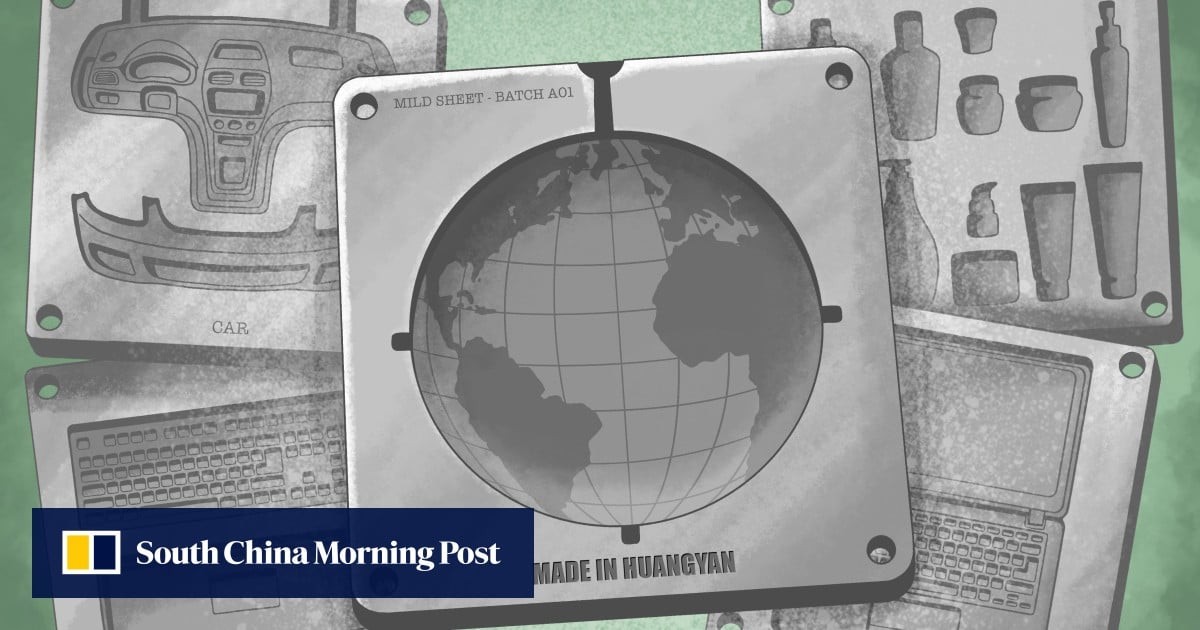
According to www.scmp.com, the industrial district of Huangyan — a little-known area within Taizhou city in eastern China’s Zhejiang province — plays an indispensable role in Tesla’s global supply chain through its dominance in plastic injection moulding and component manufacturing.
A Critical Node in Global Automotive Manufacturing
Huangyan specialises in plastic components and moulding equipment — products rarely covered in mainstream media but foundational to modern mass production. The district supplies car interior trim, remote controls, keyboards, cosmetic packaging, and other everyday goods. Its factories transform resin pellets into highly precise, mass-producible parts using advanced injection moulding techniques.
The source states that Huangyan has built one of the world’s most comprehensive industrial chains for plastic injection moulding, integrating design, materials sourcing, precision machining, and trial moulding within a tightly clustered ecosystem. This vertical integration enables cost-efficient, high-volume output — a key enabler for automotive lightweighting and energy efficiency.
Tesla’s Dependence on Huangyan’s Ecosystem
For Tesla, Huangyan’s capabilities directly support vehicle lightness, affordability, and performance. As noted by the source, without Huangyan’s factories and broader ‘hidden champions’ of Chinese manufacturing, Tesla cars would be different — likely heavier, more expensive, and less energy efficient. The district’s contribution extends beyond aesthetics: plastic moulds enable complex, lightweight structural and functional parts essential to electric vehicle architecture.
“Without the factories here and the hidden champions of Chinese manufacturing more broadly, the world and many products that we’ve taken for granted, including Tesla cars, would be different.” — Huang Yue, secretary of the Huangyan Mould Industrial Association
Mutual Interdependence, Not Decoupling
The source emphasizes that dependence runs both ways: Huangyan’s manufacturers rely heavily on cutting-edge foreign equipment and technology. This intertwinement illustrates why geopolitical narratives around supply chain decoupling contradict operational realities on the ground. Unlike headline-grabbing semiconductor or battery supply chains, this plastic moulding ecosystem operates with minimal visibility yet underpins product viability across sectors.
Broader Industry Context for Supply Chain Professionals
While often overlooked, plastic injection moulding is a cornerstone of global manufacturing resilience. According to industry data cited in multiple public reports (e.g., Plastics Europe, McKinsey 2024), over 75% of non-metal automotive interior parts are now polymer-based — a figure projected to rise as OEMs pursue weight reduction targets. Huangyan’s cluster is not unique in scale alone; it reflects a wider trend where Chinese county-level industrial zones — such as Ningbo (moulds), Dongguan (electronics assembly), and Yiwu (consumer goods) — anchor global supply continuity through deep specialisation and rapid iteration cycles. For supply chain professionals, this underscores the strategic importance of mapping Tier-3 and Tier-4 suppliers — especially those embedded in regional ecosystems with integrated material-to-mould capabilities. Disruptions in such nodes may not trigger immediate headlines but can cascade rapidly across automotive, electronics, and consumer durables sectors due to long lead times for custom mould tooling (often 12–20 weeks) and limited global alternatives with comparable precision and scalability.
Source: South China Morning Post
Compiled from international media by the SCI.AI editorial team.