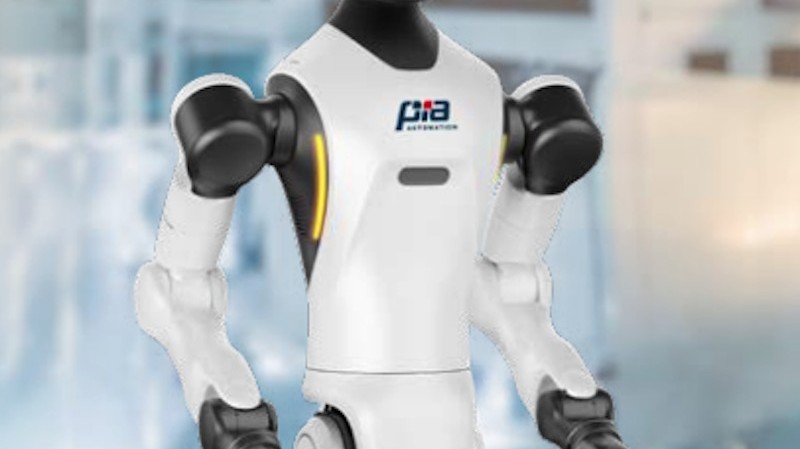
According to roboticsandautomationnews.com, PIA Automation announced on April 15, 2026 the launch of a new business segment focused on embodied AI and humanoid robotics for industrial applications. The division integrates the company’s expertise in artificial intelligence, robotics, and advanced manufacturing to deliver systems capable of physical interaction with dynamic production environments.
Strategic Expansion into Flexible Factory Automation
The initiative responds to rising demands for flexibility in modern factories, where increasing product variety and unpredictable production schedules challenge traditional automation approaches. PIA states that its new humanoid robotics segment is designed to help manufacturers improve efficiency, maintain quality, and scale operations more effectively — particularly in contexts where legacy systems have reached functional limits.
Joint Venture and Manufacturing Strategy
PIA is collaborating with Agibot, a global robotics company specializing in embodied intelligence, through the joint venture Joybot Manufacture. This partnership spans the full humanoid robotics value chain — from research and development to hardware production and assembly — and includes embodied AI capabilities. In parallel, PIA plans to establish its own manufacturing capacities in the European market to support localized, large-scale production and accelerate commercial deployment.
Product Portfolio and Industrial Use Cases
The division introduces three distinct platforms:
- P-Bot: A service-oriented humanoid unit for banks, shopping centers, and events, featuring multimodal interaction.
- I-Bot: An industrial humanoid robot with a mobile platform, built for smart factories; it collects data, supports precision manufacturing, and navigates complex production environments.
- A-Bot: A compact humanoid system intended for research, education, and interactive applications.
Thomas Ernst, chief sales officer and chief technology officer at PIA Automation, emphasized practical integration over theoretical exploration:
“Our ambition is not only to explore new technologies, but to make them usable for industrial practice. Embodied AI and humanoid robotics will enable automation in areas where traditional approaches have previously reached their limits. For us, the key is to integrate these systems reliably, safely and efficiently into existing production environments, thereby creating clear added value for our customers.” — Thomas Ernst, Chief Sales Officer and Chief Technology Officer, PIA Automation
From a supply chain professional’s perspective, this move signals a tangible shift toward adaptive automation in material handling, logistics execution, and line-side support — especially in facilities requiring rapid reconfiguration due to SKU proliferation or demand volatility. While humanoid robots remain early-stage for high-volume manufacturing, their emergence in flexible assistance systems and adaptive logistics processes aligns with broader industry trends toward resilient, human-robot collaborative workflows. Notably, other players are advancing similar strategies: Accenture’s recent investment in General Robotics targets physical AI-powered robotics in manufacturing and logistics, and CP Group’s acquisition of Recycleye underscores growing adoption of AI-driven sorting in automated distribution ecosystems. These developments collectively reinforce that embodied AI is transitioning from R&D labs to real-world operational infrastructure — particularly where workforce constraints, quality consistency, and responsiveness to demand shifts converge.
Source: Robotics & Automation News
Compiled from international media by the SCI.AI editorial team.