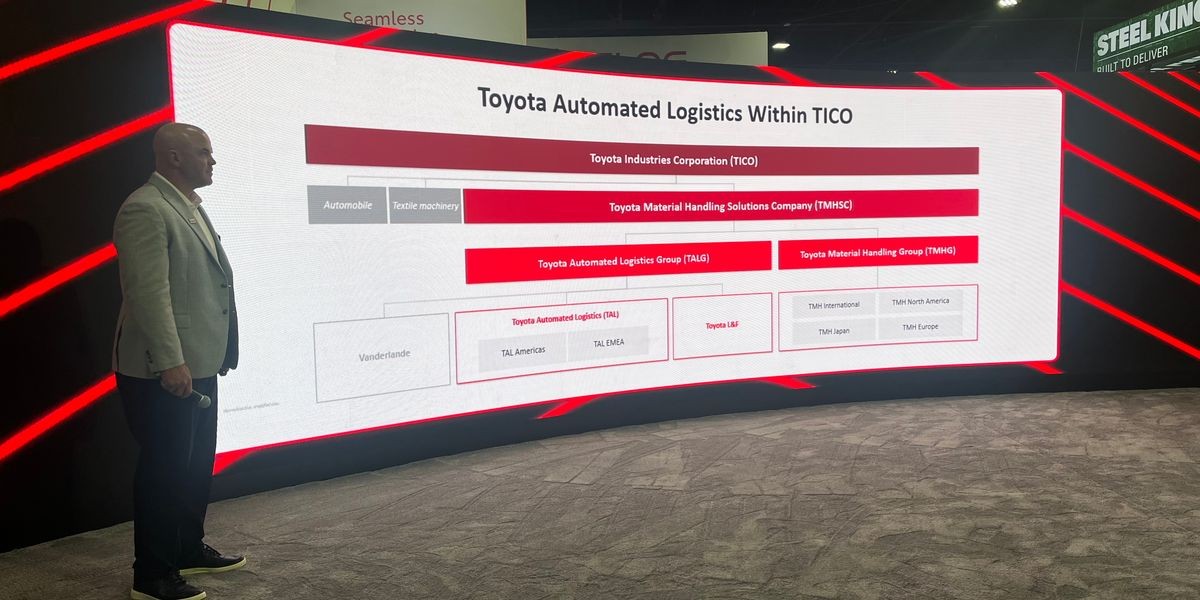
According to www.thescxchange.com, Toyota Industries Corporation (TICO) has formally consolidated its warehouse automation operations under a single global brand: Toyota Automated Logistics (TAL), effective April 1, 2026. This reorganization brings together three acquired systems integrators — Bastian Solutions and Vanderlande (both acquired in 2017) and viastore (acquired in 2024) — into one unified entity serving the global market.
Strategic Structure and Brand Exceptions
TAL is explicitly positioned as the integrated warehouse automation arm of TICO, distinct from the Toyota Material Handling Group, which continues to manufacture forklifts. At MODEX 2026, TAL’s booth featured no forklifts — only models of an autonomous mobile robot, an AS/RS shuttle, and a sliding shoe sorter — underscoring its focus on end-to-end automation integration rather than equipment manufacturing.
The consolidation preserves two key brand exceptions:
- Bastian Solutions retains its name for engagements in the automotive and aerospace markets in North America
- Vanderlande continues operating under its own brand for airport-related projects
Partner-Centric Integration Model
Aaron Jones, president and CEO of Toyota Automated Logistics Americas, emphasized during a MODEX 2026 press conference that TAL remains committed to open, collaborative integration — not vertical domination. He acknowledged early industry concerns about Toyota entering the space: “There was maybe some concern when Toyota got into this space. The big concern was would Toyota dominate and take over as a manufacturing theme?”
“But here now eight years later we continue to integrate some of the most dynamic systems, and many of our competitors and partners at this show play a very big role in the types of systems that we integrate.” — Aaron Jones, president and CEO of Toyota Automated Logistics Americas
TAL maintains active partnerships with technology providers including Exotec, OTTO Motors, Pio, and AutoStore. This reflects a deliberate strategy to avoid proprietary lock-in and instead deliver best-of-breed solutions tailored to client needs.
Regional Continuity and Market Responsiveness
Although now a global brand, TAL intentionally preserves the regional expertise and customer relationships cultivated by Bastian Solutions, Vanderlande’s warehousing business, and viastore. According to Jones, “We won’t forget what has allowed each of us to be successful in our markets.” This hybrid model — global scale with local execution — aligns with well-documented industry preferences: Gartner’s 2025 Supply Chain Technology Survey found that 78% of logistics leaders prioritize regional implementation support when selecting automation partners. Similarly, the Council of Supply Chain Management Professionals (CSCMP) reported in its 2024 State of Logistics report that system integrators with embedded local domain knowledge achieved 32% higher on-time project delivery rates versus purely centralized firms.
For supply chain professionals evaluating automation partners, TAL’s structure signals a shift toward scalable yet adaptable integration — one that balances Toyota’s engineering rigor and financial stability with the agility and specialized know-how of legacy integrators. Its absence of in-house forklift promotion further clarifies its role: not as a hardware vendor, but as a neutral systems architect focused on workflow orchestration across AMRs, AS/RS, sortation, and WMS layers.
Source: www.thescxchange.com
Compiled from international media by the SCI.AI editorial team.