Explore

  • Trending
  • Latest
  • Tools
  • Browse
  • Subscription Feed

Logistics

  • Ocean
  • Air Cargo
  • Road & Rail
  • Warehousing
  • Last Mile

Regions

  • Southeast Asia
  • South Asia
  • Central Asia
  • Japan & Korea
  • Middle East
  • Europe
  • Russia
  • Africa
  • North America
  • Latin America
  • Australia
SCI.AI
  • Supply Chain
    • Strategy & Planning
    • Logistics & Transport
    • Manufacturing
    • Inventory & Fulfillment
  • Procurement
    • Strategic Sourcing
    • Supplier Management
    • Supply Chain Finance
  • Technology
    • AI & Automation
    • Robotics
    • Digital Platforms
  • Risk & Resilience
  • Sustainability
  • Research
  • Expert Columns
  • English
    • Chinese
    • English
No Result
View All Result
  • Login
  • Register
SCI.AI
No Result
View All Result
Home Procurement

48-Hour Buyer-Owned GSM Baseline for Toilet Tissue Parent Rolls

2026/04/13
in Procurement, Strategic Sourcing
0 0
48-Hour Buyer-Owned GSM Baseline for Toilet Tissue Parent Rolls

According to www.paperindex.com, establishing a buyer-owned grammage (GSM) accuracy baseline for toilet tissue parent rolls is a critical first step for procurement and quality assurance teams—requiring decisive action within the first 48 hours of specification development.

Why GSM Baseline Control Is Non-Negotiable

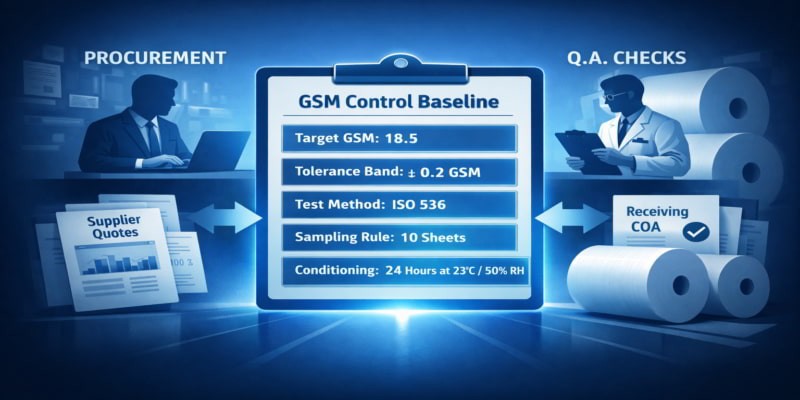
A supplier quoting “18.5 GSM” conveys no operational meaning unless paired with explicit tolerance, test method, sampling rules, and conditioning protocols. As the source states: “Numbers Without Ranges Fail: A target GSM is useless without a tolerance band; your converting line needs a defined acceptable range to work with.” Without such parameters, converters face line stoppages, inconsistent unwind performance, and downstream yield loss—even when supplier-certified results appear identical.

The Operational Cost of Ambiguity

Two suppliers may both report 18.5 GSM, yet produce rolls with divergent mechanical behavior—one testing per ISO 536 after conditioning at 23°C and 50% relative humidity, the other testing immediately post-production before moisture stabilizes. The source notes this discrepancy can shift results by nearly a full GSM point on the same material. Such misalignment directly fuels specification misalignment costs, receiving instability, and retailer rejections—especially in private-label operations where tolerances are often omitted.

The 48-Hour Action Framework

  • Hour 0–12: Audit all existing GSM references—including contracts, supplier spec sheets, Certificates of Analysis from the last three shipments, incoming inspection notes, complaint logs, and production downtime records tied to roll performance. Identify gaps where: (1) no tolerance band is named; (2) no test method is specified; or (3) no sampling or conditioning rules govern result comparison.
  • Hour 12–24: Convert one nominal GSM figure into an actionable control protocol—defining separate baselines per grade family (e.g., standard, premium, private-label), stating the target GSM in plain language, and assigning a tolerance band (e.g., ±0.3 GSM).

Alignment Between Procurement and QA

The source stresses that “Procurement and QA Need One Document: Both teams must agree on the exact same baseline—same target, same tolerance, same method—before sending anything to suppliers.” Incomplete quotes lacking named test methods must be returned for clarification—not compared against incomplete specs. As stated: “One buyer-owned baseline beats a thousand supplier assumptions.”

Source: www.paperindex.com

Compiled from international media by the SCI.AI editorial team.

More on This Topic

  • 62% of Firms to Boost Cold Chain Budgets in 2 Years (Apr 15, 2026)
  • China Enacts First Supply Chain Security Regulations (2026) (Apr 15, 2026)
  • UpGuard Ranked #1 in Third-Party & Supplier Risk Management (Apr 15, 2026)
  • Strategic Sourcing: The 6-Step Process for Supply Chain Professionals (2026) (Apr 15, 2026)
  • Strategic Sourcing 2026: A Resilience & SRP Guide (Apr 15, 2026)
ShareTweet

Related Posts

62% of Firms to Boost Cold Chain Budgets in 2 Years
Procurement

62% of Firms to Boost Cold Chain Budgets in 2 Years

April 15, 2026
1
China Enacts First Supply Chain Security Regulations (2026)
Procurement

China Enacts First Supply Chain Security Regulations (2026)

April 15, 2026
2
UpGuard Ranked #1 in Third-Party & Supplier Risk Management
Procurement

UpGuard Ranked #1 in Third-Party & Supplier Risk Management

April 15, 2026
4
Strategic Sourcing: The 6-Step Process for Supply Chain Professionals (2026)
Procurement

Strategic Sourcing: The 6-Step Process for Supply Chain Professionals (2026)

April 15, 2026
4
Strategic Sourcing 2026: A Resilience & SRP Guide
Procurement

Strategic Sourcing 2026: A Resilience & SRP Guide

April 15, 2026
4
Strait of Hormuz Disruption: Air Freight Rates Up >70%, Digital Trade Finance Critical
Procurement

Strait of Hormuz Disruption: Air Freight Rates Up >70%, Digital Trade Finance Critical

April 15, 2026
5

Leave a Reply Cancel reply

Your email address will not be published. Required fields are marked *

Recommended

UPS员工涉嫌盗窃价值67,000美元的iPhone及其他电子产品:布劳沃德警察局报告

UPS Employee Suspected of Stealing $67,000 Worth of iPhones and Other Electronics: Broward Sheriff’s Office Report

5 Views
February 16, 2026
DHL Deploys SVT Robotics’ SOFTBOT Platform Across 30 Global Warehouses, Plans 100+ Sites in 3 Years

DHL Deploys SVT Robotics’ SOFTBOT Platform Across 30 Global Warehouses, Plans 100+ Sites in 3 Years

7 Views
March 25, 2026
CBAM’s First Month Triggers 84% Collapse in EU Fertiliser Imports: Carbon Border Pricing Ignites Global Agricultural Supply Chain Crisis

CBAM’s First Month Triggers 84% Collapse in EU Fertiliser Imports: Carbon Border Pricing Ignites Global Agricultural Supply Chain Crisis

32 Views
February 21, 2026
EU Bans Destruction of Unsold Clothing from July 2026: How ESPR Eco-Design Rules Will Reshape Global Fashion Supply Chains

EU Bans Destruction of Unsold Clothing from July 2026: How ESPR Eco-Design Rules Will Reshape Global Fashion Supply Chains

28 Views
February 21, 2026
Show More

SCI.AI

Global Supply Chain Intelligence. Delivering real-time news, analysis, and insights for supply chain professionals worldwide.

Categories

  • Supply Chain Management
  • Procurement
  • Technology


  • Risk & Resilience
  • Sustainability
  • Research

© 2026 SCI.AI. All rights reserved.

Powered by SCI.AI Intelligence Platform

Welcome Back!

Sign In with Facebook
Sign In with Google
Sign In with Linked In
OR

Login to your account below

Forgotten Password? Sign Up

Create New Account!

Sign Up with Facebook
Sign Up with Google
Sign Up with Linked In
OR

Fill the forms below to register

All fields are required. Log In

Retrieve your password

Please enter your username or email address to reset your password.

Log In

Scan to share via WeChat

Open WeChat and scan the QR code to share

QR Code

Add New Playlist

No Result
View All Result
  • Supply Chain
    • Strategy & Planning
    • Logistics & Transport
    • Manufacturing
    • Inventory & Fulfillment
  • Procurement
    • Strategic Sourcing
    • Supplier Management
    • Supply Chain Finance
  • Technology
    • AI & Automation
    • Robotics
    • Digital Platforms
  • Risk & Resilience
  • Sustainability
  • Research
  • Expert Columns
  • English
    • Chinese
    • English
  • Login
  • Sign Up

© 2026 SCI.AI