According to www.freightwaves.com, the U.S.-led military conflict in Iran is costing Hapag-Lloyd $40 million to $50 million per week, driven by surging fuel, insurance, storage, and inland transportation expenses.
Operational Disruption Deepens
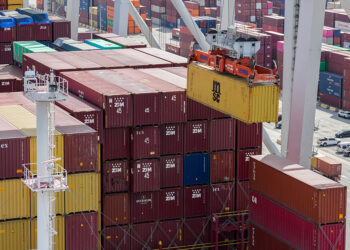
The world’s fifth-largest container line has six ships trapped in the Persian Gulf, with a combined capacity of 25,000 twenty-foot equivalent units (TEUs). These are feeder-sized vessels typically used for short-haul port-to-port shuttles. Due to Iranian restrictions on maritime transit through the Strait of Hormuz, Hapag-Lloyd cannot call ports inside the Gulf — though it continues serving Salalah in Oman and Jeddah in Saudi Arabia.
CEO Rolf Habben Jansen confirmed on an earnings call that approximately 50% of the carrier’s contract freight to the region faces disruption. The company has suspended services not only through Hormuz but also via the Red Sea–Suez Canal corridor, where Houthi militia in Yemen have threatened renewed attacks in support of Iran.
Financial and Strategic Impact
Hapag-Lloyd reported operating profit declined to $3.5 billion from $4.9 billion in 2025, citing elevated costs and excess global container shipping capacity. To offset mounting expenditures, the German carrier introduced contingency and emergency surcharges — though Habben Jansen noted recovery is typically delayed.
“Costs are increasing sharply. If we look at the impact that this has on us, then we talk easily about $40 million or $50 million per week that we are facing at this point in time,” said Hapag-Lloyd CEO Rolf Habben Jansen, on an earnings call, “mainly related to bunker [fuel], but also insurance costs are up significantly and so are costs related to storage and in some cases also inland transportation.”
The company is actively monitoring potential fuel supply constraints, especially as volatility threatens bunkering availability. While Asia is not one of Hapag-Lloyd’s primary refueling hubs, Habben Jansen emphasized it remains “something to keep an eye on” amid broader regional instability.
Realistic Outlook for Key Trade Corridors
Regarding the Red Sea route, Habben Jansen stated: “I think right now it would not have been right to assume that the Red Sea opens up soon.” He assessed the scenario of continued closure through 2026 as “the most realistic” — a view aligned with recent operational adjustments by Maersk, MSC, and CMA CGM, all of which have maintained rerouted Cape of Good Hope sailings since late 2023. Public filings and shipping industry reports confirm that over 70% of container vessel transits between Asia and Europe remain diverted around Africa, adding 10–14 days to voyage times and increasing fuel consumption by 25–35%.
Supply Chain Implications and Risk Mitigation
For supply chain professionals, these developments mean sustained pressure on landed cost modeling, longer lead times for Middle East–bound cargo, and heightened exposure for contracts tied to Gulf and Red Sea ports. Emergency surcharges are now standard across major carriers — not temporary anomalies — and require proactive clause review in procurement and logistics agreements. Visibility tools must integrate real-time geopolitical risk feeds, and dual-sourcing strategies for Gulf-based distribution centers are no longer optional but operationally urgent.
This article was AI-assisted and reviewed by the SCI.AI editorial team before publication.
Source: FreightWaves