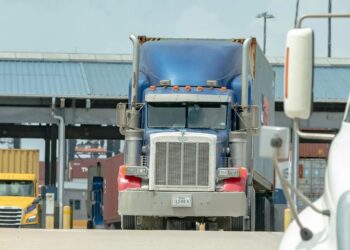
As the global supply chain faces unprecedented challenges, manufacturers and retailers across North America are increasingly turning to mobile storage trailers as a flexible alternative to traditional warehouses. This shift is driven by factors such as tariff volatility, labor shortages, and rising logistics costs, according to John Brooks, founder and CEO of Warehouse on Wheels.
Trailer Storage: A Flexible Solution for Supply Chain Disruptions
Warehouse on Wheels, with operations spanning the U.S., Canada, and Mexico, offers a fleet of over 37,000 trailers across 37 locations. These trailers provide companies with temporary capacity when warehouses are full or supply chains are disrupted, acting as a ‘pressure relief valve’ between corporate forecasts and frontline fire drills.
Instead of committing to long-term warehouse leases, companies can rent trailers on a month-to-month basis, using them as overflow storage at factories, distribution centers, or ports. This flexibility allows businesses to convert fixed logistics costs into more flexible operating expenses, offering significant savings compared to traditional warehouse leases.
The Cost-Effective Alternative
According to an internal analysis by Warehouse on Wheels, traditional warehouse leases average about $1 per square foot before operating expenses, while storage trailers cost roughly $0.64 per square foot. This cost-effectiveness makes trailer storage an attractive option for companies looking to optimize their supply chain operations.
The trailers are typically refurbished units with forklift-rated floors, making them suitable for storage or short-distance cartage within regional supply chains. This versatility, combined with the cost savings, has contributed to the growing demand for trailer storage as a solution to supply chain disruptions.
Supply Chain Disruptions and the Need for Flexibility
The demand for flexible storage has surged as supply chains grapple with unexpected disruptions, including tariff changes, port congestion, and sudden shifts in inventory demand. ‘Any kink in a finely tuned just-in-time supply chain creates total chaos,’ Brooks said. ‘You don’t have time to negotiate a warehouse lease when production is on the line. You need assets ready to go immediately.’
Companies often use the trailers to temporarily store inbound inventory, stage components for manufacturing, or hold empty packaging used in production systems. In some cases, large manufacturers have scaled their use of mobile storage significantly over time, as seen with a Midwest automotive assembly plant that increased its deployment from about 60 trailers to more than 1,600 units.
Nearshoring and Cross-Border Trade
Warehouse on Wheels is also seeing strong demand tied to nearshoring and cross-border trade. Manufacturers operating along key logistics corridors in Monterrey, Laredo, and El Paso are increasingly using mobile storage to manage cross-border supply chains. ‘Manufacturers need reliable physical capacity along the border,’ Brooks said. ‘Instead of borrowing equipment from local trucking providers, they can scale instantly using a dedicated storage network.’
While demand tied to nearshoring remains strong in Mexico and the U.S., Brooks noted that the Canadian market has been softer amid slower economic conditions.
Expanding the Network
Warehouse on Wheels has expanded rapidly in recent years through acquisitions and new market launches, integrating regional trailer rental providers into its network. The company’s long-term goal is to grow to 100 locations and about 100,000 trailers across North America, providing an early signal of supply chain activity.
‘At the same time, we’re also providing an early signal of supply chain activity,’ Brooks said. ‘When companies are deploying more trailers, it’s a sign that they’re increasing production and need more capacity to manage their supply chains.’
Source: www.freightwaves.com
This article was AI-assisted and reviewed by our editorial team.