This article presents a compelling and timely analysis of the evolving landscape of warehouse automation, centered on Mind Robotics—Rivian’s recently spun-out robotics venture. The $500M Series A raise at a $2B valuation signals a decisive market pivot: away from humanoid “general-purpose” robotics hype, and toward purpose-built, high-dexterity industrial robots optimized for real-world warehouse and factory tasks. This isn’t incremental automation—it’s a redefinition of what’s automatable.
Why This Spinout Stands Out
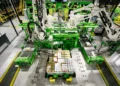
Design Philosophy: Mind Robotics rejects anthropomorphism. Robots are engineered task-first: e.g., a picking arm with adaptive grippers + vision-guided force control—not legs, not bipedal locomotion. Simpler, more reliable, faster to deploy.
Team Credibility: Founders from Physical Intelligence, Waymo, Zoox, Google bring battle-tested expertise in real-world autonomy—not lab-scale demos. Emphasis on perception, robust control, and scalable system integration—not theoretical AI or mechanical novelty.
Technical Focus: Solves the last-mile dexterity gap: mobile robots move goods; Mind Robotics handles them—sorting irregular parcels, building unstable pallets, assembling kits with mixed components. Precision manipulation > mobility.
AI-Robotics Convergence: Positions robotics as the physical execution layer of AI decision engines (e.g., WES, control towers, LLM-powered agents). When AI says “pick item X from bin Y and place it in cart Z”, the robot does it—reliably, repeatedly, adaptively.
Operational Implications for Warehouse Management
Facility Design: Warehouses will shift from human-centric layouts (aisle widths, staging zones, ergonomic workstations) to machine-optimized flows: denser storage, modular robotic cells, vertical handling zones.
Labor Evolution: Not job replacement—but role transformation: humans move upstream—to supervise fleets, manage exceptions, train AI models, and handle unstructured edge cases.
Adoption Pathway: Early wins in high-variability, low-volume tasks where traditional automation fails: e-commerce returns processing, mixed-SKU kitting, pharmaceutical packaging, light assembly.
Strategic Takeaway for Supply Chain Leaders
Don’t wait for “the robot.” Deploy the right robot for the right task—today.
The era of “all-or-nothing” automation is over. Success belongs to organizations that:
- Treat robotics as integrated operational software—not standalone hardware,
- Prioritize task ROI (e.g., $/pallet handled, % reduction in mispicks) over tech novelty,
- Align capital, talent, and facility strategy with modular, composable automation—where AI plans, robots act, and data closes the loop.
The End of the Humanoid Assumption in Industrial Robotics
There is a tendency to assume that the most advanced robotics will resemble humans. That assumption does not hold in supply chain operations. Efficiency, reliability, and cost per task matter more than form. A robot does not need to look like a human to outperform one in a warehouse. In many cases, the human form is a constraint.
Purpose-built systems offer several advantages:
- Simpler mechanical design
- Higher reliability in controlled environments
- Faster integration into existing workflows
- Lower cost per unit of work
These are the same factors that drove adoption of earlier automation technologies such as conveyors, sortation systems, and goods-to-person solutions.
A More Likely Path Forward
The near-term evolution of robotics in the supply chain will not be defined by general-purpose humanoid systems. It will be defined by targeted, high-performance machines that solve specific operational problems. Mind Robotics fits that pattern.
The broader implication is that automation will continue to expand task by task, function by function, rather than through a single breakthrough system. Each incremental gain compounds across the network.
For supply chain leaders, the focus should remain on where these systems can deliver measurable value today. High-variability picking, returns processing, and light manufacturing are likely early candidates.
The combination of AI-driven decision making and robotic execution is moving from concept to deployment. The companies that align their operations to that model will have a structural advantage in cost, service, and resilience.
Final Thought
Mind Robotics embodies a maturing robotics industry—one grounded in engineering pragmatism, operational discipline, and economic rigor. Its rise doesn’t negate humanoid research; it redirects focus where value is immediately measurable: in the warehouse, on the line, in the relentless pursuit of throughput, accuracy, and resilience.
The future of supply chain automation isn’t walking. It’s grasping, placing, adapting—and scaling.
Source: logisticsviewpoints.com
This article was AI-assisted and reviewed by our editorial team.