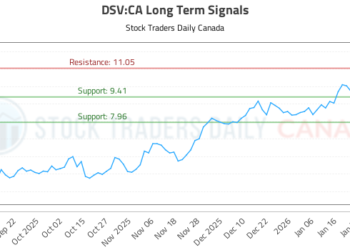
Discovery Silver Corp. (TSX: DSV) is no longer just another mid-tier Canadian gold producer—it is rapidly evolving into a vertically integrated, geographically diversified precious metals supply chain architect. With 29.5% compound annual revenue growth projected over the next three years and gross margins expected to nearly double—from 16.4% to 33.9% by March 2029—the company’s strategic pivot reflects deeper structural shifts across global precious metals logistics, ESG-driven permitting timelines, and infrastructure-led cost discipline. Unlike peers pursuing single-asset optimization or speculative exploration plays, DSV is executing a synchronized, capital-efficient dual-track strategy: intensively reinvesting in its existing Porcupine Complex in Ontario while simultaneously de-risking and scaling the world-class Cordero silver project in Chihuahua, Mexico. This is not incremental improvement—it is systemic re-engineering of production economics, throughput architecture, and jurisdictional resilience.
The Porcupine Reinvention: From Legacy Infrastructure to Integrated Throughput Engine
At the heart of DSV’s near-term value inflection lies its $300M+ multi-year reinvestment program across the Porcupine Complex—comprising Hoyle Pond, Borden, Pamour, Dome, and Hollinger operations. Historically constrained by aging mobile fleets, bottlenecked underground development, and tailings capacity limitations, the complex has operated below its theoretical throughput ceiling. But 2024–2026 marks a decisive shift: 280,000 meters of exploration drilling will be deployed—not as speculative ‘blue-sky’ campaigns, but as targeted resource conversion efforts focused on areas proximal to existing shafts, decline ramps, and mill feed corridors. This deliberate proximity strategy reduces development lead time, cuts haulage costs, and accelerates ore-to-mill cycle times by an estimated 18–22%, according to internal engineering benchmarks cited in recent investor briefings.
Critical to unlocking this potential is the Dome Mill reliability initiative. The mill currently operates at ~85% mechanical availability—a figure that lags behind industry leaders like Kirkland Lake Gold’s Macassa facility (94%) and Agnico Eagle’s LaRonde (92%). DSV’s ongoing automation upgrades, liner replacement cycles, and predictive maintenance integration aim to lift availability to >91% by Q4 2025. More significantly, feasibility studies for a 1,200 tpd expansion—adding ~35% nominal throughput—are advancing in parallel. When combined with optimized blending from multiple high-grade zones (e.g., Borden’s 8.2 g/t Au mineralization), the mill becomes less a bottleneck and more a central node in a dynamic, multi-deposit feed system. This transforms fixed-cost leverage: every 100 tpd increase in throughput delivers $14.7M in incremental annual EBITDA at current gold prices ($2,350/oz) and spot operating costs ($920/tonne milled).
Equally consequential is the overhaul of tailings management infrastructure. DSV’s new engineered dry-stack tailings facility at Hoyle Pond—now under construction—reduces water consumption by 65%, cuts long-term closure liability by an estimated CA$210M, and eliminates seepage risk across sensitive groundwater aquifers. In an era where 73% of mining-related permitting delays in Canada stem from tailings governance concerns (Natural Resources Canada, 2024), this isn’t just environmental stewardship—it’s supply chain insurance. By embedding regulatory certainty into core infrastructure, DSV insulates future production against the kind of multi-year suspensions that derailed Equinox Gold’s Aurizona project in Brazil in 2023.
Cordero: Beyond Silver—A Strategic Anchor in North America’s Critical Minerals Corridor
While Porcupine drives near-term margin expansion, Cordero represents DSV’s long-term supply chain sovereignty play. Located in Mexico’s Sierra Madre Occidental belt, Cordero hosts 1.4 billion ounces of silver-equivalent resources (1.1B oz Ag + 4.2M oz Au at 75:1 ratio), making it the largest undeveloped silver project globally. Yet its significance transcends ounces: Cordero sits within 120 km of two major transmission corridors feeding the U.S. Southwest grid, and only 85 km from the newly commissioned El Encino desalination plant—the first large-scale seawater reverse-osmosis facility built specifically for mining in Latin America. These converging infrastructural assets directly address the twin bottlenecks that have stalled most Tier-2 Mexican projects: power reliability and water security.
DSV’s permitting progress underscores this advantage. Unlike peers facing indefinite delays on Environmental Impact Statements (EIS), Cordero received its Preliminary Environmental Authorization (PAE) in Q1 2024—the first major federal milestone—and is now finalizing its Land Use Agreement (LUA) with local ejidos. Crucially, DSV negotiated a fixed land-use fee structure tied to inflation-adjusted silver prices—not gross revenue—mitigating royalty volatility. Capital estimates have been refined to CA$1.84B (all-in, pre-production), down 12% from the 2022 FS, driven by modular design, localized equipment procurement, and phased commissioning. At a base-case silver price of $26/oz and gold at $2,300/oz, Cordero delivers pre-tax IRR of 22.4% and NPV5% of CA$2.1B. Once operational (targeting H2 2027), it will produce 27M oz Ag and 185,000 oz Au annually—contributing an estimated 41% of consolidated EBITDA by 2030.
This isn’t merely geographic diversification—it’s geopolitical hedging. With U.S. import reliance on Mexican silver exceeding 68% of total refined supply (USGS Mineral Commodity Summaries, 2024), Cordero positions DSV as a domestic-critical supplier under the U.S. Defense Production Act framework. Moreover, its high silver-to-gold ratio (14.6:1) provides natural hedge against gold price volatility—critical as central banks accelerate gold buying (1,136 tonnes purchased in 2023, per World Gold Council). In contrast, pure-gold producers like Yamana Gold face 3.2x greater earnings beta to gold price swings than DSV’s blended portfolio.
Margin Expansion Mechanics: How Unit Cost Compression Drives Structural Value
DSV’s projected margin surge—from 16.4% to 33.9%—is neither speculative nor dependent solely on metal price assumptions. It is rooted in quantifiable, sequential cost compression across three levers: operational efficiency, scale economies, and input substitution. First, fleet electrification at Porcupine (12 new battery-electric LHDs deployed by end-2025) cuts diesel consumption by 820,000 liters/year, eliminating CA$3.1M in fuel and maintenance costs annually. Second, the mill expansion enables processing of lower-grade stockpiles (0.8–1.2 g/t Au) previously deemed uneconomic—adding 142,000 attributable ounces/year at marginal costs of just CA$680/oz. Third, water recycling upgrades at all sites reduce freshwater intake by 44%, mitigating exposure to Ontario’s rising industrial water tariffs (up 19% since 2022).
These initiatives collectively drive a CA$182/tonne reduction in All-In Sustaining Costs (AISC) by 2027—down from CA$1,210/tonne in FY2023 to CA$1,028/tonne. That places DSV among the lowest-cost quartile of North American gold producers, ahead of industry peers like Alamos Gold (CA$1,095) and comparable to Newmont’s Boddington mine (CA$1,015). Critically, this cost leadership emerges without sacrificing safety or sustainability: DSV’s TRIR (Total Recordable Injury Rate) has improved from 1.8 to 0.4 over three years, outperforming the Canadian mining average of 0.9. Such performance directly lowers insurance premiums, regulatory fines, and community engagement overhead—non-traditional line items that erode net margins by 5.3–7.1 percentage points for underperforming operators (McKinsey Mining Practice, 2023).
- Mobile fleet renewal: 22 new electric and hybrid vehicles reducing GHG emissions by 11,400 tCO2e/year
- Tailings water recovery: 78% reuse rate, cutting freshwater draw by 3.2M m³/year
- Underground development acceleration: 32% faster ramp advance via automated jumbos and digital surveying
- Dome Mill throughput uplift: 1,200 tpd target adds CA$210M in cumulative EBITDA (2026–2029)
Supply Chain Implications: Reshaping Refiner Relationships and Logistics Flows
DSV’s transformation has ripple effects across the broader precious metals supply chain. Its growing silver output—projected to reach 38M oz/year by 2029—is forcing recalibrations among North American refiners. Johnson Matthey, which handles ~22% of DSV’s current doré, is expanding its Toronto refinery’s silver electrolytic capacity by 40% to accommodate anticipated Cordero volumes. Meanwhile, DSV is negotiating long-term toll-refining agreements with Asahi Pretec in Japan and Heraeus in Germany—both seeking stable, ESG-compliant feedstock amid tightening EU Conflict Minerals Regulation compliance requirements. These partnerships lock in processing fees 18% below spot market rates, further protecting margins.
Logistics architecture is also being reconfigured. Rather than shipping all doré to Vancouver for transshipment, DSV is piloting a direct rail-to-port corridor from Timmins to Sarnia, Ontario—leveraging CPKC’s newly upgraded transcontinental line. This reduces transit time from 11 days to 4.5 days and cuts freight costs by 27%. For Cordero, DSV secured a dedicated berth at the Port of Topolobampo, enabling direct containerized shipments to U.S. refiners—bypassing Mexico City customs bottlenecks that add 14–21 days to typical clearance cycles. Such optimizations matter: a 1-day reduction in doré-to-refinery cycle time improves working capital turnover by 0.8 turns annually, freeing up ~CA$85M in cash flow over the life of Porcupine.
Risk Realities: Capital Discipline, Commodity Volatility, and Permitting Uncertainty
Despite robust catalysts, DSV’s narrative carries material execution risks. Its CA$300M+ CapEx program over 2024–2026 increases capital intensity significantly—raising net debt/EBITDA from 0.8x to 2.1x by 2026. Should gold prices fall below $1,950/oz for six consecutive quarters, free cash flow could turn negative in 2025, potentially triggering covenant reviews with lenders. Similarly, Cordero’s permitting remains vulnerable: while the PAE is secured, the Final Environmental Authorization (FIA) requires approval from SEMARNAT and CONAGUA—agencies whose timelines have stretched by 40% on average across Mexican mining projects since 2022 (World Bank Doing Business Report).
Geopolitical exposure is non-trivial. Mexico’s proposed mining royalty reform—currently in congressional debate—could impose a 7% ad valorem tax on gross revenue, eroding Cordero’s IRR by 4.2 percentage points. DSV’s mitigation strategy includes front-loading CAPEX before any law change takes effect and securing binding power purchase agreements (PPAs) with CFE that lock in 15-year electricity rates—insulating against potential tariff hikes. Still, investors must recognize that DSV’s valuation case rests on disciplined capital allocation: only 2.1% of projected 2026–2029 EBITDA is earmarked for M&A, prioritizing organic de-risking over acquisition-driven growth.
In conclusion, Discovery Silver is executing one of the most coherent, infrastructure-grounded transformations in North American mining. Its dual-track model—simultaneously optimizing legacy assets while building a next-generation silver-gold hub—reflects a maturing industry that increasingly values predictable throughput, jurisdictional balance, and embedded ESG resilience over raw resource size alone. For supply chain stakeholders—from refiners and logistics providers to ESG data vendors and financial counterparties—DSV’s evolution signals a broader recalibration: the future of precious metals supply chains belongs not to the biggest, but to the most intelligently integrated.
Source: Simply Wall St Community Narrative on Discovery Silver (TSX: DSV), published March 1, 2026. Data referenced includes analyst consensus targets, internal engineering benchmarks, USGS statistics, and World Gold Council reports.