The Milestone: From Human-Assisted to Full Autonomy
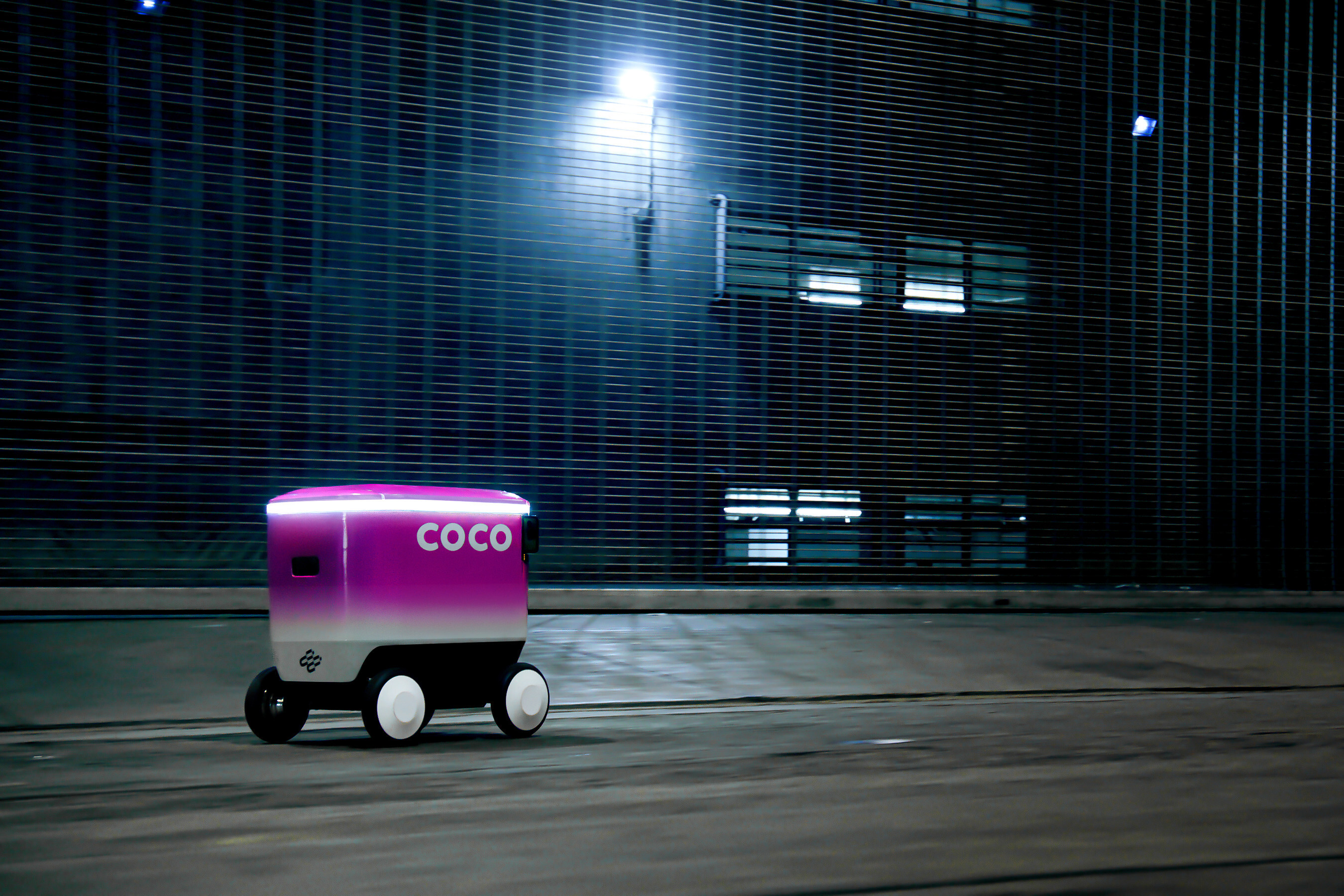
On February 28, 2026, Coco Robotics—described in its official press release as the world’s leading urban robotics platform—announced the commercial launch of Coco 2, its next-generation fully autonomous delivery robot. This represents a definitive technological inflection point: the transition from human-guided or remote-supervised operation to full autonomy without remote human drivers. According to the source, this is not an incremental upgrade but a foundational shift in operational architecture, validated by over 500,000 zero-emission deliveries completed across the U.S. and Europe prior to launch. These deployments served as both real-world validation and data acquisition infrastructure—each delivery contributing to model refinement through edge-case exposure in diverse geographies including Miami’s flood-prone sidewalks, Chicago’s winter-impacted bike lanes, and Los Angeles’s high-density traffic corridors.
This milestone reflects a deliberate, multi-year maturation path since Coco Robotics’ founding in 2020. Coco’s public emphasis on retiring the human-in-the-loop underscores a confidence rooted in empirical performance: the press release states that Coco 2 reduces delivery times by up to 50% versus the prior generation, a gain attributable not only to improved path-planning algorithms but also to uninterrupted mission continuity. Unlike first-generation units requiring manual intervention for curb cuts or pedestrian surges, Coco 2 operates end-to-end with adaptive decision-making trained on millions of city miles of proprietary driving data. That volume of contextualized urban mobility data—spanning weather extremes, infrastructure variability, and behavioral heterogeneity—is itself a defensible asset that cannot be synthetically replicated at scale.
From a supply chain governance perspective, full autonomy fundamentally reconfigures accountability structures. With no remote driver, liability attribution shifts from human operator error to software reliability, sensor fidelity, and edge-computing resilience—factors now embedded in the NVIDIA Jetson Orin NX hardware stack. Regulatory acceptance follows technical maturity: Coco’s ability to navigate sidewalks, bike lanes, and roads where permitted implies jurisdiction-specific compliance engineering. This means deployment velocity is no longer gated solely by technology readiness but by municipal permitting cycles and crosswalk signal integration protocols—variables demanding deep civic engagement. The ‘full autonomy’ label signals not just algorithmic competence but institutional interoperability, marking the point where robotics transitions from pilot novelty to licensed logistics infrastructure.
Physical AI as Logistics Infrastructure: NVIDIA’s Strategic Role
Coco Robotics’ architecture is explicitly built on the NVIDIA full stack, a strategic alignment transforming autonomous delivery into a vertically integrated physical AI system. As cited in the source, this includes the Jetson Orin NX for on-robot edge computing, NVIDIA Omniverse for digital twin simulation, Isaac Sim and Isaac Lab for reinforcement learning training, and Cosmos world foundation models for generalizable urban scene understanding. The press release quotes Amit Goel, NVIDIA’s Head of Strategic Partnerships: “The era of physical AI has arrived, and scaling it requires a seamless loop between massive real-world data and high-performance edge computing.” This articulates a new paradigm: AI must inhabit and act upon the physical world with deterministic timing and fault tolerance.
The significance lies in how this stack enables continuous learning at scale. Coco’s integration with Isaac Lab allows for sim-to-real transfer learning: edge cases captured during live operation are instantly simulated in Omniverse, where thousands of variants are stress-tested before model weights are pushed OTA to the fleet. Cosmos foundation models further abstract this by encoding universal priors about urban physics, object affordances, and social navigation norms. This creates a self-reinforcing infrastructure loop: more robots drive more diverse edge cases, enriching simulations, producing more robust models, yielding higher fleet uptime—generating more data. Without this stack, scaling beyond hundreds of units would face exponential marginal costs in safety oversight and software maintenance.
For logistics stakeholders, this signals a material shift in capital expenditure logic. Under the physical AI model, robots become depreciable hardware hosting appreciating AI assets. Each Coco 2 unit’s value increases with cumulative mileage-driven intelligence, as its onboard models improve in accuracy and generalization. This flips traditional total cost of ownership (TCO) calculations: upfront hardware cost is partially offset by declining per-mile software maintenance and rising operational yield. NVIDIA’s ecosystem ensures backward compatibility—future Isaac Lab upgrades can be deployed across existing fleets without hardware replacement, extending useful life.
“Every mile our robots have driven has made the whole fleet smarter. Human-in-the-loop learnings have helped us improve with every edge case, creating a feedback loop between deployment, data collection, and model advancements.” — Zach Rash, CEO of Coco Robotics
Cost Economics: Reshaping the Last-Mile Cost Curve
The economic rationale for autonomous urban delivery rests on dismantling structural inefficiencies of human-dependent last-mile logistics. The source provides critical proxy indicators: Coco 2 achieves 3x longer uptime and improves weather/wear resilience, directly targeting two primary cost drivers—downtime-related dispatch failures and premature hardware replacement. Human couriers face fatigue, scheduling friction, and variable availability; robots operate 24/7 with predictable maintenance intervals. A 3x uptime multiplier implies one Coco 2 unit delivers the equivalent volume of three first-generation units without proportional increases in supervision overhead. The 500,000+ deliveries completed represent empirically validated throughput under real-world constraints, establishing baseline productivity metrics for financial modeling.
Coco’s integration with Uber Eats, DoorDash, and Wolt means it operates within existing order orchestration systems—avoiding the massive build-out cost of a proprietary dispatch platform. This third-party platform leverage compresses time-to-revenue and de-risks capital allocation. Furthermore, zero-emission operation confers tangible economic benefits in cities imposing low-emission zone fees or offering EV charging subsidies. When aggregated across thousands of daily trips in multiple municipalities, such regulatory arbitrage compounds into meaningful margin enhancement—particularly as carbon pricing mechanisms expand globally.
The cost curve shift is spatially selective. Urban density creates the essential precondition for viability: in low-density suburbs, human couriers remain cost-competitive relative to robot hardware amortization. Robots capture dense, repetitive, high-margin urban delivery segments. For merchants, this means predictable per-delivery fees unlinked to wage inflation or holiday surcharges. The 3,000+ merchant and restaurant partners cited in the release reflect early adoption by businesses prioritizing delivery consistency—signaling a willingness to pay a premium for reliability and brand-aligned sustainability credentials.
Scale Effects: Network Density and the Urban Logistics Tipping Point
Autonomous delivery economics hinge on a precise network density threshold where fleet utilization crosses into positive marginal returns. The source states Coco Robotics plans to scale its fleet to thousands of robots globally by end of 2026. Coco’s 500,000+ deliveries across U.S. and European cities provide concrete validation: sustained operations in Miami, Chicago, and LA confirm that heterogeneous urban morphologies can support profitable robot density when paired with intelligent fleet management.
The 3,000+ merchant and restaurant partners represent demand-side critical mass. Each partner generates recurring, time-bound delivery requests enabling predictive load balancing. When integrated with Uber Eats, DoorDash, and Wolt, Coco accesses aggregated order streams with temporal clustering—lunch rushes, dinner peaks—allowing proactive robot positioning near high-yield kitchens before orders materialize. This anticipatory deployment reduces customer wait times and increases trips per battery charge.
- Coverage expansion: Sidewalks, bike lanes, and permitted roads—service range increased significantly
- Speed improvement: Coco 2 delivery times up to 50% faster than prior generation
- Uptime: 3x longer operational availability with improved weather/wear resilience
- Platform reach: Integrated with Uber Eats, DoorDash, and Wolt globally
Network density creates defensibility. Competitors entering a mature Coco market face a dual barrier: matching hardware reliability and the accumulated urban intelligence embedded in Coco’s models. A new entrant starts from zero on snow-ice traction modeling in Chicago, while Coco’s fleet has logged thousands of blizzard miles—creating a data moat that scales non-linearly. Each additional robot contributes disproportionately to collective knowledge, making competitive catch-up prohibitively expensive.
Platform Integration: Uber Eats, DoorDash, and Wolt as Force Multipliers
Coco Robotics’ decision to power deliveries through three dominant food delivery platforms bypasses the capital-intensive path of building proprietary merchant relationships. Rather than negotiating individual contracts with 3,000+ restaurants, Coco embedded itself into the existing order orchestration layer of platforms serving over one billion users globally. For merchants, adopting Coco requires no new app and no staff training—orders flow seamlessly from platform dashboards to robot dispatch systems. The 3,000+ partner count reflects organic platform pull-through, validating Coco’s technical interoperability and SLA reliability.
Coco positions itself as a platform-enabling infrastructure layer, capturing value from performance premiums—faster deliveries, higher success rates, sustainability branding—rather than transaction fees. Its multi-platform presence ensures technology agnosticism, enabling rapid expansion without architectural overhaul. This creates aligned incentives: platforms gain competitive differentiation, merchants gain delivery reliability, consumers gain speed. Each new vertical—pharmacy, grocery, retail—adds data diversity, enriching the Cosmos foundation models and increasing the platform’s general-purpose utility.
This is why the source describes Coco as a general-purpose urban robotics platform: its architecture is designed for modularity, not single-use optimization. For logistics executives, the imperative is to treat robotics not as a point solution but as a foundational layer in a multi-tiered, AI-coordinated delivery network where investments compound across business units and geographies. The 2026 fleet scaling target represents ecosystem embedding—where success is measured in API call volumes, SLA adherence rates, and cross-platform feature adoption.
The 2026 Commercialization Threshold and Future Outlook
The year 2026 marks the commercialization threshold where autonomous urban delivery transitions from regulated experiment to financially sustainable infrastructure. Coco Robotics’ announcement arrives with auditable metrics: 500,000 zero-emission deliveries, 3,000+ merchant partners, and thousands of robots for global deployment by year-end. These represent crossing of three critical thresholds: technical (full autonomy validated), economic (positive unit economics at scale), and regulatory (multi-city permitting velocity). The 50% delivery time reduction and 3x uptime improvement establish performance baselines against which competitors will be benchmarked—creating market-wide pressure to accelerate autonomy roadmaps.
This threshold has profound implications for infrastructure planning. Logistics real estate developers must redesign facilities to include robot charging docks, battery-swapping stations, and secure staging zones. Municipal planners must update zoning codes for robot-friendly right-of-way. As Coco proves viability, it expands the addressable market for complementary technologies: automated loading docks, AI-powered demand forecasting, and hyperlocal inventory hubs. The commercialization of autonomous delivery is not a zero-sum competitive race but a rising tide that elevates entire ecosystems of enabling technologies and services.
Looking ahead, the 2026 threshold sets the stage for the next inflection: intermodal orchestration. Coco’s NVIDIA-powered stack is inherently extensible to aerial drones for suburban extensions and autonomous cargo bikes for higher-weight parcels. For supply chain leaders, the data collected by Coco 2 fleets—traffic flow patterns, pedestrian congregation points, micro-weather variations—becomes strategic intelligence for optimizing warehouse locations, dynamic pricing, and delivery network design. The 500,000 deliveries are not an endpoint but the seed dataset for what will become the world’s most granular urban mobility intelligence platform, whose value compounds with every mile driven, every edge case resolved, and every new city mapped.
Source: prnewswire.com
This article was AI-assisted and reviewed by our editorial team.