The Hormuz Flashpoint: US-Iran Tensions Threaten the World’s Most Critical Oil Artery
In February 2026, the US Department of Transportation issued an urgent advisory directing American-flagged vessels to avoid Iranian territorial waters when transiting the Strait of Hormuz. The warning arrived amid a sharp escalation in US-Iran tensions — the US military had just shot down an Iranian drone that approached the USS Abraham Lincoln carrier in the Arabian Sea, while both sides simultaneously engaged in nuclear negotiations in Oman. Jakob Larsen, chief safety and security officer at the international shipping association Bimco, was unequivocal in his assessment: Iran poses a “credible threat” to commercial shipping, and crucially, “there is no alternative route to the Strait of Hormuz.” Unlike the Red Sea, where vessels can reroute around the Cape of Good Hope, any disruption to Hormuz would create an entirely different category of crisis with no viable maritime detour.
The implications extend far beyond American-flagged vessels, which constitute only a small fraction of global commercial shipping. Alexander Perjessy, vice president and senior credit officer at Moody’s Ratings, characterized the Strait of Hormuz as one of the key transmission channels through which geopolitical tension affects credit fundamentals across the entire region. He described the risk as “always there” — a low-probability, high-impact scenario that the US advisory has now thrust back into the spotlight. The strait handles approximately 21% of global petroleum consumption daily, along with substantial LNG flows. If hostilities were to break out, non-US shipping companies — which operate the vast majority of vessels transiting Hormuz — could face security threats, sanctions exposure, or violent freight rate swings that would cascade through global energy supply chains.
Red Sea Reopening: Maersk’s Suez Transit Signals a New Era of Oversupply
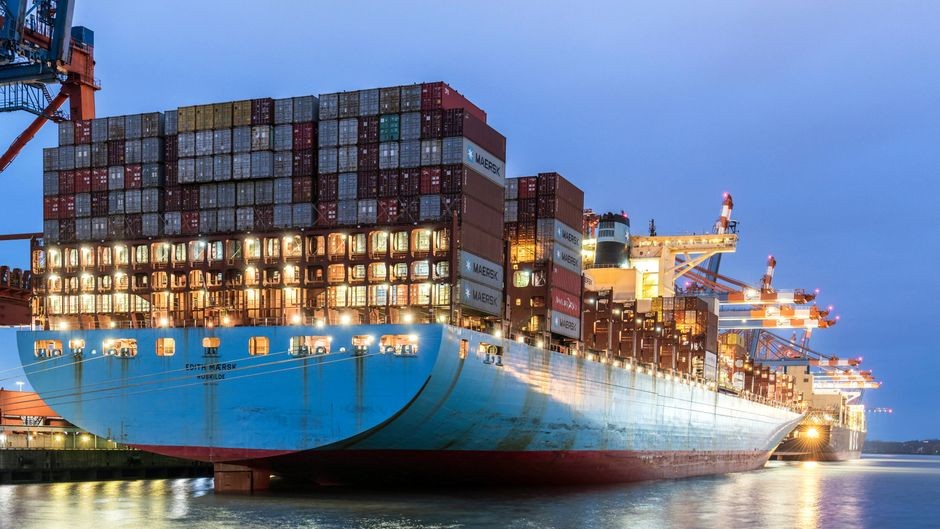
In stark contrast to the Hormuz tensions, the Red Sea shipping corridor is gradually returning to normalcy. Maersk, one of the world’s largest container shipping companies, has completed two successful transits through the Suez Canal — its first since Houthi attacks forced a mass exodus of commercial vessels to the Cape of Good Hope route beginning in late 2023. The significance of this milestone cannot be overstated: it signals the potential end of over two years of Red Sea disruption that fundamentally reshaped global container shipping economics. However, the return to normalcy carries its own set of challenges, primarily the release of vast amounts of vessel capacity that had been absorbed by the longer Cape routing.
Bloomberg Intelligence analyst Kenneth Loh projects that a full return to Red Sea routing could cause global container shipping demand to contract by 1.1% in 2026 — not because trade volumes are declining, but because shorter voyages would free up capacity equivalent to hundreds of additional vessel deployments. This projection is set against a backdrop of unprecedented fleet expansion: global container ship capacity is expected to grow approximately 36% between 2023 and 2027, with record newbuild deliveries concentrated in 2025-2026. Bank of America analysts have described the situation as “structural overcapacity,” and freight rates are already reflecting this reality. The Drewry World Container Index fell to $2,107 per 40-foot container in late January, declining 4.7% in a single week as congestion eased and disruption-driven pricing began to unwind.
Suez Revenue Collapse and the Cascading Impact on Middle Eastern Transshipment Hubs
The economic toll on the Middle East from the Red Sea crisis has been severe and multifaceted. The Suez Canal, Egypt’s crown jewel revenue generator, peaked at approximately $10 billion in annual revenue in 2023 before experiencing an estimated 40% decline according to UNCTAD assessments. While Egypt’s diversified economy prevents an existential fiscal crisis, the loss of foreign exchange earnings has placed significant pressure on the country’s balance of payments and broader economic stability. In a notable diplomatic development, Egypt has recently reached out to Iran in hopes that improved relations might help influence the Houthis — whom Iran supports militarily and ideologically — to ensure safe commercial passage through the Red Sea.
Middle Eastern transshipment ports bore the brunt of the routing disruption. Oman’s Salalah Port, which relies heavily on transshipment volumes, reported a 16% decline in container throughput in the first half of 2024, directly attributable to the conflict. Traffic through the Bab el-Mandeb Strait — the southern gateway to the Red Sea — dropped by approximately 50%, decimating hub-and-spoke operations at ports like Salalah and Jebel Ali that depend on mainline vessel calls. East African nations, for whom Europe is a major trading partner via the Suez Canal, saw their export corridors severely disrupted. South and West African ports received more vessel calls as ships rerouted via the Cape, but systemic infrastructure challenges — including outdated port equipment, insufficient yard capacity, and weak rail connections — prevented them from fully capitalizing on the windfall.
The Twin Chokepoint Risk Matrix: An Unprecedented Challenge for Global Shipping
The simultaneous instability at the Strait of Hormuz and the Red Sea has created what industry analysts are calling a “twin chokepoint” risk matrix — a scenario that global shipping has never previously confronted at this scale. While the Red Sea route is gradually recovering, the Houthi threat has not been completely eliminated; despite a reduction in attack intensity following the Gaza ceasefire, shipping companies must maintain contingency plans for sudden flare-ups. Meanwhile, the Hormuz situation introduces a new dimension of uncertainty for oil and gas transportation. These two chokepoints together control critical nodes in both containerized trade and energy transport, and any individual or combined disruption would generate cascading effects far beyond the Middle East region.
From a supply chain management perspective, this risk matrix is forcing fundamental changes in shipping strategy. An increasing number of shippers and logistics service providers are adopting “multi-corridor” approaches, maintaining two or more alternative routing plans for the same trade lane. The insurance market has recalibrated accordingly — war risk and strikes premiums for Middle Eastern waters increased several-fold over the past two years, and while they have partially retreated as Red Sea conditions improve, the new Hormuz uncertainty threatens to push premiums higher once again. War risk surcharges have become standard in shipping contracts, and these additional costs ultimately propagate through supply chains to end consumers, adding an inflation layer that central banks and policymakers are increasingly monitoring.
Structural Overcapacity and Rate Erosion: The Shipping Industry’s 2026 Reckoning
The convergence of Red Sea reopening and the newbuild delivery wave is pushing the global container shipping industry into what may prove to be the most challenging supply-demand environment since 2015-2016. Industry analysts note that the Red Sea disruption effectively served as the “last prop” supporting freight rates over the past two years — by extending voyage lengths and locking up capacity, it inadvertently mitigated the impact of massive fleet expansion. That prop is now being removed. Newbuild deliveries in 2025-2026 are reaching historic highs, with ultra-large container vessels (ULCVs) of 24,000+ TEU capacity comprising an ever-larger share of the global fleet.
For carriers, the operating environment in 2026 will be markedly more difficult. Major lines including Maersk, Hapag-Lloyd, Nippon Yusen, Cosco Shipping Holdings, and Orient Overseas all face earnings pressure. The industry is likely to see a resurgence of blank sailings — alliance-coordinated cancellations of scheduled voyages to artificially manage capacity deployment. Alliance restructuring, including the dissolution of THE Alliance in early 2025 and the formation of new partnership configurations, is simultaneously reshaping competitive dynamics. For supply chain managers, while declining rates reduce direct transportation costs, increased rate volatility and reduced schedule reliability may generate higher hidden costs — including elevated safety stock levels, delivery time uncertainty, and logistics planning complexity that could offset the savings.
Middle East Supply Chain Transformation: From Crisis Response to Strategic Reinvention
The deeper significance of the twin chokepoint crisis lies in its acceleration of structural transformation across the Middle East logistics landscape. Gulf Cooperation Council nations, led by Saudi Arabia and the UAE, are dramatically scaling infrastructure investments to reduce dependence on single maritime corridors. Saudi Arabia’s Vision 2030 agenda includes the development of NEOM and new Red Sea coastal port facilities, while the UAE continues to upgrade Jebel Ali Free Zone and Abu Dhabi’s Khalifa Port into next-generation logistics platforms. These investments reflect a strategic recognition that the region’s traditional role as a maritime transit zone must evolve into a more resilient, diversified logistics hub connecting Asia, Europe, and Africa through multimodal networks incorporating air freight, rail connections, and digital logistics platforms.
From a global perspective, the Middle East shipping landscape in 2026 stands at a critical inflection point. The gradual reopening of the Red Sea route promises to revitalize the Suez Canal as a traditional trade artery, but persistent Hormuz tensions and regional geopolitical uncertainty mean that full “normalization” may prove permanently elusive. For global supply chain professionals, this reality demands that Middle Eastern shipping risk be integrated into long-term strategic planning rather than treated as a short-term crisis to weather. Building diversified transport corridors, enhancing supply chain visibility and predictive capabilities, and establishing deep partnerships with reliable logistics providers will be essential strategies for maintaining competitiveness in this complex environment. Emerging technologies — including digital twin simulation, AI-driven route optimization, and real-time risk monitoring platforms — are providing enterprises with unprecedented decision-support tools to navigate what is increasingly being described as the “new abnormal” in global maritime trade.
Source: The National News | Gulf News | Marine Insight