Uber Freight Announces New Features at Annual Conference in Texas, Carrier Management Reaches $20 Billion
At the annual Deliver conference held in Frisco, Texas, managed transportation provider Uber Freight announced a series of new features available to customers and stated that its carrier management has grown to $20 billion.
“Our network advantage is that as we grow, we can better drive algorithmic and planning optimizations, bringing more savings to our clients,” said Lior Ron, founder and CEO of Uber Freight. He added that the company saved over $1.5 billion in transportation costs for its customers last year.
Ron told FreightWaves that Uber Freight recently launched its Design Partner Program, a collaboration with 40 transport partners aimed at co-creating new transportation services and products released at the conference.
“We conduct comprehensive discovery workshops and interviews to co-create across all levels of the company,” Ron said. “We even educate these partners on best practices, so it’s not just about creating technology but integrating it correctly into the organization. We believe this is a prerequisite for success and now it’s a prerequisite for all innovation.”
Since last year’s Deliver conference, the company has focused on developing its customer transportation management system, combining its point-to-point shipping expertise with managed transport operations acquired from traditional provider Transplace in 2022.
Related: Uber Freight and Transplace are now one operational entity with a firewall on proprietary data
Key improvements include control towers that make access to critical data smoother, as well as updated tracking portals for vendor integration. Dock scheduling tools aim to improve warehouse efficiency, while redesigned route guides provide data-driven insights into transportation costs and carrier management. Uber Freight has also simplified order entry, improved location accuracy, and enhanced financial management tools.
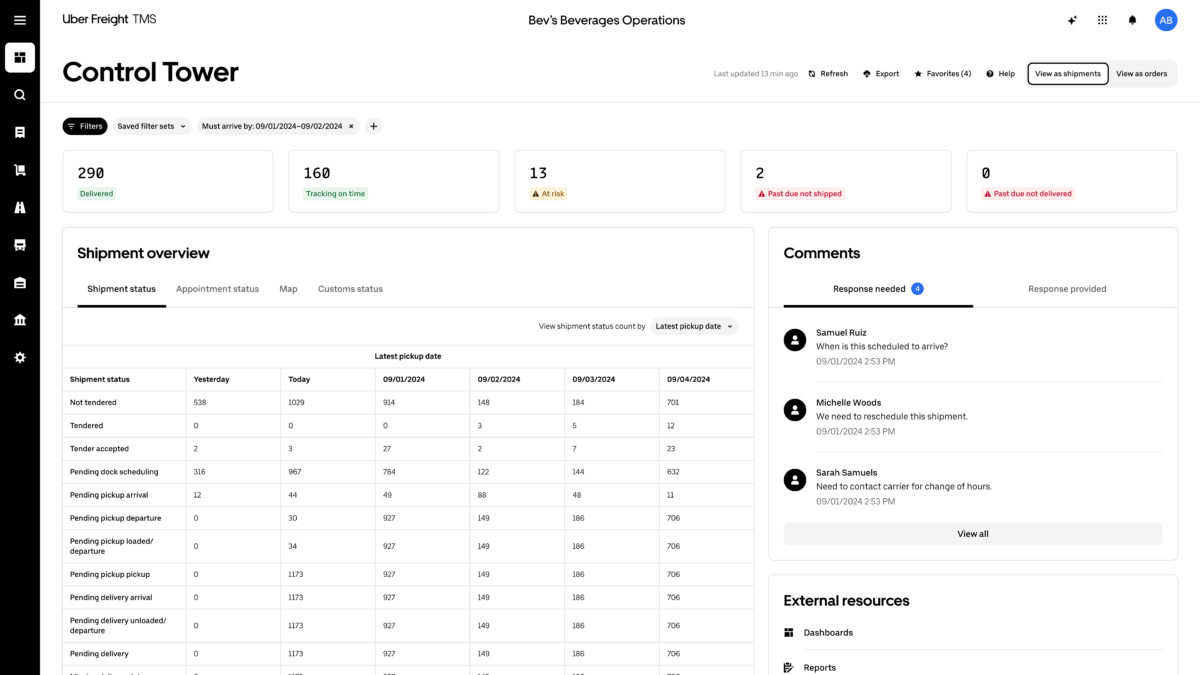
“Module by module, we have completely redesigned the TMS from planning to procurement and beyond,” Ron explained. “The advantage of modularity is that users can choose and use certain components as needed, making it very user-friendly.”
He also detailed how Uber Freight managed over 24 million shipments last year for more than 6,000 brands, leveraging this transportation data to provide AI tools, including the new solution Insights AI showcased at the Frisco conference.
Using insights from the top five shippers in its Design Partner Program, the company’s new AI application can answer over 2,000 questions with 92% accuracy across areas such as freight cost analysis, contract utilization, average savings, and yard operations analysis. This information is delivered to customers through chat functionality, updated KPI dashboards, or a new proactive recommendation feature in its updated TMS.
Uber Freight continues to improve its procurement product Exchange, initially launched in September 2023 as a contract-specific platform and expanded at the previous conference in May to cover point-to-point shipping markets. This creates a unified carrier and shipper portal for freight quotes.
Related: Latest Uber Freight launch combines market and managed services networks
In May, the product was rolled out to its entire carrier network, with about 180 shippers transitioning to the new technology. On Tuesday, Uber Freight announced that all shippers can now access the platform through its new TMS, offering carrier scorecards, pricing tools, and instant booking features.
Finally, the company announced it will now link shippers with its parent product, Uber Direct, leveraging Uber’s driver network for deliveries within two hours. According to the company, Uber Freight’s parcel transportation management system processed over 250 million packages in the past year.
“Uber’s last-mile capabilities have grown rapidly, and it is time to start combining both companies to help customers optimize their last-mile networks,” Ron said. “Through this integration, they can assist clients with shipments from store-to-customer, warehouse-to-customer, or even customer-to-customer.”
He explained that Uber Freight aims to apply these technological innovations in Europe, Mexico, and cross-border markets.
Source: FreightWaves