For centuries, as ships have carried various goods across the oceans, companies operating ports have sought to reduce costs associated with loading and unloading crews. Longshoremen have countered by employing a familiar strategy: threatening to disrupt international trade through strikes.
In response to militant dock union behavior, port operators have partially adopted automation technologies to reduce their vulnerability to labor issues. Unfortunately, longshoremen often view robots and other forms of innovation with suspicion, seeing them as threats to their livelihoods.
This history of labor-management relations at ports, from Australia to the UK, is central to the dynamics threatening a potential strike this Tuesday at East Coast U.S. and Gulf Coast ports.
Longshoremen are unapologetic about the compensation they seek—over $200,000 annually when overtime is factored in—for their dangerous and physically demanding work of loading and unloading containers onto ships while maintaining supply chains for businesses and consumers.
Historically, their employers have employed automation partly to cut costs. The most notable example was the advent of container shipping in the 1950s.
Before this, loading and unloading cargo ships was a slow and hazardous process that often took days. Longshoremen struggled with three-dimensional puzzles as they tried not to be crushed by moving goods, configuring mismatched loads such as beef alongside barrels of wine, chemicals, and bales of cotton.

The use of containers greatly simplified the loading and unloading process. Image Credit: Brandon Bell/Getty Images
Unions have leveraged their control over loading speeds—or stopping business altogether—to secure high wages.
The adoption of containers significantly streamlined this process, reducing labor needs. Suddenly, goods could be loaded into standardized steel boxes at factories, transported to ports via trucks and trains, then hoisted onto ships by cranes.
In April 1956, local officials gathered at the Port Newark to witness the departure of the first container ship, celebrating a milestone in American industrial efficiency.
However, according to reports from that day, a high-ranking official from the International Longshoremen’s Association (ILA), which represents East Coast dockworkers, watched with alarm and wished he could curse the vessel into sinking.
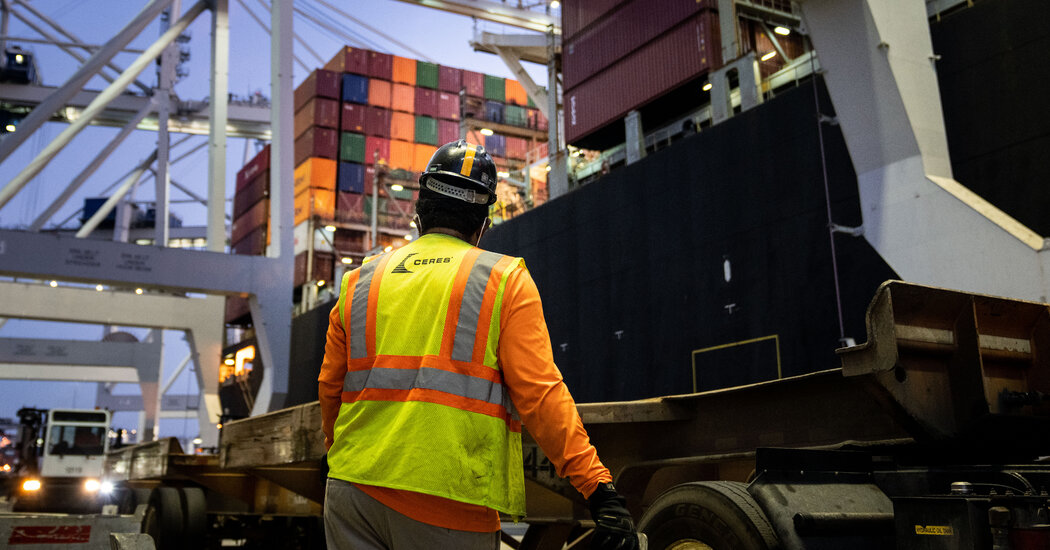
The union now threatens strikes at Newark and over a dozen other major ports handling about half of America’s imports. One core issue in new contract negotiations is the speed and scope of automation.
For decades following the advent of container shipping, union members have been wary of the technology’s implications. According to Marc Levinson’s book “The Box,” when the first ship sailed from Newark to Houston, manual loading costs were nearly $6 per ton. Soon after, these costs dropped to 16 cents per ton, largely due to reduced reliance on dockworkers.
Over the past quarter-century, during a period of remarkable global economic integration, the number of officially employed workers handling U.S. oceanborne cargo grew from about 41,000 to around 64,000—a roughly 56% increase—according to Labor Department data.

One key issue delaying new contracts is disagreement over the speed and scope of automation. Image Credit: Mario Tama/Getty Images
However, according to some studies, dockworkers have lost jobs in major ports where automation has already been implemented.
In two terminals in Los Angeles and Long Beach—handling about 40% of container imports into the U.S.—automation reduced nearly 5% of approximately 13,000 jobs, according to a report funded by the International Longshore and Warehouse Union (ILWU).
Most industry experts view automation as both inevitable and positive. The question is: who controls this technology, and whether workers can gain new opportunities through training programs.
“Innovation changes how ports and shipping companies operate,” said Ricardo Ungo, a professor at Old Dominion University’s Supply Chain, Logistics & Maritime Operations School. “This was true when they shifted from wind to steam power and later from manual handling to containerization. This will continue with new types of innovation in the future.”
Under pressure from their membership numbers, the two major unions representing U.S. dockworkers are increasingly opposed to automation unless it comes with job protections for remaining members.
Port administrators facing strike threats turn to consumers, industries reliant on continuous cargo flow, and employees of companies dependent on transoceanic transport of parts and products.
They pressure successive presidential administrations by citing the significant economic losses caused by each slowdown in cargo movement, hoping to facilitate agreements that avoid strikes.
Rising freight costs could anger the public, a hurdle for union action.

In 2021, President Biden visited the Port of Baltimore with International Longshoremen’s Association Local No. 333 president Scott Cowan. Image Credit: Al Drago for The New York Times
If a strike occurs, it will set new obstacles to cargo movement ahead of an important holiday shopping season and just weeks before a presidential election that may hinge on economic sentiment.
American business groups have urged the Biden administration to use the 1947 Taft-Hartley Act to request an 80-day cooling-off period to avoid a strike. They cite data warning of about $50 billion in economic losses, or 6% of the national economy, according to JPMorgan Chase analysis.
Two years ago, President Biden angered union activists by invoking another law to prevent a rail workers’ strike over lack of paid sick leave. But calling himself one of history’s most pro-union presidents, he may be reluctant to anger unions—core Democratic voters.
In his 2022 State of the Union address, Biden accused shipping companies of fueling inflation by “hiking prices up to 1,000%” and setting record profits.
The surge in orders for manufactured goods during the pandemic overwhelmed transportation systems. The result was soaring freight costs and traffic jams outside major ports. Shipping a container from China to the U.S. West Coast rose from about $2,000 to over $20,000 within months.
Freight rates have since fallen, but recent shocks have unsettled the industry. The Panama Canal’s drought has limited traffic on this vital waterway. Houthi rebels in Yemen have launched missile attacks on ships heading for the Suez Canal, forcing most traffic to detour around Africa, adding costs.

Drought in the Panama Canal has limited traffic on this critical waterway. Image Credit: Federico Rios for The New York Times
According to senior researcher John D. McCown at the Center for Maritime Strategy, container shipping companies earned over $10 billion in profits from April to June of this year—almost double that of the previous three months.
Dockworkers argue for a share of the gains from handling increasing volumes of cargo.
“Strikes are never easy,” said Dennis A. Daggett, executive vice president of the International Longshoremen’s Association, in a statement this month. “But in today’s world, where labor laws work against us and corporate greed is at its peak, strikes remain one of our most powerful tools for justice.”
Peter S. Goodman is a reporter covering the global economy. He writes about intersections between economics and geopolitics, with particular focus on their impact on people’s lives and livelihoods.
Source website: