Skip to content

Warehousing & Transport

Analysis

Ocean Carrier ETAs Missing for 8.43% of Shipments

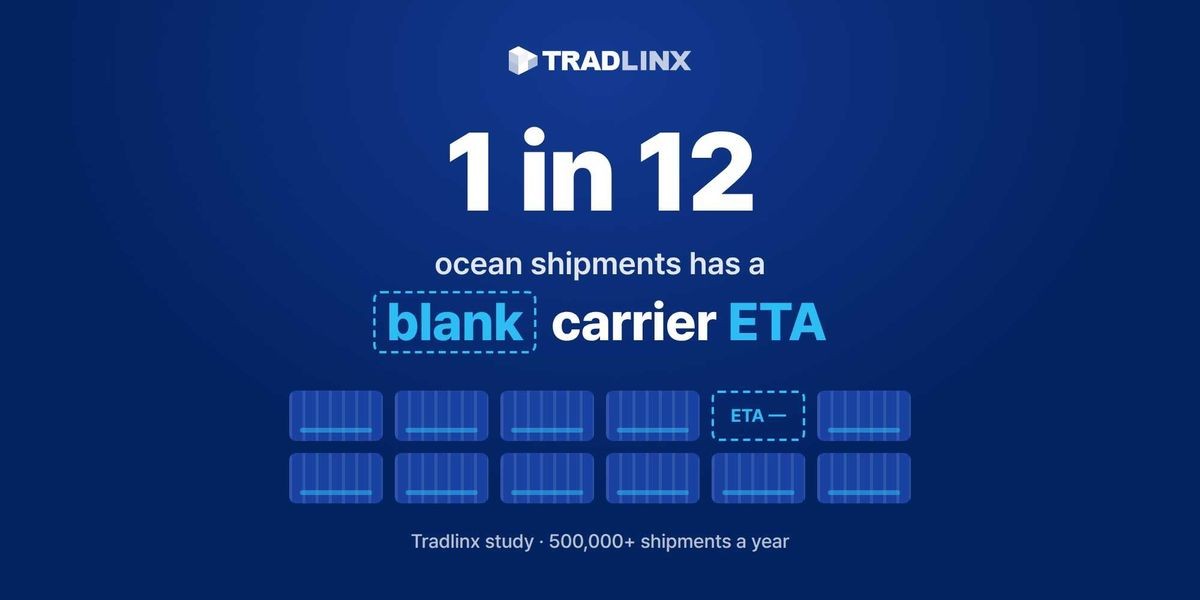
A Tradlinx analysis of over 500,000 annual ocean shipments found carrier ETAs were missing in 8.43% of cases — with 87% of those gaps occurring at transshipment ports. The average ETA error was 15.4 hours; 4.99% of shipments missed actual arrival by 48+ hours, averaging 90.0 hours of error. Tradlinx stated the core problem is not just inaccuracy but the frequent absence of ETA data altogether — especially where operational planning is most critical.

Original source: dcvelocity.com

Ocean Carrier ETAs Missing for 8.43% of Shipments

According to DC Velocity, an analysis of more than 500,000 shipments per year by Tradlinx — a supply chain data platform headquartered in South Korea — reveals that ocean carrier estimated time of arrival (ETA) fields are frequently blank or inaccurate.

Widespread ETA Gaps Concentrated at Transshipment Ports

The report found carriers left the ETA field blank in 42,832 cases, representing 8.43% of all shipments analyzed. Nearly three-quarters of these gaps occurred at transshipment ports: the intermediate transshipment port ETA was missing in 30,929 cases (6.09%), the final-destination ETA for transshipment cargo in 6,168 cases (1.21%), and the destination ETA for direct shipments in 5,735 cases (1.13%). Transshipment cargo accounted for 87% of all ETA gaps.

Average Delay and Severe Errors

Across the validation sample, the mean absolute error between carrier-provided ETAs and actual arrival times was 15.4 hours. In the worst-performing 5% of shipments — totaling 25,341 shipments (4.99% of the sample) — carrier ETAs missed actual arrival by 48 hours or more. For this group, the average error ballooned to 90.0 hours.

Operational Impact of Blank Fields

Tradlinx emphasized that the issue is not merely accuracy but basic data completeness.

“Most of the industry conversation is about how accurate carrier ETAs are. Our data points to a more basic gap: for roughly one in twelve shipments, the ETA simply goes missing somewhere along the way.” — Tradlinx

The company noted these blanks cluster precisely where planners need visibility most — at transshipment ports — and that empty fields rarely trigger automated alerts, forcing manual checks, slowing customer updates, and undermining trucking and warehouse scheduling.

Source: DC Velocity

Compiled from international media by the SCI.AI editorial team.
Ask SCI.AI Finished reading? Continue with SCI.AI. Explore the related policy, route, company and historical context. Continue asking
Rosatom acquires Delo for $900M, creates Russia’s largest logistics firm
Warehousing & Transport

Rosatom acquires Delo for $900M, creates Russia’s largest logistics firm

Russia’s Rosatom has acquired Delo Group’s remaining 51% stake—valued at $900m—to gain full control and integrate it with FESCO (92.5%-owned) and other transport assets. The consolidated platform includes over 220,000 teu of container capacity, 40,000 rail platforms, 30 ships, and the Commercial Port of Vladivostok. It now commands 50% of Russia’s container handling market and 44% of rail container transportation, positioning itself as the country’s largest national logistics company.

Union Pacific CEO 99.99% confident on $85B Norfolk Southern merger
Risk & Resilience

Union Pacific CEO 99.99% confident on $85B Norfolk Southern merger

Union Pacific CEO Jim Vena expressed 99.99% confidence in regulatory approval of the $85 billion acquisition of Norfolk Southern. Speaking on Oct. 6, he argued the merger would cut freight transit times by 24–48 hours between U.S. coasts and enhance rail’s competitiveness against trucking. The combined network would span roughly 50,000 miles of track, with a final Surface Transportation Board decision expected in 2027. Opponents, including the Stop the Rail Merger Coalition, warn the deal would place nearly half the nation’s rail traffic under single control, risking higher costs and supply chain instability.

6 Trucking Firms File RICO Suit Against C.H. Robinson, TQL
ESG & Regulation

6 Trucking Firms File RICO Suit Against C.H. Robinson, TQL

Six U.S. trucking companies — Stevens Trucking, Western Flyer Express, Freymiller, IWX Motor Freight, Christenson Transportation, and E.O.S. — filed a civil RICO lawsuit against C.H. Robinson and Total Quality Logistics in Texas federal court on September 23. They allege the brokers used carriers employing forced labor and falsified logs to submit artificially low bids, costing plaintiffs over $120 million in lost revenue across multiple shippers including Ford, Driscoll’s, and Graphic Packaging. The case hinges on whether lost contracts constitute a direct injury under the Racketeer Influenced and Corrupt Organizations Act — a question shaped by the Supreme Court’s 2006 Anza v. Ideal Steel precedent. Plaintiffs seek treble damages, citing revenue drops up to 30%, $51 million in lost sales, and $21 million in missed linehaul revenue.

Welcome Back!

Login to your account below

Create New Account!

Fill the forms below to register

Retrieve your password

Please enter your username or email address to reset your password.

Scan to share via WeChat

Open WeChat and scan the QR code to share

QR Code

Add New Playlist