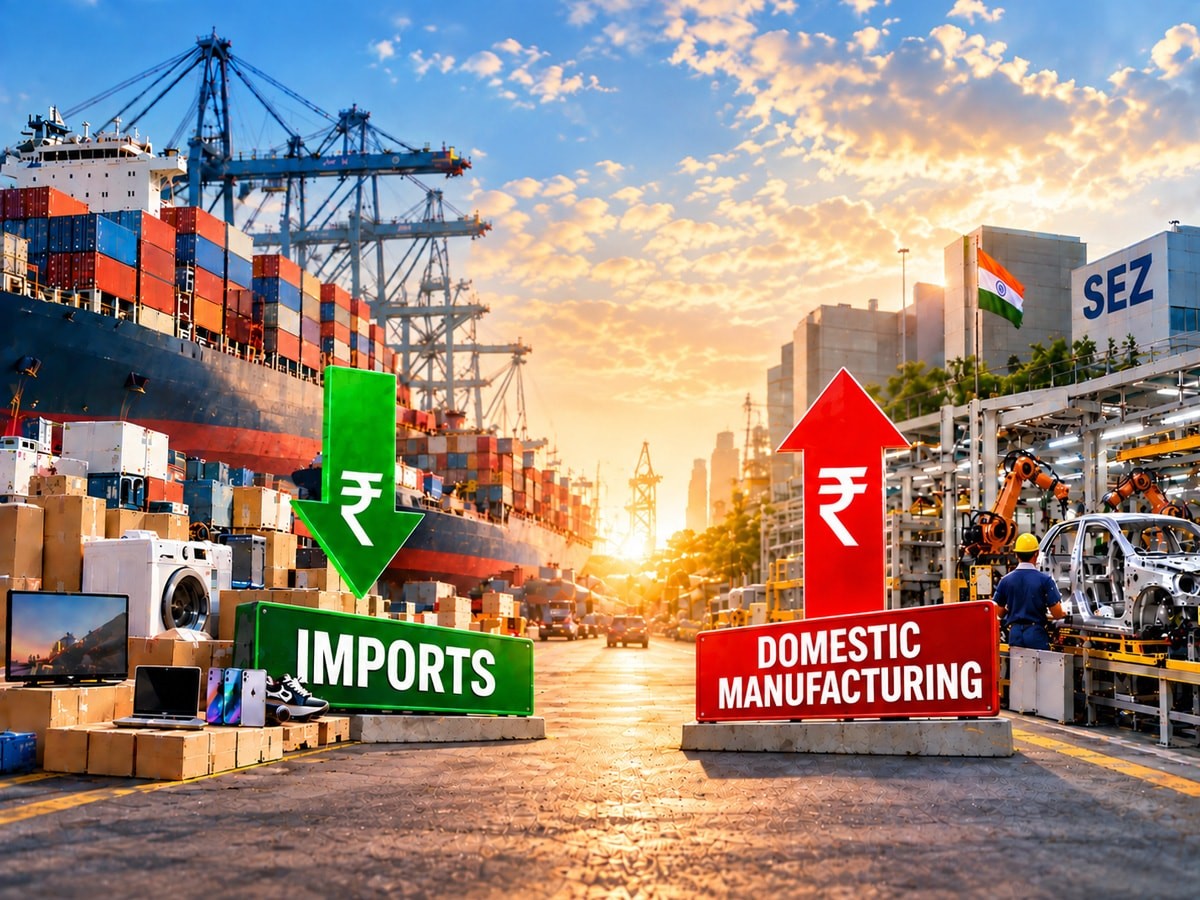
According to www.forbesindia.com, India’s current customs treatment of goods cleared from Special Economic Zones (SEZs) into the Domestic Tariff Area (DTA) creates a cost disadvantage for domestically manufactured ferrochrome—making imported ferrochrome cheaper than Indian-made equivalents.
Policy Fragmentation Undermines ‘Make in India’
Individual trade policies—such as duty-free imports of inputs and capital goods for SEZ units, or zero-duty concessions under the Oman Comprehensive Economic Partnership Agreement (CEPA)—are defensible in isolation. However, their cumulative effect, as demonstrated by the TUF case, incentivizes relocating manufacturing activity that India is fully capable of undertaking domestically—directly contradicting the objectives of Make in India and Atmanirbhar Bharat.
The problem lies not in any single measure, but in the lack of integrated evaluation. For example, SEZ units selling into India are taxed as if their products were imports—even though domestic labour, power, and manufacturing processes contribute significantly to value addition. Meanwhile, identical ferrochrome imported under preferential trade agreements faces lower effective duties.
This misalignment is especially acute for TUF’s Low Carbon Ferro Chrome, classified under tariff item 72024900. The product does not fall under the scope of Notification No. 11/2026-Customs dated March 31, 2026, which introduced a temporary concessional-duty window for certain SEZ-to-DTA clearances.
A Targeted Duty-Recovery Mechanism
A durable solution does not require scrapping the Oman CEPA or abandoning SEZs’ export orientation. Instead, it calls for extending an existing principle—already applied under the Export Oriented Undertakings (EOUs) and MOOWR (Manufacturing and Other Operations in Warehouse) schemes—to SEZs. Under those schemes, customs duty foregone on imported inputs is recovered only upon domestic sale—not levied anew on the finished product’s full value.
India already implements this targeted recovery mechanism for EOUs and MOOWR units. There appears to be no significant administrative obstacle to applying the same logic to SEZ clearances into the DTA. The government has taken a limited, time-bound step in this direction: the concessional-duty window applies only between April 1, 2026 and March 31, 2027.
As Prof. Rajesh Babu Ravindran, Professor of Law and Public Policy at IIM Calcutta, notes:
“Where the answer is yes [that imports are cheaper than domestic manufacturing], as it currently is for ferrochrome, the issue is worth fixing before the furnace goes cold, not after.” — Prof. Rajesh Babu Ravindran, Professor of Law and Public Policy at IIM Calcutta
Level Playing Field for SEZ-Produced Goods
A more fundamental reform would ensure that goods manufactured in Indian SEZs entering the DTA receive duty treatment comparable to identical products imported under India’s Preferential Trade Agreements (PTAs), subject to appropriate safeguards. This would eliminate the current penalty on domestic value addition and strengthen India’s manufacturing competitiveness.
India is negotiating and signing free trade and preferential trade agreements at a faster pace than at any point in its history. Yet new tariff concessions are layered onto an existing framework of domestic exemptions, SEZ regulations, and customs rules—without sufficient scrutiny of their combined impact.
The core test for future agreements must be consistent: Do newly negotiated tariff concessions, when combined with existing rules, make it cheaper to import a finished product than to manufacture it in India or an Indian SEZ? For ferrochrome, the answer today is yes—and the policy gap requires correction before structural damage deepens.
Source: forbesindia.com
Compiled from international media by the SCI.AI editorial team.