Skip to content

Japan & Korea Supply Chain

Analysis

South Korea Launches $3.52B Semiconductor Fund, Samsung Rises 6.7%

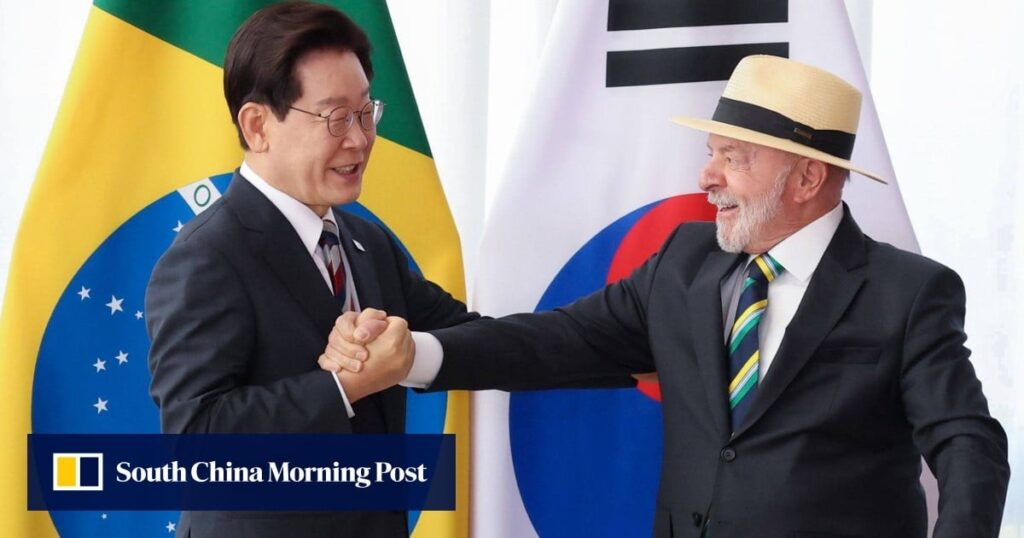
On September 23, 2026, South Korean President Lee Jae-myung announced a plan to double semiconductor production and secure the AI supply chain, unveiled at the Korea Investment Summit in New York. The government launched a ₩5 trillion ($3.52 billion) semiconductor fund and another ₩5 trillion for trade financing. Samsung Electronics surged 6.7% amid the announcement; its $1.38 trillion market cap reflects 70% revenue dependence on semiconductors and mobile devices. SMCI, with a $27.22 billion valuation, stands to benefit from rising AI server demand. The June 29, 2026 investment plan underscores South Korea’s strategic pivot toward technological sovereignty.

Original source: Source information pending

South Korea Launches $3.52B Semiconductor Fund, Samsung Rises 6.7%

According to www.gurufocus.com, on September 23, 2026, South Korean President Lee Jae-myung announced an initiative to double the country’s semiconductor production capacity and safeguard the artificial intelligence (AI) supply chain against external disruptions — a move unveiled at the “Korea Investment Summit” in New York.

Strategic Timing and Geopolitical Context

The announcement follows the South Korean government’s broader investment plan, unveiled on June 29, 2026, aimed at strengthening domestic semiconductor and AI infrastructure. This coordinated effort reflects growing concern over supply chain fragility, particularly as global demand for AI accelerates. The initiative explicitly calls for increased American investment in South Korea, positioning the country as a secure node in the U.S.-aligned tech supply network.

President Lee Jae-myung’s address emphasized resilience:

“Double the country’s semiconductor production capacity and safeguard the artificial intelligence (AI) supply chain against external disruptions” — President Lee Jae-myung, South Korea

The statement underscores how geopolitical volatility has reshaped national industrial strategy, moving beyond export competitiveness toward sovereign capability.

With memory chips and AI hardware becoming foundational to cloud computing and national security, South Korea’s push targets both scale and strategic autonomy — a shift validated by immediate market response and concrete fiscal commitments.

Funding Architecture and Scale

South Korea is establishing a ₩5 trillion, roughly $3.52 billion, semiconductor fund focused on materials, equipment, components, and fabless chip companies. An additional ₩5 trillion is earmarked for trade financing across the semiconductor supply chain — signaling support not only for R&D and fabrication but also for liquidity and logistics resilience.

These figures, while substantial, are described in the source as “almost pocket change” relative to the overarching megaproject led by Samsung Electronics and SK Hynix. The dual-fund structure reveals a deliberate segmentation: one targeting upstream enablers (materials, tools), the other ensuring working capital flows across tiers of suppliers — a design directly addressing bottlenecks exposed during recent global disruptions.

The total financial commitment reflects South Korea’s prioritization of vertical integration: from silicon wafers to high-bandwidth memory modules essential for AI servers, all anchored domestically to reduce exposure to export controls or shipping interruptions.

Corporate Impact and Market Response

Samsung Electronics (SSNLF) surged approximately 6.7% in Wednesday’s South Korean trading session following the announcement. With a market capitalization of $1.38 trillion, Samsung generates over 70% of its revenue and profit from mobile phones and semiconductors — making it the primary beneficiary of the state-backed expansion.

Meanwhile, SMCI, a company designing and manufacturing data center infrastructure, carries a market capitalization of $27.22 billion. Its modular, open-standard architecture aligns with South Korea’s emphasis on interoperable, scalable AI hardware — suggesting downstream synergy beyond memory chips alone.

The surge in Samsung’s stock signals investor confidence not just in near-term capacity growth, but in sustained demand: the source notes that Samsung still requires AI servers, high-bandwidth memory, and advanced computing systems to absorb future output — implying multiyear tailwinds if AI adoption continues accelerating globally.

Source: gurufocus.com

Compiled from international media by the SCI.AI editorial team.
Ask SCI.AI Finished reading? Continue with SCI.AI. Explore the related policy, route, company and historical context. Continue asking
India, Japan Ink Next-Gen Pact Targeting JPY 10 Trillion Investment
Japan & Korea Supply Chain

India, Japan Ink Next-Gen Pact Targeting JPY 10 Trillion Investment

Union Commerce and Industry Minister Piyush Goyal concluded a four-day Japan visit on August 27, advancing the India-Japan Next Generation Economic Partnership. The initiative targets JPY 10 trillion in Japanese private investment in India over the next decade, as set during PM Modi’s 2025 Japan visit. Goyal’s delegation — nearly 200 strong — engaged over 200 industry participants across Tokyo, Osaka, and a third city, yielding early outcomes including a robotics firm’s commitment to invest in and manufacture in India. Discussions emphasized semiconductors, AI, clean energy, defence-linked manufacturing, space, and robotics for ageing societies — all under the framework of resilient supply chains and economic security.

South Korea, Brazil Ink Deal to Restart Mercosur FTA Talks
Japan & Korea Supply Chain

South Korea, Brazil Ink Deal to Restart Mercosur FTA Talks

South Korean President Lee Jae Myung and Brazilian President Luiz Inacio Lula da Silva agreed on 29 July 2026 to restart free-trade negotiations with Mercosur — the South American bloc of Argentina, Brazil, Paraguay, Uruguay, and Bolivia. A joint working group will prepare a formal declaration for the Mercosur summit in December 2026. Talks, launched in 2018, stalled in late 2021 amid manufacturing-sector concerns. Analysts say Seoul must back diplomacy with real investment and technology transfer. Mercosur’s $3.5 trillion GDP and 270 million consumers make it a high-stakes opportunity for Korean exporters and supply chain planners.

Nissan to export US-built Murano to Japan in early 2027
Japan & Korea Supply Chain

Nissan to export US-built Murano to Japan in early 2027

Nissan will begin exporting the U.S.-built Murano SUV from its Smyrna, Tennessee plant to Japan in early 2027 — enabled by a September 2025 U.S.-Japan trade agreement that lowered U.S. tariffs on Japanese vehicles from 25% to 15% and allowed U.S. safety certification to satisfy Japanese regulatory requirements. The move follows similar announcements by Toyota and Honda to export U.S.-assembled models to Japan. Nissan sold 42,747 Muranos in the U.S. in 2025 (+121% YoY), while U.S. imports from Japan fell 17.4% to 113,094 units.

Welcome Back!

Login to your account below

Create New Account!

Fill the forms below to register

Retrieve your password

Please enter your username or email address to reset your password.

Scan to share via WeChat

Open WeChat and scan the QR code to share

QR Code

Add New Playlist