Skip to content

Manufacturing

Analysis

J.B. Hunt boosts driver spending by $25M amid tight freight capacity

J.B. Hunt Transport Services Inc. is committing an additional $25 million to driver-related spending in Q3 2026 amid tightening freight capacity. CFO Brad Delco announced the move on September 15, citing intense driver shortages and rising operational costs—including a $10 million fuel expense increase. The investment supports recruiting, onboarding, training, and sign-on bonuses, reflecting J.B. Hunt’s strategy to gain market share. Profits may dip below Q2 levels, though executives see rising costs as an opportunity to raise rates. The company ranks No. 4 on the 2026 FleetOwner 500 list.

Original source: Source information pending

J.B. Hunt boosts driver spending by $25M amid tight freight capacity

According to www.fleetowner.com, J.B. Hunt Transport Services Inc. is allocating an additional $25 million to driver-related initiatives in the third quarter of 2026, as freight capacity tightens across U.S. markets.

Strategic investment amid rising operational costs

CFO Brad Delco announced the increase during Morgan Stanley’s 14th Annual Laguna Conference on September 15, citing intensified competition for qualified drivers. The funds will support recruiting, advertising, onboarding, training, and sign-on bonuses — measures the company described as atypical for mid-year execution. Delco emphasized that this move reflects both immediate market constraints and a deliberate effort to expand J.B. Hunt’s share in a consolidating industry.

Delco noted that the $25 million increment is separate from baseline driver expenditures and represents a targeted response to supply-side pressure. He added that J.B. Hunt does not normally issue intra-quarter earnings guidance, but chose to do so because of what he called “incredibly strong demand” across all its business segments — a signal, he said, of widespread customer difficulty securing freight capacity.

This proactive stance follows broader cost pressures: fuel expenses alone are expected to add approximately $10 million to Q3 costs, while claims and group medical expenses are also climbing in line with national economic trends.

Margin impact and competitive positioning

The added spending coincides with expectations that third-quarter profits will fall below second-quarter levels. According to the source, this dip may occur despite rate increases, as J.B. Hunt is the No. 4 carrier on the 2026 FleetOwner 500 list — a ranking that underscores its scale and visibility in the U.S. for-hire carrier market.

Executives view the rising carrier costs not as a threat but as leverage: tighter capacity gives carriers more room to raise rates. As Delco stated,

“This is not something that we normally do. But I think it’s indicative of just this incredibly strong demand we’re seeing across our businesses […] This is, to me, just a really strong indicator of what our customers are feeling in terms of the challenge of sourcing capacity.” — Brad Delco, CFO of J.B. Hunt Transport Services Inc.

The company’s actions highlight how labor-market dynamics directly influence pricing power and capital allocation in the North American trucking sector — particularly among top-tier carriers navigating elevated fuel, medical, and recruitment costs in the second half of 2026.

Source: FleetOwner

Compiled from international media by the SCI.AI editorial team.
Ask SCI.AI Finished reading? Continue with SCI.AI. Explore the related policy, route, company and historical context. Continue asking
Coca-Cola pledges $10B for US manufacturing by 2030
Manufacturing

Coca-Cola pledges $10B for US manufacturing by 2030

Coca-Cola and its bottling partners will invest $10 billion in U.S. infrastructure by 2030, expanding facilities in California, Colorado, Indiana, Alabama, Michigan, Florida, Minnesota, and New York. An independent study found the company contributes $85 billion to U.S. GDP and $10 million per hour in economic activity. It spends $37 billion with U.S. suppliers and supports 1 million jobs. The announcement coincides with a 2026 restructuring that included layoffs and increased focus on AI and emerging brands.

Maersk tops intra-Asia capacity with 340,000 TEU
Manufacturing

Maersk tops intra-Asia capacity with 340,000 TEU

Maersk has overtaken Cosco Shipping to become the largest container shipping line in the intra-Asia market, with deployed capacity exceeding 340,000 TEU as of mid-August 2026. The intra-Asia fleet grew 6.2% year on year to nearly 2.6 million TEU — outpacing global fleet growth of over 5%. Mainline operators control 63% of capacity despite fewer ships, leveraging larger vessels averaging 2,699 TEU versus regional carriers’ 1,338 TEU. Cosco’s capacity rose by just 500 TEU, while CMA CGM added 15,000 TEU and Gold Star Line expanded 72% (11,000 TEU). Fleet age averages 12 years, ranging from TS Lines’ six-year fleet to MSC’s 21-year fleet.

BYD to launch ETT 44 e-truck in Europe by Q2 2026
Manufacturing

BYD to launch ETT 44 e-truck in Europe by Q2 2026

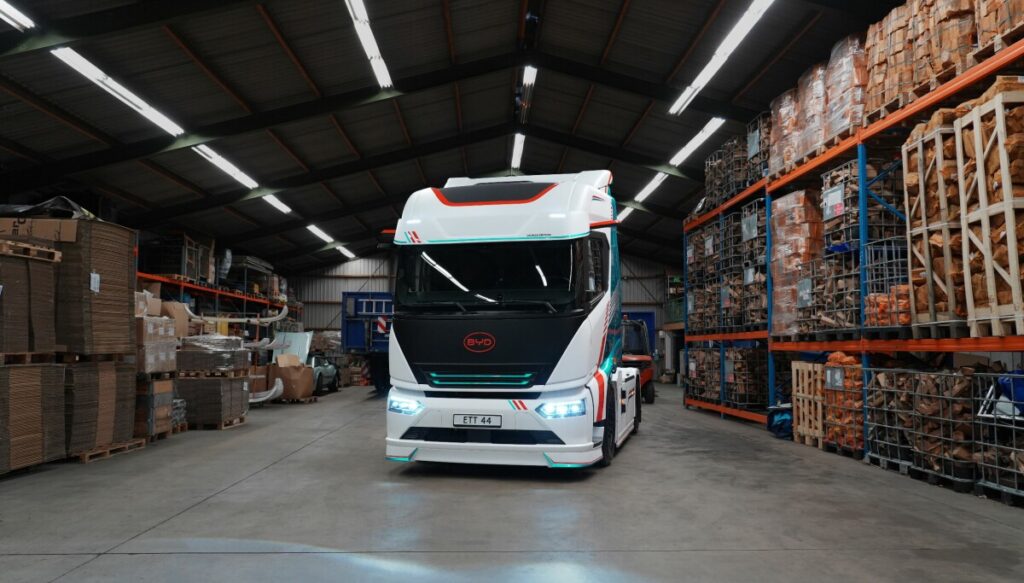
BYD plans to deliver its ETT 44 electric tractor unit to Europe by Q2 2026 and pursue local manufacturing to become 'a European company.' The truck offers up to 372 miles of range and charges 20–80% in 20 minutes. With current EU tariffs on Chinese EVs reaching up to 45%, local production — potentially in Hungary or via acquisition — aims to mitigate duties. BYD already operates bus and battery facilities in Hungary and holds partnerships with Forvia and Voestalpine. ACEA reports €1.3bn in EU imports of Chinese commercial vehicles in 2025.

Welcome Back!

Login to your account below

Create New Account!

Fill the forms below to register

Retrieve your password

Please enter your username or email address to reset your password.

Scan to share via WeChat

Open WeChat and scan the QR code to share

QR Code

Add New Playlist