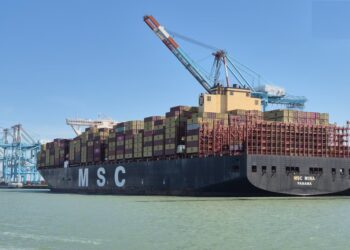
According to theloadstar.com, Indian exporters shipping containerized cargo to Latin America are facing acute supply chain disruption due to sharply reduced vessel space and surging freight rates — with spot prices reaching $9,000 per 40ft container to Santos, Brazil, and $8,500 to Paranaguá, both from Nhava Sheva Port (JNPA).
Capacity crunch triggers shipping crisis
Container lines have reportedly withheld already-cleared export freight at loading ports for several weeks, as carriers recalibrated tonnage deployment to capitalize on the early onset of the Asia peak season. A freight forwarder cited by The Loadstar described the situation as a
“There is a serious shipping crisis.”
Loading allocations for India have been drastically reduced in recent weeks, exacerbating delays and straining logistics planning across the trade lane.
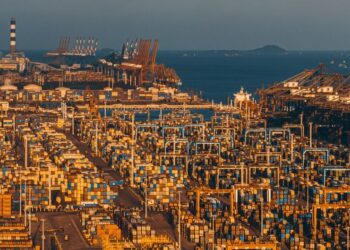
This capacity squeeze has generated significant cargo backlogs, as shippers struggle to secure space on vessels operating between India and key Latin American markets. Yard congestion and slowed cargo clearance at Nhava Sheva Port (JNPA) and Mundra ports have further frustrated exporters and importers since early 2026.
Rising demand intensifies pressure
Indian merchandise exports to Latin America rose 8% in fiscal year 2025–26, despite tariff-related headwinds. The growth was driven largely by automobile shipments, with Brazil, Mexico, and Colombia emerging as the top destination markets. In the first two months of fiscal year 2026–27, India’s overall goods exports rebounded strongly — up 16% year-on-year by value, according to provisional government data released in March 2026.
SC Ralhan, president of the Federation of Indian Export Organisations (FIEO), attributed this momentum to broadening global acceptance:
“The continued strong demand from both traditional and emerging markets reflects increasing global confidence in Indian products and services. The growing presence of Indian exporters in diverse geographies is helping strengthen India’s position in global trade and reducing dependence on a limited number of markets.”
Structural imbalances emerge
Market participants warn that rapidly rising containerized export volumes — particularly on the India–Latin America corridor — are widening the gap between supply and demand for ocean capacity. Historically, capacity allocation for Latin American markets out of Asia has been governed by Chinese export volume fluctuations; however, India’s expanding role is now exerting independent pressure on service networks.
A container industry analyst told The Loadstar:
“Supply chain reliability and resilience are critical to supporting the trade expansion.”
This observation underscores mounting operational risks — including last-minute terminal shuffles at JNPA, transhipment-driven congestion at Bharat Mumbai Container Terminals (BMCT), and ongoing truck shortages affecting box flows at JNPA.
Compounding these challenges, port stakeholders remain locked in mutual recrimination over congestion management — with the Nhava Sheva Container Operators’ Welfare Association (NSCOWA) and Brihanmumbai Customs Brokers Association (BCBA) citing inconsistent customs processing and infrastructure bottlenecks as root causes.
Broader regional context
The India–LatAm shipping strain occurs amid broader network restructuring by global carriers. Recent shifts include the rise of regional ports over mega-hubs, increased transhipment activity through Colombo and Nhava Sheva, and capacity reallocations toward high-yield corridors. Meanwhile, intra-regional port competition is intensifying across South Asia — notably between Nhava Sheva Port (JNPA) and Sri Lanka’s Hambantota International Port (HIP).
On parallel routes, container capacity between India and China is also expanding rapidly — with operators such as United Lines (CULines) and Ningbo Ocean Shipping Company (NBOSCO) adding sailings — highlighting how capacity constraints on one corridor can ripple across interconnected trade lanes.
Source: The Loadstar
Compiled from international media by the SCI.AI editorial team.