According to m.economictimes.com, India and the United States signed a bilateral framework on May 26, 2026, to secure critical mineral and rare earth supplies — part of a broader Quad initiative pledging up to $20 billion in public and private investment for mining, processing, and recycling.
Quad Framework Targets Full Supply Chain Integration
The agreement was unveiled on the sidelines of the Quad foreign ministers’ meeting in New Delhi. Alongside India, the United States, Australia, and Japan jointly launched the Quad Critical Minerals Initiative Framework. External Affairs Minister S Jaishankar stated:
“This framework aims to deepen our cooperation across the entire critical minerals and rare earth supply chain, including mining, processing, recycling and related investment.” — S Jaishankar, External Affairs Minister of India
US Secretary of State Marco Rubio underscored the strategic imperative:
“We cannot afford to leave the foundational materials of these industries vulnerable to a single-source monopoly that could deny us these things, not just in a time of conflict, but as a leverage point contrary to our sovereign national interests.” — Marco Rubio, US Secretary of State
The remarks explicitly referenced China’s concentrated control over downstream processing — a choke point distinct from raw ore production.
India’s Overseas Mining Push and Bilateral Deals
India’s strategy extends beyond multilateral frameworks into targeted bilateral partnerships. In January 2024, state-owned Khanij Bidesh India Limited (KABIL) signed an exploration and development agreement with Argentina’s CAMYEN SE for five lithium brine blocks in Catamarca Province — India’s first overseas lithium mining project, according to the Press Information Bureau (PIB). Later, during Prime Minister Narendra Modi’s visit to Japan in August 2025, India signed a Memorandum of Cooperation on critical minerals. An MoU followed with Australia’s Critical Minerals Office covering lithium and cobalt projects. Most recently, on June 1, 2026, India and Myanmar agreed to maintain close engagement on critical minerals and rare earths, confirmed by Foreign Secretary Vikram Misri following talks between Modi and Myanmar President U Min Aung Hlaing.
China’s Processing Dominance and India’s Vulnerability
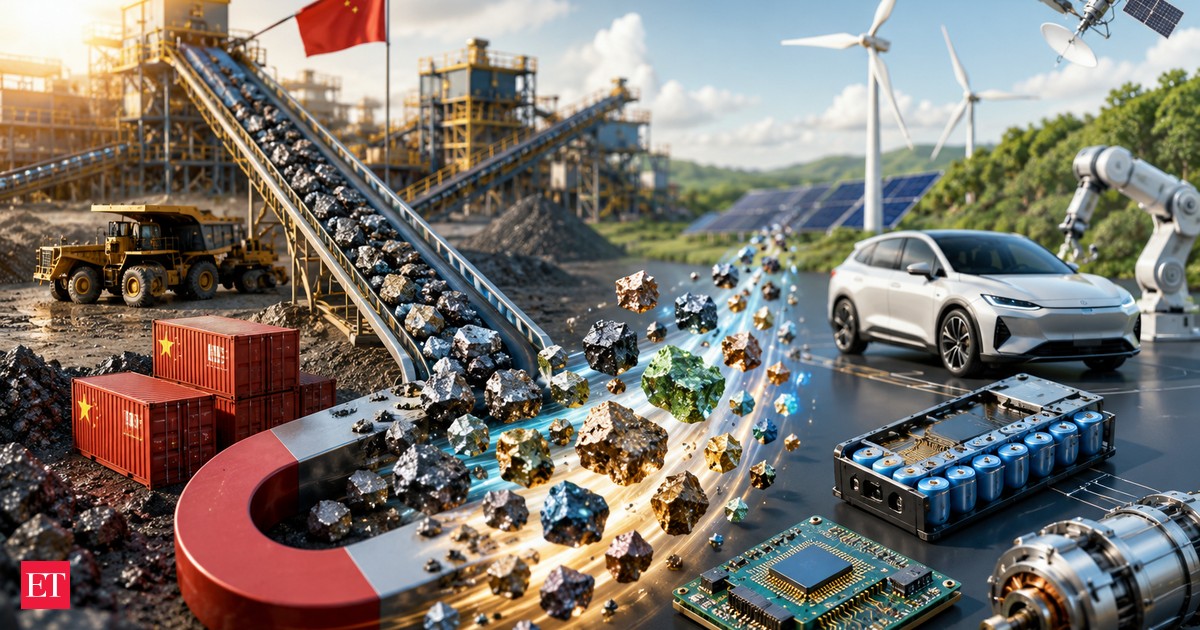
China controls approximately 80% of global rare earth refining capacity and roughly 91% of refined rare earth output, according to the Institute for Energy Economics and Financial Analysis (IEEFA). Its share of permanent magnet production stands at 94% globally — a figure that directly impacts electric vehicles and defence systems. As Harsh Pant, Vice President at ORF, explained:
“China’s dominance is much greater in processing, separation, refining and magnetic manufacturing than in raw ore production. That is where the strategic choke point lies.” — Harsh Pant, Vice President, Observer Research Foundation
Beginning in 2023, China imposed export restrictions on critical minerals, rare earths, and related processing technologies — later suspending some measures after the Trump-Xi meeting in November 2025. For India, exposure is acute: rare earth imports from China accounted for more than 45% of India’s total rare earth imports between 2014 and 2024. Between 2022–23 and 2024–25, China supplied 59.6% to 81.3% of India’s permanent magnet imports by value and 84.8% to 90.4% by quantity.
India’s Domestic Processing Gap
Despite possessing significant rare earth reserves — particularly in beach sands along Kerala and Odisha — India’s domestic refining capacity remains severely constrained. According to official trade data cited by the Ministry of Mines, India’s rare earth refining capacity is estimated at 400–500 tonnes per annum of neodymium-praseodymium oxide — less than 25% of domestic demand. This shortfall underscores why international partnerships and sustained capital infusion are central to India’s strategy. As Asit Saha, Director General of the Geological Survey of India (GSI), noted:
“The concentration of critical mineral and rare earth processing capacities in a few geographies has transformed these commodities from industrial raw materials into strategic assets.” — Asit Saha, Director General, Geological Survey of India
The geopolitical shift creates opportunity: countries now offer financing, technology transfer, long-term purchase agreements, and diplomatic backing to diversify away from China. Yet experts stress that building robust processing infrastructure in India — not just securing upstream mining rights — is the decisive bottleneck. Without scaling refining and magnet manufacturing, India’s ambition for strategic self-reliance in clean energy and defence sectors will remain unfulfilled.
Source: m.economictimes.com
Compiled from international media by the SCI.AI editorial team.