According to discoveryalert.com.au, South Eastern Coalfields Limited (SECL) and the Central Warehousing Corporation (CWC) have formalized a Memorandum of Understanding to address structural bottlenecks in India’s coal logistics chain — a move triggered by record production levels exceeding 100 million tonnes in early FY2026–27.
India’s Coal Supply Chain Gap: Production ≠ Delivery
For decades, India’s coal policy has prioritized output targets over movement reliability. Yet as Coal India Limited’s subsidiaries scale production, the gap between mined tonnage and delivered fuel has emerged as the dominant constraint on energy security. Rail infrastructure carries the overwhelming majority of bulk coal, but systemic inefficiencies — including wagon shortages, scheduling delays, and congestion — routinely disrupt thermal power plants, integrated steel mills, and cement manufacturers. The source states that India’s general freight rail network was not purpose-built for today’s commodity volumes, making ad hoc fixes increasingly inadequate.
First-mile connectivity — physical links from mine sites to rail loading points — remains underdeveloped at numerous collieries. Simultaneously, last-mile delivery failures persist even after coal reaches the correct rail junction. These dual deficits mean strong mine-level output does not translate into fuel security for end users. According to the report, this shortfall affects not only domestic industry but also constrains India’s capacity to meet global resource export commitments.
MoU Scope: Dedicated Rakes, Multimodal Nodes, Real-Time Tracking
The MoU, signed in May 2026, establishes five interlinked operational pillars. First, dedicated railway rake operations will be deployed under the Goods Train Private Wagon Investment Scheme (GPWIS) and functionally equivalent frameworks. Second, integrated rail logistics services aim to reduce transit times between pithead and consumer. Third, multimodal transportation solutions will incorporate road, rail, and warehousing nodes. Fourth, first-mile and last-mile connectivity improvements are targeted at both mine and consumer ends. Fifth, digital monitoring systems will enable real-time logistics tracking and operational oversight.
The agreement was formally signed in the presence of Harish Duhan, Chairman-cum-Managing Director of SECL, and Santosh Sinha, Managing Director of CWC, alongside functional directors and senior officials from both organisations. Long-term transportation planning is embedded in the framework to reduce systemic bottlenecks — a structural shift beyond point-solution interventions.
GPWIS: Reserving Rolling Stock to Cut Uncertainty
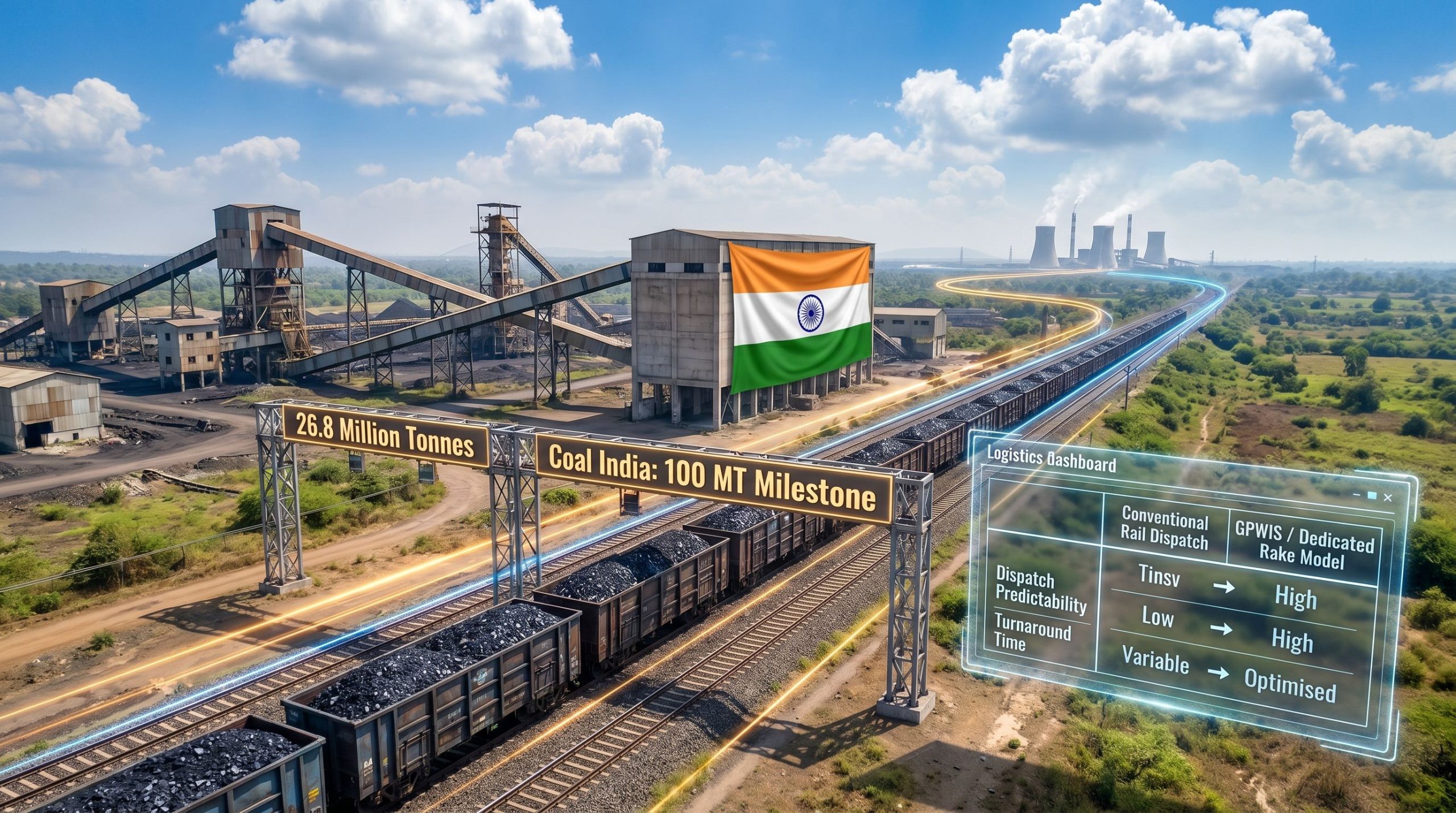
The Goods Train Private Wagon Investment Scheme (GPWIS) serves as the operational engine for dedicated rake provisioning. Under conventional rail dispatch, coal consignments compete with dozens of other commodities for wagons in Indian Railways’ general freight pool — leading to extended wait times and unpredictable dispatch windows. GPWIS resolves this by reserving privately owned or institutionally dedicated wagons for specific shippers or commodities.
- Wagon availability: Subject to general freight demand (conventional) vs. reserved and dedicated allocation (GPWIS)
- Turnaround time: Variable, frequently delayed (conventional) vs. optimised through pre-planned scheduling (GPWIS)
- Dispatch predictability: Low (conventional) vs. substantially higher (GPWIS)
- Digital monitoring integration: Limited (conventional) vs. built into operational framework (GPWIS)
For SECL — the second-largest coal-producing subsidiary within the Coal India Limited group — these advantages compound across thousands of annual rake movements. The source states GPWIS enables pre-planned scheduling, shorter turnaround times, and significantly improved dispatch predictability for bulk coal.
CWC’s Role: Leveraging Existing Infrastructure, Not Building Anew
CWC brings deep institutional capability: a national network spanning warehousing nodes, cold chain facilities, and multimodal transport interfaces — all with proven rail-linked cargo experience. Crucially, SECL did not pursue vertical integration by building parallel logistics capacity. Instead, it leveraged CWC’s existing infrastructure, regulatory familiarity, and operational expertise — capabilities that would require years and substantial capital to replicate independently.
This producer-logistics partner model reflects a broader shift among India’s large public sector enterprises. As the report notes, it mirrors integrated mine-to-port logistics strategies adopted by resource producers in other major mining jurisdictions. CWC’s Navaratna status — conferred by the Government of India — underscores its strategic role in national supply chain resilience. The partnership avoids duplication while accelerating implementation: no new procurement lead times, no de novo capital outlay, and no diversion from SECL’s core mining competency.
Source: discoveryalert.com.au
Compiled from international media by the SCI.AI editorial team.