According to roboticsandautomationnews.com, Singapore-based Doozy Robotics has launched a coordinated global expansion across the United States, Gulf Cooperation Council (GCC) countries, and Asia — marking its next phase of growth ahead of a planned Series A funding round. The move follows commercial traction at the seed stage, including a qualified global pipeline exceeding $200 million and a signed $144 million agreement with a major industrial conglomerate.
Vertically Integrated Physical AI Platform
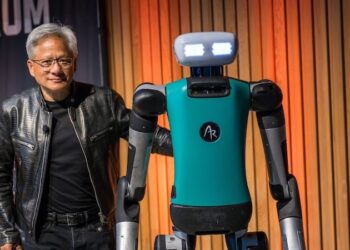
Doozy Robotics, co-founded by Suresh Chandrasekar, CEO and Ajmal Thahseen, is building a vertically integrated ecosystem — not standalone hardware. Its platform comprises three core physical components: the ‘Industrial Super Humanoid’, a fleet of autonomous mobile robots (AMRs), and autonomous forklifts — all governed by Eywa-OS, the company’s proprietary orchestration layer. Designed as a ‘super-intelligent factory manager’, Eywa-OS interprets high-level production goals, dynamically allocates agents across the facility floor, and adapts to disruptions in real time. The Industrial Super Humanoid is scheduled for launch in Q3 2026, with first deployments beginning immediately thereafter.
Robot-as-a-Service Ecosystem and Real-World Traction
The company is extending its Robot-as-a-Service (RaaS) model into a full multi-agent ecosystem: customers subscribe monthly to an integrated autonomous workforce and scale humanoids or robots up or down based on production demand — converting factory automation from a heavy capital expenditure into an elastic operational service. Doozy already has paying customers live across two continents, with active engagements spanning Daimler, Carrier, and VitaQuest. A large pilot deployment is underway with a US pharmaceutical leader, and the company reports that its systems are actively deployed across warehouses and factories globally.
Addressing Structural Labor Shortage
This expansion responds directly to a structural, generational labor shortage now affecting industrial economies worldwide. In the US, labor constraints are projected to contribute to over $1 trillion in negative GDP impact by 2030; nearly half of American workers are over age 45, while Gen Z accounts for just 8 percent of the workforce. Doozy positions itself as the first scalable agentic industrial workforce built for this reality — one that navigates uneven floors and disorganized spaces, reduces operational footprint by 50 percent compared to traditional forklifts, and delivers advanced capability at a price point enabling mass-market adoption.
“The global labor shortage is a structural shift, not a temporary imbalance. We are building the Physical AI workforce that will power the next era of manufacturing. By combining humanoids, autonomous systems, and Eywa-OS orchestration, we are enabling facilities to operate with intelligence at scale. This expansion into the US marks a critical step towards that vision.” — Suresh Chandrasekar, CEO and co-founder of Doozy Robotics
“We have been incredibly impressed by the sheer velocity of Doozy Robotics’ traction to date. Already having global customers actively deploying these systems across their warehouses and factories is a testament to the team’s execution. They have cracked some of the most persistent bottlenecks in industrial robotics… Most importantly, they are delivering this advanced capability at a price point that makes mass-market adoption inevitable.” — Michael Blakey, managing partner at Cocoon Capital
Source: Robotics & Automation News
Compiled from international media by the SCI.AI editorial team.