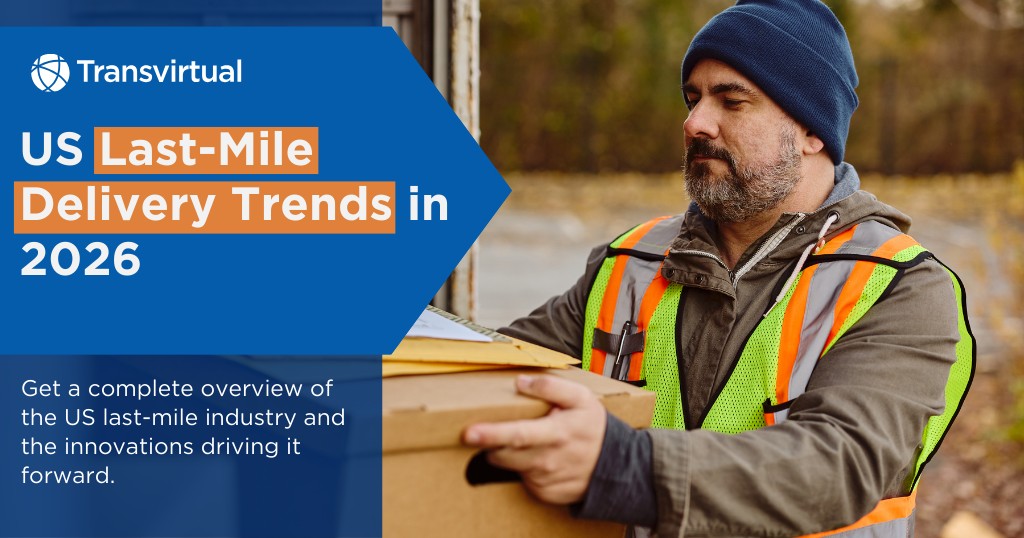
According to www.transvirtual.com, last-mile delivery now accounts for more than half of total delivery costs, despite being the shortest leg of the parcel journey — a structural inefficiency driving urgent operational overhauls across North America.
North American Market Dominance and Parcel Volume Surge
North America holds more than 40% share of global last-mile transportation revenue, propelled by ecommerce leaders including Amazon and Walmart. In 2024, U.S. consumers shipped 22.37 billion parcels, reflecting sustained growth in online retail demand. That year, the United States Postal Service (USPS) delivered 6.9 billion parcels, slightly ahead of Amazon Logistics at 6.3 billion. However, Amazon is projected to surpass USPS by 2028. To close coverage gaps, Amazon has committed a $4 billion investment to expand delivery infrastructure in rural America by 2026.
Rising Cost Pressures Across Urban and Rural Networks
Cost inflation is intensifying across the last-mile segment. According to the report, 76% of retailers report rising cost per package, with most deeming home delivery unprofitable without efficiency gains. The average U.S. delivery cost rose 12% from 2024 to 2025. Location remains a critical cost driver: urban deliveries average $10 per package, while rural deliveries cost $50 per package due to longer distances and lower density. Failed deliveries compound losses — each failed attempt costs retailers an average of $17.20 per order, amounting to approximately $197,730 per year per retailer, based on typical failure volumes.
Carrier Network Restructuring and Strategic Shifts
Major carriers are actively recalibrating partnerships and operations. UPS plans to cut the volume it handles for Amazon by more than 50% by 2026. Meanwhile, FedEx and Amazon recently renewed a delivery agreement focused specifically on high-margin and rural shipments. USPS has opened its last-mile network to all shippers via public solicitations, enabling same- or next-day delivery services to reduce unit costs and diversify revenue — a reversal of prior exclusivity policies. FedEx’s Network 2.0 initiative merged FedEx Express, FedEx Ground, FedEx Services, and other operating units to eliminate redundant routes, targeting $2 billion in savings by 2027.
Customer Expectations and Real-Time Visibility Demand
Consumer expectations are tightening service benchmarks. Tracking and order visibility are important to 90% of customers, making real-time tracking a non-negotiable feature. Yet only 68% of U.S. customers say they prefer same-day delivery when available — indicating strong but not universal demand for speed. These behavioral patterns are pushing logistics providers to embed mobile barcode scanning, electronic proof of delivery, and customer portal integrations into core delivery management systems — capabilities highlighted in Transvirtual’s software suite.
Source: www.transvirtual.com
Compiled from international media by the SCI.AI editorial team.