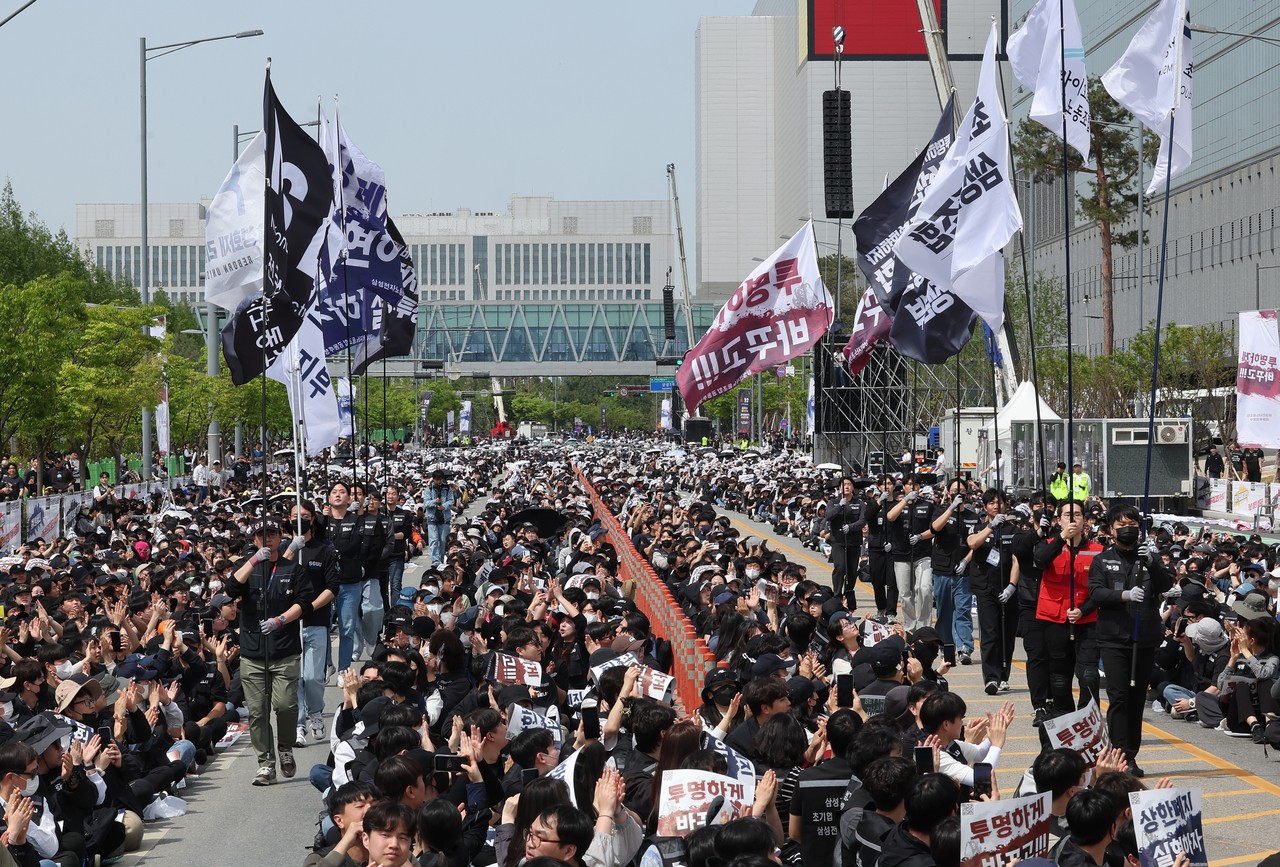
According to www.koreaherald.com, a planned general strike by Samsung Electronics’ labor unions — set for May 21 to June 7, 2026 — poses acute risks to global semiconductor supply chain reliability, with production at the Pyeongtaek chip complex already disrupted during the night shift following a rally of approximately 40,000 union members.
Immediate Production Impact
During the 10 p.m. to 6 a.m. shift, production performance — referred to by the union as “moving” — fell 18.4 percent at memory fabs and a stark 58.1 percent at foundry fabs, according to the joint labor action committee comprising the Samsung Electronics Labor Union, the National Samsung Electronics Union, and Samsung Electronics Labor Union Donghaeng.
Economic and Strategic Risks
University of Seoul economics professor Song Heon-jae, speaking at a seminar hosted by the Ahnmin Policy Forum, warned that a plant shutdown could cost Samsung tens of billions of won per minute — roughly 1 trillion won ($677 million) per day. A prolonged strike could reduce chip operating profit by up to 10 trillion won.
The deeper concern, he emphasized, lies beyond short-term financials:
“Global big tech clients could begin looking at alternative suppliers such as TSMC as part of efforts to spread risk. In the semiconductor industry, where process verification takes enormous time and money, customers who leave are difficult to win back.” — Song Heon-jae, Professor of Economics, University of Seoul
He identified several non-immediate but consequential risks: erosion of customer trust, market share losses as clients absorb switching costs, missed opportunities in the AI chip race, departure of key talent, and a deepening “Korea discount” — a term reflecting investor skepticism toward Korean corporate governance and labor stability.
Union Demands and Strike Logistics
The unions are demanding three core changes: scrapping the cap on performance-based bonuses (currently limited to 50 percent of annual salary), greater transparency in bonus calculation methodology, and a written commitment to allocate 15 percent of operating profit to the bonus pool.
The walkout is scheduled to begin with a gathering near Samsung Electronics Chairman Lee Jae-yong’s residence in Yongsan-gu, Seoul. The Samsung Electronics Labor Union filed a rally notice with Yongsan Police Station for an event at around 1 p.m. on May 21 involving about 50 participants; a union official clarified the event is likely to resemble a press briefing rather than a full-scale protest, though turnout remains fluid.
Broader Industry Context
This would be Samsung Electronics’ second general strike since its founding in 1969 — the first occurred in July 2024 and lasted 25 days. At a time when Nvidia, TSMC, and Intel are intensifying competition in AI-optimized chips, Song stressed that “semiconductor technology can lose competitiveness after falling behind by just one or two years.”
For supply chain professionals, this incident underscores how labor actions at single-tier suppliers — especially those with concentrated, highly specialized manufacturing capacity like Samsung’s advanced logic and memory fabs — can rapidly propagate upstream and downstream. Unlike commodity components, semiconductor process nodes require extensive qualification cycles; even brief disruptions may trigger multi-quarter requalification timelines for customers like Advanced Micro Devices and Nvidia, both of which prioritize supply stability above all else, according to the source.
Source: www.koreaherald.com
Compiled from international media by the SCI.AI editorial team.