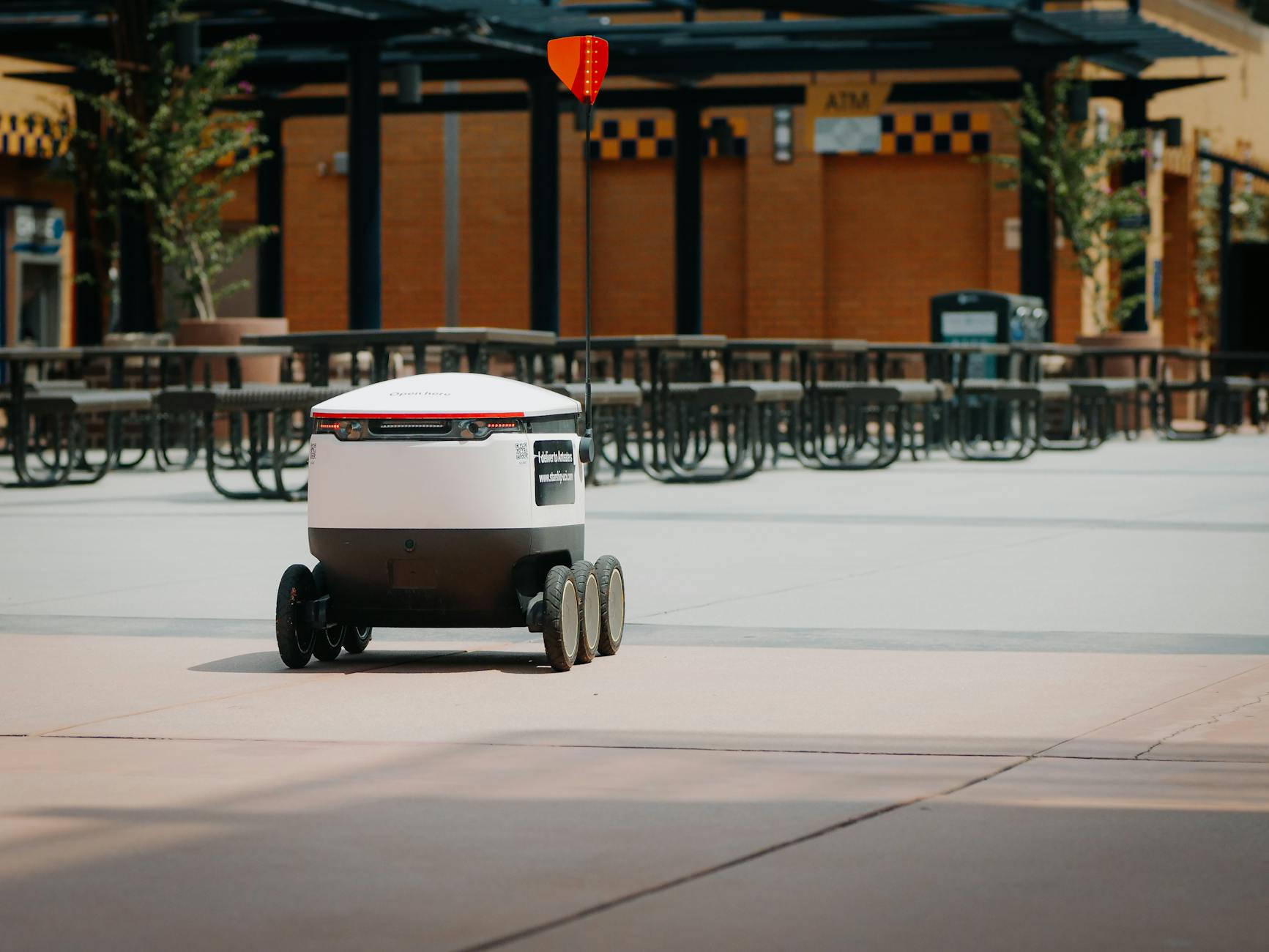
According to siliconangle.com, Amazon.com Inc. has acquired Rivr Technologies AG, a Swiss developer of autonomous last-mile delivery robots.
Rivr Two Robot Capabilities
Rivr’s flagship product is the Rivr Two, a four-legged robot that rolls on wheels and is purpose-built for last-mile delivery—the final leg between a logistics hub (e.g., warehouse or store) and the customer’s home. It can carry more than 60 pounds of parcels or food in an internal compartment and travels at up to 8.7 miles per hour—roughly twice walking speed. The robot is engineered to navigate urban environments: it stops at red lights, opens gates, and climbs stairs. Safety features include high-visibility lighting, instant object-proximity braking, and a physical deactivation button.
Deployment Models and Amazon’s Prioritization
The Rivr Two supports multiple operational models:
- Retailers and brick-and-mortar businesses deploying direct-to-customer deliveries from stores
- Logistics companies integrating the robots into delivery vans—enabling drivers and robots to split tasks at a stop and parallelize drop-offs
Amazon has confirmed it will prioritize the latter use case. As reported by CNBC, the company informed its third-party logistics contractors that it will collaborate with them to field-test Rivr’s technology. In an internal memo, Amazon stated:
“We are in the early stages of this journey, and as we progress, we will engage you and our teams to help us field test this technology, gathering real-world insights and incorporating your feedback into how we scale this technology in the future.”
AI Framework and Broader Supply Chain Applications
Rivr trains its AI models using a hybrid framework combining supervised and unsupervised learning. Supervised learning relies on annotated training data; unsupervised learning uses unlabeled datasets and differs methodologically in several key respects. Rivr states this framework is adaptable across robot form factors: during one internal project, its software was ported to a new robot platform in just one week. Given Amazon’s existing fleet of more than 1 million robots in fulfillment centers, this AI scalability could significantly enhance perception, navigation, and decision-making capabilities across its warehouse automation infrastructure.
Strategic Context in Amazon’s Autonomous Logistics Portfolio
This acquisition extends Amazon’s multi-year investment in autonomous delivery systems. In 2020, Amazon acquired self-driving vehicle startup Zoox Inc. for $1.2 billion and is now testing Zoox-powered autonomous SUVs in multiple U.S. cities. The Rivr acquisition positions Amazon to potentially integrate Zoox vans with Rivr Two robots—creating a coordinated, fully autonomous workflow spanning middle-mile transport and last-mile execution. Rivr’s technology also complements Amazon’s broader robotics ecosystem, including its Kiva-derived mobile drive units and recently deployed Sparrow robotic sorting systems.
Industry Context for Supply Chain Professionals
Rivr joins a growing cohort of last-mile robotics firms attracting strategic investment. In 2023, FedEx partnered with Nuro to deploy autonomous delivery vehicles in Houston and Phoenix; in 2024, UPS began testing Nuro’s R2 vehicles in Arizona. Meanwhile, Alibaba’s Cainiao launched autonomous delivery robots in Hangzhou and Shenzhen, and Walmart piloted Gatik’s autonomous box trucks for middle-mile B2B deliveries. Unlike many competitors focused solely on wheeled ground robots or drones, Rivr Two’s stair-climbing capability and gate-opening functionality address persistent pain points in mixed-use urban and suburban residential environments—where over 65% of U.S. single-family homes have front steps (U.S. Census Bureau, American Housing Survey). For supply chain professionals, this signals increasing viability of human-robot handoff models within existing contractor networks—not wholesale replacement. Integration success will hinge on interoperability with TMS platforms, driver interface design, regulatory alignment across municipal jurisdictions, and real-time parcel tracking synchronization.
Source: siliconangle.com
Compiled from international media by the SCI.AI editorial team.