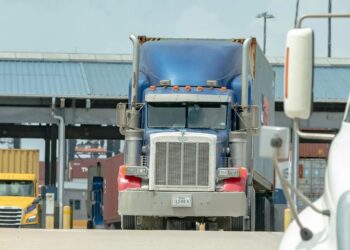
According to mexicobusiness.news, logistics has evolved from an operational function into a strategic driver of growth and market presence across North America — directly influencing corporate viability in regional trade.
USMCA Integration Powers Regional Supply Chains
Under the United States–Mexico–Canada Agreement (USMCA), North America accounts for nearly 30% of global GDP, anchored by deeply interconnected supply chains in manufacturing, automotive, technology, and energy. This integration enables goods to cross borders multiple times during production — reducing time, cost, and risk while reinforcing Mexico’s role as a pivotal node. The region’s economic cohesion is underscored by bilateral trade volumes: U.S.–Canada exchanges approach US$1 trillion annually, predominantly overland, while U.S.–Mexico trade reached US$399.5 billion in exports from Mexico to the U.S. in 2025, per the U.S. Department of Commerce Census Bureau.
Record Trade Flows Highlight Operational Interdependence
In the first 10 months of 2025 alone, Mexican exports to the United States totaled nearly US$448 billion, setting a new bilateral record; U.S. shipments to Mexico exceeded US$283 billion in the same period. These figures reflect a continuous, high-volume logistical engine moving vehicles, engine parts, appliances, avocados, beer, electronic components, heavy machinery, and natural gas — all with equal urgency. As the article notes: “If that logistical engine slows down, the economies on both sides slow down.”
From Efficiency to Resilience: A Strategic Pivot
Historically focused on low costs and next-day delivery, logistics now prioritizes adaptability amid political volatility and regulatory shifts. Leaders are shifting from rigid structures to resilient, flexible networks — where flexibility is “today’s stability.” This recalibration elevates supply chain planning beyond route optimization to scenario analysis, diversification, and intelligent response capability. As Francisco Ricaurte, President of UPS, states:
“Flexibility is today’s stability. Therefore, partnering with a logistics provider enables companies to deliver visibility, speed, and the most crucial aspect: certainty to their customers.” — Francisco Ricaurte, President
This evolution positions distribution not just as execution but as a core risk management tool — with implications for operational continuity and long-term corporate reputation.
Practitioner Implications & Industry Context
For supply chain professionals, this signals a material shift in KPI weighting: real-time visibility, multi-scenario modeling, and border-crossing agility are now non-negotiable. Nearshoring initiatives — accelerated by USMCA’s rules of origin and tariff predictability — have intensified demand for integrated land-based logistics, especially along the U.S.–Mexico corridor. Similar trends are evident elsewhere: Maersk has expanded its U.S. inland rail and warehousing footprint since 2023, while DHL launched a dedicated North American nearshoring advisory unit in early 2025. Public data from the U.S. International Trade Commission shows that between 2021 and 2025, U.S. imports from Mexico grew at an average annual rate of 7.2%, outpacing overall import growth by 3.8 percentage points. Meanwhile, logistics technology adoption — particularly TMS platforms with embedded trade compliance and multimodal routing — rose among top-tier manufacturers by 64% (Gartner, 2025 Supply Chain Technology Survey). These developments reinforce that resilience is no longer theoretical: it is measured in border crossing times, inventory-in-transit visibility, and the speed of rerouting when policy changes occur.
Source: mexicobusiness.news
Compiled from international media by the SCI.AI editorial team.