I. Geopolitical Crisis Triggers Logistics Cost Tsunami
In March 2026, as the Iran war continues to escalate, the global logistics network is experiencing its most severe test since the COVID-19 pandemic in 2020. UPS and FedEx, the two giants of international express delivery, have successively announced emergency surcharges on freight between the US and the Middle East, while significantly increasing fuel surcharge rates. These measures not only reflect the sharp rise in geopolitical risks in the Middle East but also herald a fundamental restructuring of global supply chain cost structures. According to industry experts, the logistics cost increases resulting from this conflict may persist until the end of 2026, having profound impacts on manufacturing, retail, and cross-border e-commerce sectors that rely on international logistics.
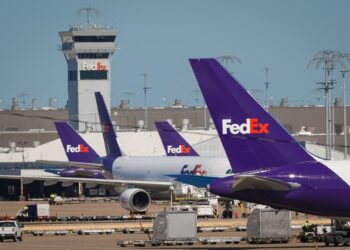
UPS announced on March 9 that it would impose an emergency surcharge of $0.64 per pound on goods shipped from the US to 15 Middle Eastern countries, with the same applying to reverse shipments. This fee applies to UPS Worldwide Express and five other core services, and is “effective indefinitely.” Almost simultaneously, FedEx introduced similar surcharge policies: $0.50 per pound for parcels and freight from the US to dozens of countries in the Middle East, South Asia, and Africa; and $0.70 per pound for reverse shipments. More notably, FedEx’s surcharge for shipments to Israel surged from $0.50 to $1.50 per pound, a staggering 200% increase.
II. Data Perspective: The Three-Stage Surge in Fuel Surcharges
A deep analysis of the fuel surcharge data released by UPS and FedEx for March clearly shows the transmission path of cost pressures. UPS’s fuel surcharge rates experienced significant increases between March 2 and 16: ground transportation rose from 21.5% to 25.5%, domestic air transport from 21.25% to 26%, export air transport from 26% to 30.75%, and import air transport from 29.75% to 34.5%. FedEx’s rate trends were almost synchronous: ground transportation from 22% to 25%, domestic air transport from 21.75% to 25.5%, export transport from 26% to 30.75%, and import transport from 29.75% to 34.5%.
This synchronized increase is no coincidence but reflects unified pressure from the global fuel market. Brent crude oil prices have approached $90 per barrel following the outbreak of conflict, while the Strait of Hormuz—the passage for 20% of global oil trade—is located at the heart of the conflict zone. David Sullivan, Director of Professional Services at ShipScience, explicitly stated on LinkedIn: “UPS and FedEx’s new surcharges directly respond to the Iran war, oil price concerns, and geopolitical risks. Parcel shippers should expect more price volatility and targeted lane fees tied to the conflict.”
III. Operational Challenges: Route Reconstruction and Capacity Squeeze
The actual impact of the Iran war on logistics operations extends far beyond cost increases. Flexport’s latest report indicates that extensive airspace closures in the Middle East severely challenge connectivity between the Indian subcontinent and North America and Europe. Logistics providers are forced to take longer routes and carry heavier fuel loads, further squeezing already tight air freight capacity.
UPS acknowledged in its service alert that the company is activating contingency plans and working to limit impacts on customers. FedEx stated it has resumed pickup and delivery services in safe areas but noted that affected shipments will experience extended transit times. This chain reaction of operational disruptions is spreading globally: average transit times from the US to the Middle East have extended by 3-5 days, with capacity on some sensitive routes reduced by over 30%.
IV. Industry Impact: Full-Chain Shock from B2B to Cross-Border E-commerce
The impact of this logistics cost increase is transmitting along the supply chain. For B2B manufacturing enterprises, international transportation costs for raw materials and components may increase by 15-25%, posing a direct threat to already thin profit margins in manufacturing. Industries such as automotive, electronics, and medical devices that rely on just-in-time (JIT) supply are particularly vulnerable, as any transportation delay could lead to production line shutdowns.
The impact on cross-border e-commerce is even more pronounced. Chinese cross-border e-commerce platforms like SHEIN and Temu face dual pressures: on one hand, transportation costs from China to the Middle East have increased due to detour routes; on the other hand, return logistics costs from the Middle East to Europe and North America are also soaring. Industry estimates suggest that overall logistics costs in the Middle East market for cross-border e-commerce have increased by 40-50%, which may force some sellers to reassess market priorities.
V. Risk Management: Comprehensive Enterprise Response Strategy Map
Facing this round of logistics crisis, supply chain managers need to adopt multi-level risk management strategies. Short-term strategies include: 1) Renegotiating transportation contracts to secure surcharge cap clauses; 2) Optimizing shipping plans, consolidating small-batch goods to reduce unit costs; 3) Establishing alternative transportation routes, particularly through land routes in Africa or Central Asia.
Medium-term strategies should focus on supply chain resilience building: 1) Implementing multi-source procurement to reduce dependence on single regions; 2) Increasing safety stock to buffer against transportation delays; 3) Investing in supply chain visualization tools to monitor transportation status and cost changes in real-time. Long-term, enterprises need to consider regionalized supply chain layouts, moving production facilities closer to consumer markets to reduce dependence on long-distance international transportation.
VI. Future Outlook: Structural Transformation of the 2026 Logistics Market
The Iran war may become a watershed event for the global logistics market in 2026. Sullivan predicts that shippers should closely monitor fuel surcharge price fluctuations, longer transit times on affected corridors, capacity pressures, and potential variations in month-to-month invoices. FedEx and UPS’s weekly fuel surcharge rates are poised to jump further amid rising diesel prices.
A more profound impact lies in the transformation of industry pricing models. Traditional supply-and-demand-based pricing logic is being replaced by geopolitical risk pricing. Carriers are increasingly inclined to adopt “surcharge-driven” pricing strategies, which may lead to structural increases in transportation costs. For shippers, this means needing to establish more flexible cost forecasting models, incorporating geopolitical risks as routine variables in budget planning.
Ultimately, this crisis may accelerate the digital transformation of the logistics industry. Real-time risk monitoring, intelligent route optimization, and dynamic pricing algorithms will become core competitive advantages for enterprises. Those that can quickly adapt to changes and build resilient supply chains will gain decisive advantages in an uncertain era.
Related Reading
- Maersk 10 Ships Trapped in Strait of Hormuz: 2026 Global Shipping Disruption Deep Analysis
- Salalah Port Becomes Middle East’s Only Accessible Container Hub: 4.3M TEU Throughput and 237 LSCI Index (2026 Q1)
- De Minimis Cancellation Devastates Chinese Cross-Border E-commerce Air Freight: US Exports Plunge 50%, SHEIN and Temu Accelerate Shift to Europe to Reconstruct Logistics Landscape
This article was generated with AI assistance and reviewed by the SCI.AI editorial team.
Source: supplychaindive.com