2026 Supply Chain Trends: The Convergence of AI, Network Optimization, and Integrated Technologies
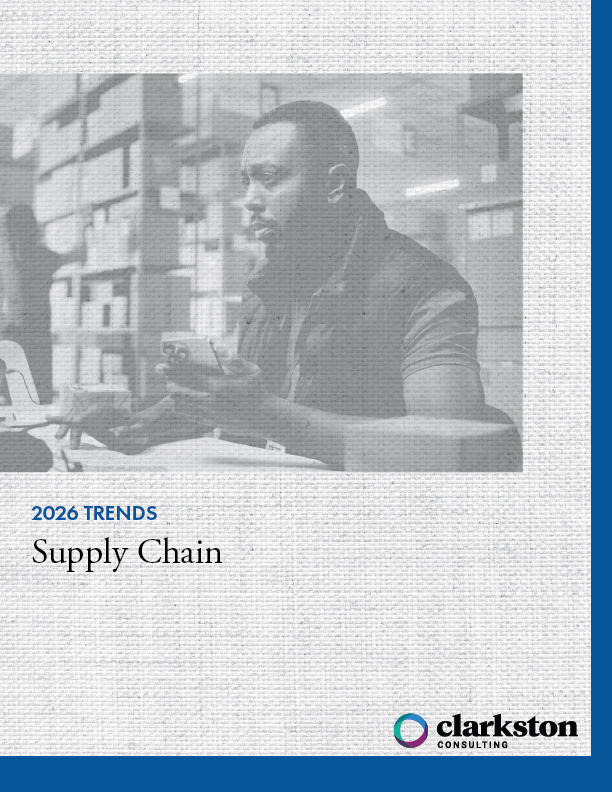
“In 2026, supply chain transformation will accelerate through rising AI adoption and deeper integrations across core technologies.” — Clarkston Consulting, 2026 Supply Chain Trends Report
In an era of unprecedented global economic transformation, supply chain management stands at a critical inflection point. Clarkston Consulting’s recently published 2026 Supply Chain Trends Report identifies three pivotal trends that will reshape global supply chain dynamics. This comprehensive analysis synthesizes the report’s key findings with data from Gartner, McKinsey, and other authoritative sources, providing strategic insights for supply chain professionals worldwide.
I. The Expansion of AI from Planning to Autonomous Execution
Artificial Intelligence in supply chain management is undergoing a fundamental shift from decision support to autonomous execution. According to Gartner research, by 2025, over 70% of large organizations will adopt AI-based supply chain forecasting. However, 2026 trends indicate a more profound transformation: AI’s scope will expand from traditional planning functions to encompass full execution capabilities.
1.1 The Maturation of Agentic AI and Autonomous Supply Chain Execution
The maturation of Agentic AI technology marks a new era in supply chain automation. Unlike traditional rule-based systems, Agentic AI can comprehend complex contexts, make independent decisions, and execute corresponding actions. Clarkston’s report highlights that enterprises are exploring Touchless Planning models, where AI systems autonomously manage the entire workflow from demand forecasting to production scheduling.
Case Study: Ford Motor Company’s AI-Driven Supply Chain
Ford Motor Company is piloting an Agentic AI-based supply chain execution system. During the 2021 semiconductor crisis, traditional methods required weeks to recalibrate production plans. The new AI system accomplishes the same task in hours by analyzing supplier capabilities, transportation routes, and market demand in real-time, autonomously formulating optimal production adjustment strategies.
1.2 The Foundational Role of Data Quality and Analytical Maturity
Successful AI-driven supply chain transformation requires robust data foundations. Clarkston’s report emphasizes that data quality and analytical maturity are critical determinants of AI implementation success. Organizations must establish comprehensive data governance frameworks to ensure supply chain data accuracy, completeness, and timeliness.
McKinsey Research Insight: Organizations with high data quality achieve 3x higher success rates in supply chain digital transformation compared to those with poor data quality. This necessitates investments not only in data engineering but also in cross-functional data governance mechanisms to ensure consistency across procurement, production, and logistics.
II. Building Uncertainty-Resistant Supply Chain Network Design
Geopolitical tensions, evolving trade policies, and cybersecurity threats have elevated supply chain uncertainty to historic levels. Clarkston’s report indicates that in 2026, organizations will increasingly focus on network design and optimization to enhance supply chain resilience.
2.1 Dynamic Network Optimization and Scenario Planning
Traditional static supply chain networks are inadequate for rapidly changing environments. Enterprises must develop dynamic network optimization capabilities that can adjust network structures in real-time based on market conditions, supplier status, and risk factors. Clarkston recommends adopting Scenario Planning methodologies to pre-simulate supply chain performance under various risk scenarios.
Case Study: Huawei’s Supply Chain Network Restructuring
Facing evolving international political landscapes, Huawei has established a multi-layered, multi-regional supply chain network. By creating backup production capabilities across different countries and regions, Huawei can rapidly switch production when issues arise in specific areas, ensuring business continuity.
2.2 Cybersecurity and Risk Management Integration
As supply chain digitalization intensifies, cybersecurity risks become increasingly prominent. Clarkston’s report warns that supply chain cyberattacks can lead to production disruptions, data breaches, and brand reputation damage. Organizations must integrate cybersecurity considerations into core supply chain design.
IBM’s 2025 Cost of Data Breach Report: Supply chain attacks result in average losses of $4.5 million. This requires organizations to not only protect their own systems but also ensure supplier cybersecurity standards, establishing end-to-end security protection systems.
III. Integrated Technology Platforms Driving Supply Chain Collaboration
Siloed supply chain processes remain a major efficiency barrier. Clarkston’s report emphasizes that in 2026, organizations will increasingly focus on achieving end-to-end supply chain collaboration through integrated technology platforms.
3.1 Unified Data Platforms and Real-Time Visibility
Establishing unified data platforms forms the foundation for supply chain collaboration. Such platforms integrate data from suppliers, production facilities, warehouses, and transportation links, providing end-to-end real-time visibility. Clarkston research finds that organizations with unified data platforms respond 40% faster to supply chain disruptions than those without.
Case Study: Alibaba’s Cainiao Network
Alibaba’s Cainiao Network exemplifies unified data platform excellence. By integrating data from over 3,000 logistics partners, Cainiao can monitor nationwide logistics status in real-time, predict transportation delays, and automatically adjust routes, reducing average delivery times by 30%.
3.2 Rapid Scenario Analysis and Decision Support
Another critical function of integrated technology platforms is supporting rapid scenario analysis. Organizations can use these platforms to simulate impacts of different decision alternatives and evaluate supply chain performance under various risk scenarios. Clarkston’s report notes that advanced scenario analysis tools can reduce decision-making time from days to hours.
Case Study: Toyota’s Scenario Analysis System
Toyota’s scenario analysis system can simulate global supply chain network responses to natural disasters like earthquakes and floods within minutes. The system considers not only directly affected production facilities but also analyzes cascading effects on secondary and tertiary suppliers, helping management develop comprehensive contingency plans.
IV. Implementation Challenges and Strategic Responses
Despite promising prospects for supply chain transformation, organizations face multiple implementation challenges. Clarkston’s report identifies four key challenge areas and proposes corresponding strategic responses.
4.1 Technology Integration and Interoperability
Organizations typically use multiple independent supply chain management systems, with data silos and interoperability issues hindering end-to-end visibility. Clarkston recommends adopting API-First architecture designs to ensure seamless integration between different systems.
Case Study: Procter & Gamble’s Digital Transformation
Procter & Gamble’s digital transformation provides a successful example. By establishing a microservices-based supply chain platform, P&G consolidated over 20 independent systems into a unified platform, achieving full-process digitalization from raw material procurement to product delivery.
4.2 Organizational Change and Skill Development
Supply chain digital transformation represents not only technological change but organizational transformation. Organizations must cultivate talent with both supply chain business knowledge and digital technology expertise. Clarkston’s report emphasizes that establishing AI Literacy Programs is crucial for successful AI-driven supply chain transformation.
Case Study: Unilever’s Digital Supply Chain Academy
Unilever established a dedicated Digital Supply Chain Academy providing training in AI, data analytics, and automation technologies. Through systematic skill development programs, Unilever increased its digital supply chain talent proportion from 15% to 45% within three years.
V. Future Outlook and Strategic Recommendations
Looking toward 2026, supply chain management will become increasingly intelligent, resilient, and collaborative. Based on Clarkston’s report analysis, we propose the following strategic recommendations:
- Prioritize Data Foundation Investments: Ensure data quality and analytical capability maturity before advancing AI applications.
- Adopt Incremental Transformation Pathways: Begin with specific business scenarios, gradually expanding AI and automation technology applications.
- Establish Cross-Functional Governance Mechanisms: Break down departmental barriers, create comprehensive governance frameworks covering technology, business, and risk management.
- Cultivate Digital Talent: Invest in employee skill development, building organizational capabilities adapted to the digital era.
- Strengthen Ecosystem Collaboration: Partner with technology providers, logistics partners, and industry organizations to collectively drive supply chain innovation.
Supply chain digital transformation is a marathon, not a sprint. Organizations must maintain strategic patience, continuously investing in technology, organizational change, and ecosystem development. By embracing the three major trends of AI expansion, network optimization, and integrated technologies, organizations can build more intelligent, resilient, and efficient supply chains, maintaining competitive advantages in uncertain environments.
Source: Clarkston Consulting – 2026 Supply Chain Trends Report
This article was AI-assisted and reviewed by our editorial team.