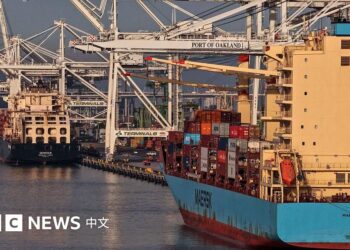
At the heart of America’s supply chain resilience lies a quiet, escalating crisis—not of port congestion or container shortages, but of chronic policy unpredictability. While global logistics professionals track vessel ETAs and inventory turnover ratios with precision, thousands of U.S. small businesses are now operating without reliable baselines for cost forecasting, procurement timing, or even basic cash flow modeling. The recent U.S. Supreme Court ruling declaring key Trump-era tariffs unlawful—widely hailed as a legal vindication—has done little to restore operational stability. Instead, it has exposed a deeper structural failure: a supply chain ecosystem designed for consistency collapsing under successive waves of ad hoc trade interventions. As of March 2026, American importers have paid $126 billion in duties imposed under Section 301, Section 232, and emergency tariff authorities—nearly all of which were applied without congressional authorization or transparent economic analysis.
The $126B Sunk Cost Trap: When Legal Victory Doesn’t Translate to Operational Relief
The Supreme Court’s decision—while constitutionally significant—did not automatically trigger refunds, nor did it invalidate prior collections. Crucially, it did not halt new tariff actions. Within 72 hours of the ruling, the Trump administration announced new duties on lithium-ion battery components and medical-grade PPE, citing ‘national security’ under a reinterpreted Section 232 framework. For small enterprises like Walter Rowen’s glass-and-ceramic decor business in Lancaster County, Pennsylvania, this sequence wasn’t a resolution—it was a pivot into deeper uncertainty. Rowen estimates his firm paid $87,400 in additional duties between Q3 2023 and Q2 2025 alone—costs embedded in inventory, absorbed in margins, or passed through to customers who then reduced order volumes by 31% year-on-year.
What makes this especially damaging is the asymmetry of administrative burden. Large multinationals deploy dedicated customs compliance teams, automated duty-drawback systems, and tariff engineering consultants. Small firms lack such infrastructure. Rowen manually tracks every shipment in Excel, cross-referencing Harmonized System (HS) codes against Federal Register notices published with minimal advance notice. His ‘compliance workflow’ includes scanning 14+ government portals daily—a task consuming 11–14 hours per week that previously went to product development and customer outreach.
Worse, the legal win created new liabilities. Refund claims require exhaustive documentation: commercial invoices, proof of origin, chain-of-custody affidavits, and CBP Form 7501 corrections—all retroactive to 2020. For a business with 23 active SKUs sourced across six countries, filing a single claim takes an average of 19.6 hours, according to a National Retail Federation audit. And success is far from guaranteed: only 12.3% of Section 301 refund petitions filed before 2025 received full reimbursement; 68% were denied or pending beyond 18 months.
From Margin Erosion to Demand Collapse: The Cascading Impact on Inventory & Planning
Tariffs don’t just raise input costs—they distort the entire demand-sensing architecture of small-business supply chains. Consider the ripple effect described by Mark Bauch, owner of a 23-year-old comic bookstore in Columbus, Ohio. His top-selling imported graphic novels—sourced from publishers in Belgium, South Korea, and Canada—faced layered duties: 7.5% under Section 301 (China-origin paper), 10% under Section 232 (aluminum-bound editions), and a surprise 25% ‘digital content surcharge’ applied administratively in late 2024. Bauch’s gross margin on these titles fell from 42% to 19.8%, forcing him to raise retail prices by 18.3%. Result? A 44% decline in pre-order volume for the 2025 fall catalog—the steepest drop in his company’s history.
This isn’t isolated to retail. In manufacturing, tariff volatility directly compromises production scheduling:
- A Midwest HVAC component supplier delayed hiring two assembly technicians after its largest distributor postponed its Q2 2025 order cycle by 11 weeks—citing ‘uncertainty around aluminum and copper tariff renewals’;
- A Vermont organic baby food brand canceled a $2.1M contract with a Dutch co-packer after three consecutive tariff recalculations rendered the landed cost non-competitive against domestic alternatives;
- An Oregon craft brewery abandoned plans to launch canned seltzers using Japanese yuzu concentrate when duties spiked from 0% to 32.5% overnight—killing projected ROI before R&D completion.
These decisions reflect what supply chain academics term ‘planning horizon collapse’: the shrinking window within which firms can confidently forecast demand, allocate capital, or commit labor. Pre-2018, small manufacturers averaged 6.2-month forward visibility. Today, that median has fallen to 2.4 months—a 61% contraction, per MIT’s 2025 SME Supply Chain Resilience Index. When lead times for custom molds or specialty packaging exceed that window, procurement freezes become inevitable.
The Hidden Tax: Administrative Overhead as a Supply Chain Drag
Beyond direct duties, the regulatory tax on small-business logistics is staggering—and largely unmeasured in official trade statistics. Every tariff action triggers cascading compliance obligations:
- Customs bond escalations: CBP increased minimum continuous bond amounts by 200% for importers filing >50 entries/year—pushing annual bonding costs from $1,200 to $3,600 for firms like Bauch’s;
- Origin verification audits: Post-ruling, CBP launched ‘Project Veritas,’ auditing 17,400 small-firm entries in 2025; 38% required supplemental documentation, averaging $2,150 in third-party legal/accounting fees per case;
- ERP system upgrades: 63% of SMEs surveyed by CSCMP reported spending $15,000–$89,000 to integrate real-time tariff rule engines into legacy inventory systems—often mid-fiscal year.
This overhead isn’t abstract. It represents diverted capital: money that could fund warehouse automation, cybersecurity hardening, or nearshoring feasibility studies. Worse, it creates perverse incentives. To avoid scrutiny, many SMEs now ‘over-declare’ country of origin or classify goods conservatively—adding 5–8% to landed costs unnecessarily. One textile importer told SCI.AI he routinely pays 9.5% duty on cotton yarn labeled ‘Made in Vietnam’—despite 92% of value-add occurring in Bangladesh—because proving transshipment compliance would cost more than the duty itself.
The irony is profound: tariffs intended to ‘protect’ domestic industry are instead subsidizing compliance consultancies, customs brokers, and litigation firms—none of which create tangible supply chain capacity. Meanwhile, actual production investment lags. U.S. small-manufacturer capital expenditures grew just 1.2% YoY in 2025, versus 5.7% for large firms—confirming that policy instability hits scalability hardest at the SME layer where 47% of U.S. manufacturing employment resides.
Rethinking Resilience: Beyond Tariff Arbitrage to Structural Adaptation
Resilience in this environment demands moving past reactive tactics—like shifting sourcing to Vietnam or Malaysia—to proactive structural redesign. Forward-thinking SMEs are adopting three interlocking strategies:
- Modular Sourcing Networks: Rather than single-country dependency, firms like Rowen’s now split orders across three jurisdictions (e.g., ceramic blanks from Portugal, glazes from Mexico, finishing in North Carolina), accepting 3–5% higher unit costs for 80%+ duty mitigation via de minimis thresholds and regional trade agreements;
- Dynamic Pricing Algorithms: Bauch integrated a Python-based pricing engine that auto-adjusts retail markup based on real-time CBP tariff bulletins, FX rates, and freight indices—reducing price lag from 14 days to under 90 minutes;
- Supply Chain Transparency Consortia: 127 SMEs across 14 states now share anonymized tariff impact data via a blockchain-secured platform hosted by the National Association of Manufacturers, enabling collective lobbying and early-warning signaling on proposed duties.
Yet systemic change remains elusive. The WTO’s latest Trade Policy Review notes that U.S. unilateral tariff actions have increased 320% since 2017, while formal dispute settlements have declined 64%. This reflects a broader shift: trade policy is no longer governed by rules-based institutions but by executive discretion amplified through social media announcements and midnight Federal Register postings. For supply chain leaders, the implication is stark: operational excellence now requires political risk intelligence as core competency—not as a peripheral function.
Ultimately, the $126 billion isn’t just money paid—it’s trust eroded, planning cycles shortened, and strategic horizons narrowed. Until trade policy regains predictability, U.S. small businesses won’t just face higher costs. They’ll operate in permanent crisis mode—where the next tariff announcement isn’t a disruption to plan for, but the very ground beneath their supply chain strategy.
Source: China Daily, “[World Says] U.S. Media: Illegal Tariff Ruling Fails to Ease Uncertainty; Small Business Owners Say ‘Operations Are Hard’”, March 7, 2026.