MOL’s First Vietnam Ownership: The BLUE ACTION 2035 Strategy Takes Physical Form
Mitsui O.S.K. Lines, Ltd. (MOL) has announced an investment in the Logicross Hai Phong logistics facility development project led by Mitsubishi Estate Co., Ltd. in Hai Phong, Northern Vietnam — marking its first entry into logistics facility ownership in the country. MOL’s investment amounts to approximately USD 16 million for a 50% stake in the project, matched equally by Mitsubishi Estate. This move is a concrete execution of MOL’s “BLUE ACTION 2035” management plan, which prioritizes strengthening the “Logistics Infrastructure” segment to generate stable, market-cycle-resistant earnings. According to the source from cyprusshippingnews.com, the facility is designed to accelerate MOL’s logistics expansion across Southeast Asia — a region the company has identified as a critical priority due to its sustained economic growth.
The strategic rationale is straightforward: by owning physical logistics infrastructure rather than merely providing shipping services, MOL is transforming its business model from a linear carrier into a multi-node logistics network operator. The facility completed development in October 2025 and began operations in November 2025, making it immediately relevant to shippers seeking integrated solutions in Northern Vietnam. MOL decided to participate after confirming the project’s alignment with two key objectives: deepening its existing collaboration with Mitsubishi Estate Group, and executing the regional expansion component of BLUE ACTION 2035. For cargo owners, this development means access to an end-to-end solution encompassing ocean freight, warehousing, customs, and real-time visibility — all under one operator’s accountability.
At a deeper level, this investment represents MOL’s strategic bet on several converging trends: manufacturing migration away from single-country dependency, cross-border e-commerce growth in Southeast Asia, and nearshoring acceleration driven by global trade policy shifts. The USD 16 million commitment secures MOL’s first self-owned warehousing asset in the Southeast Asian logistics corridor, establishing a physical foothold before modern warehousing supply in Northern Vietnam reaches saturation. This kind of pre-emptive positioning — locking in quality land and green certifications before high-density industrial clusters form — is precisely the “stable earnings” logic that BLUE ACTION 2035 is designed to operationalize.
Hai Phong’s Geographic Advantage: Why Northern Vietnam Wins the Logistics Race
The Logicross facility’s placement in the Nam Dinh Vu Industrial Park within Hai Phong City is a calculated geographic decision, not an arbitrary one. As the source highlights, the location offers three critical infrastructure advantages: proximity to Lach Huyen Port — the largest deep-water port in northern Vietnam — access to Cat Bi International Airport, and superior road connectivity to Hanoi (the region’s largest consumer market) and the Chinese border region. These elements combine to create a multimodal logistics hub capable of handling international ocean containers, time-sensitive air freight, and last-mile regional distribution within a single operating zone.
“This property is strategically located in the Nam Dinh Vu Industrial Park, close to major infrastructure such as Lach Huyen Port, the largest deep-water port in northern Vietnam, and Cat Bi International Airport. It also offers superior access to Hanoi, the largest consumer market in the north, as well as the Chinese border region.” — Source: cyprusshippingnews.com
From a cost-structure perspective, the Hai Phong location delivers a triple cost-reduction effect. First, maritime cost optimization: direct vessel calls at Lach Huyen Port eliminate the costly northern transshipment routing via Ho Chi Minh City. Second, inland transport compression: the facility sits approximately 100 km from Hanoi by expressway — a four-hour truck run — making the “northern manufacturing→Hai Phong consolidation→global delivery” loop significantly more efficient than southbound alternatives. Third, cross-border corridor advantage: the proximity to Chinese border crossings (approximately 180 km by road to Lang Son) creates the shortest physical path for operations running “Chinese raw materials + Vietnamese assembly + global export” manufacturing triangles.
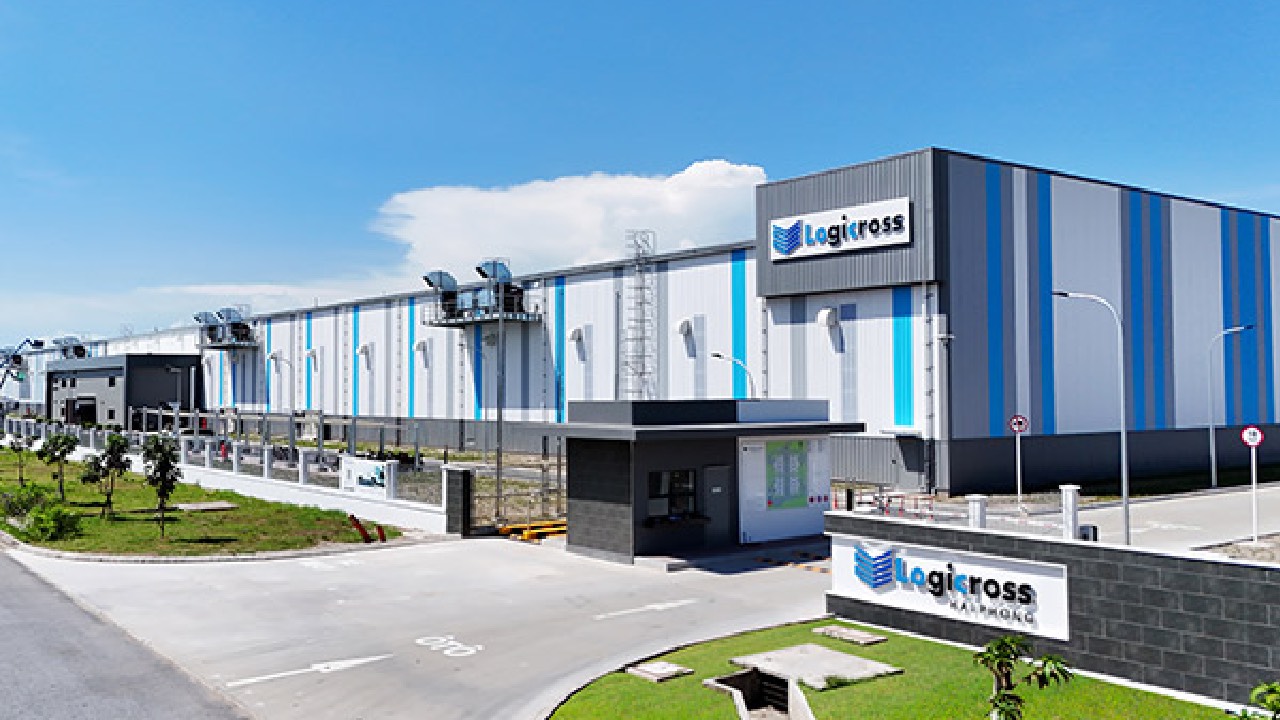
Scale and Function: 151,000 m² Designed for Regional Supply Chain Leadership
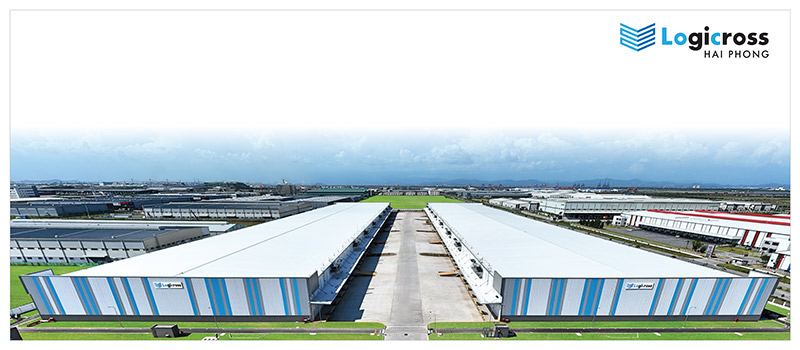
The physical dimensions of Logicross Hai Phong are purpose-built for regional leadership. The facility occupies a site area of approximately 151,000 m², with a total floor area of approximately 88,300 m² across two single-story ambient temperature warehouses divided into 10 sections. At 151,000 m², this ranks as a large-format industrial property in the Vietnamese context, offering significant land reserves for future phase expansions while supporting a versatile “high-specification warehouse plus flexible zoning” design philosophy. The single-story structure ensures high clear heights and column-free spans suited to a wide range of cargo types — from automotive components to consumer electronics to textiles.
The 10-section warehouse layout enables fine-grained operational segmentation by customer industry, order velocity, or handling requirements — minimizing cross-contamination and workflow interference between tenants. The facility also incorporates typhoon-resistant structural design, a critical feature given Northern Vietnam’s exposure to annual tropical cyclones, as well as motion-sensor LED lighting and state-of-the-art water-saving and fire-suppression systems. These systems reduce both energy consumption and long-term maintenance costs, contributing to a more favorable total cost of ownership for operators and tenants alike.
From a network density and scale effects perspective, this facility’s 88,300 m² of floor area is sufficient to support a full Regional Distribution Center (RDC) function serving Hanoi, Hai Phong, and Quang Ninh provinces — a coverage radius approaching 200 km. This means MOL is not merely adding a warehouse; it is establishing a physical node capable of orchestrating inventory positioning, order fulfillment, and outbound logistics for Northern Vietnam’s entire manufacturing ecosystem. The scale advantage compounds over time: a dominant, well-certified node attracts premium customers first, generating the data volume and operational learnings needed to continuously improve service quality and deepen competitive barriers.
EDGE Advanced Certification: Green Warehousing as Competitive Moat in Southeast Asia
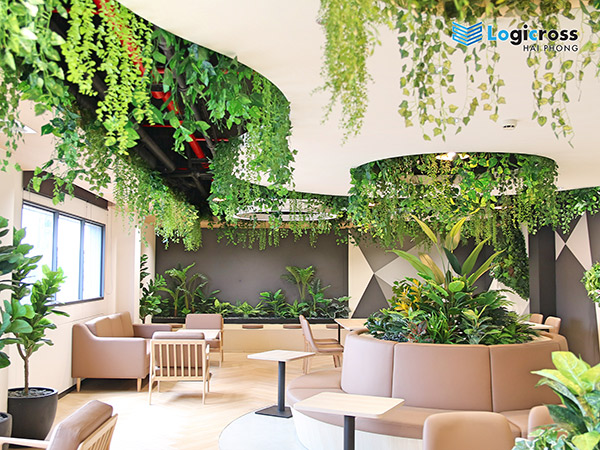
The EDGE Advanced certification earned by Logicross Hai Phong distinguishes it from the vast majority of existing logistics facilities in Vietnam. Established by the International Finance Corporation (IFC) — part of the World Bank Group — EDGE (Excellence in Design for Greater Efficiencies) certification requires quantified reductions in a building’s energy consumption, water use, and embodied carbon across its full lifecycle. As the source notes, this facility is “one of the few cutting-edge logistics facilities in Vietnam designed to prioritize both environmental sustainability and employee wellbeing” — a designation carrying significant competitive weight in today’s ESG-sensitive procurement environment.
In the Southeast Asian context, green certification has shifted from an aspirational label to a hard commercial requirement along multiple dimensions. Exporters shipping to the European Union face growing pressure to account for upstream logistics emissions as part of product carbon footprints under carbon adjustment mechanisms. A facility with EDGE Advanced certification provides tenants with verifiable, IFC-endorsed low-carbon credentials — directly reducing their regulatory compliance costs. Meanwhile, Vietnam’s own evolving industrial property policies favor certified green buildings through differential fee structures, meaning MOL benefits financially in the near term as well as over the long run through enhanced asset valuation.
More broadly, EDGE Advanced certification signals a generational shift in Vietnam’s logistics infrastructure standards: the competitive question has moved from “do you have warehouse space?” to “how smart, green, and resilient is your facility?” For MOL, the certification is both an ESG commitment and a business development tool — green-certified facilities attract higher-quality tenants (multinational electronics brands, Tier-1 automotive suppliers, global 3PLs) who require ESG-compliant supply chain partners, enabling premium pricing and longer lease terms that support the stable-earnings objective at the heart of BLUE ACTION 2035.
Japan’s Systematic Push into Vietnam’s Logistics Infrastructure
The MOL-Mitsubishi Estate joint investment is a case study in Japan’s coordinated approach to Vietnam’s logistics sector. Mitsubishi Estate, Japan’s largest real estate developer, brings substantial experience in industrial property development across Asia, while MOL contributes global shipping networks, tenant relationships, and logistics operations expertise. By committing to a 50-50 ownership split, both parties signal a commitment to shared governance and long-term operational alignment — rather than a passive financial investment. As the source highlights, MOL joined specifically “to deepen collaboration with Mitsubishi Estate Group” as part of its portfolio transformation goals, suggesting this is not a one-time project but a platform for future joint developments in Southeast Asia.
The pattern emerging in Hai Phong is one of Japanese shipping and industrial capital converging on a single logistics corridor. When multiple Japanese operators build warehousing, terminal, and distribution networks around the same port ecosystem, the resulting collaboration potential amplifies individual investments significantly. MOL customers gain access to neighboring port terminal services; cold chain operators can leverage nearby ambient-temperature buffer capacity at Logicross; integrated logistics solutions become possible without coordination across multiple providers. This self-organizing “industrial logistics commons” model tends to be more adaptive and market-responsive than government-planned industrial parks.
Strategic Implications for Global Supply Chain Players
For multinational manufacturers and logistics operators, the Logicross Hai Phong investment signals that Vietnam’s Northern logistics corridor has crossed a threshold of infrastructure maturity. The availability of a 151,000 m² certified facility with deep-water port access, international airport proximity, and Chinese border connectivity removes a significant barrier that previously made Northern Vietnam a secondary consideration relative to Greater Ho Chi Minh City. Automotive, electronics, and apparel supply chains in particular benefit from the “Northern Vietnam manufacturing + Hai Phong consolidation + global delivery” model that Logicross enables, given the corridor’s combination of short lead times to China and efficient transoceanic access.
The investment also has implications for the competitive positioning of local and regional logistics providers. Japanese-standard warehousing raises the baseline for facility quality, WMS compatibility, and operational SOP in the Northern Vietnam market. For Vietnamese logistics operators, this creates an inflection point: adapt to a higher-standard ecosystem to participate in the upstream supply chains of multinational manufacturers, or focus on the “final kilometer” and market-specific niches where local knowledge and relationships remain the primary competitive advantage.
Ultimately, MOL’s USD 16 million investment in a 151,000 m² site operational from November 2025 represents more than a single facility announcement. It is a signal that the global logistics industry’s leading operators are transitioning from opportunistic Southeast Asia participation to systematic, asset-backed network construction. For supply chain planners, sourcing strategists, and logistics executives assessing their Southeast Asia footprint, the Logicross model — certified, scaled, multimodal, and partnership-anchored — offers both a benchmark and a reference point for what next-generation regional infrastructure looks like.
Source: cyprusshippingnews.com
This article was AI-assisted and reviewed by our editorial team.