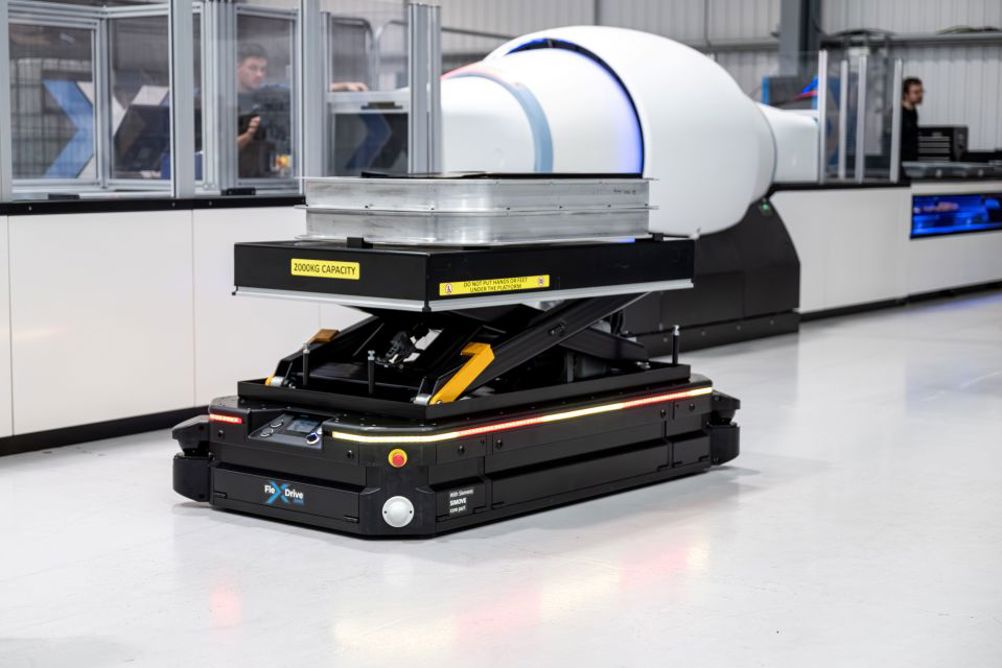
The Strategic Imperative of On-Demand Automation in Volatile Supply Chains
Global supply chains have undergone a fundamental recalibration since 2020—not merely as a reaction to pandemic-induced disruptions, but as a structural response to geopolitical fragmentation, climate-driven logistics volatility, and accelerating customer demand for mass customization. Traditional lean manufacturing paradigms, optimized for scale and predictability, now face existential pressure when confronted with cascading delays, regionalized sourcing mandates, and the need for sub-lot production runs. In this context, factory-level agility is no longer a competitive differentiator—it is the baseline condition for operational survival. Siemens’ decision to establish the UK’s first fully customizable autonomous mobile robot (AMR) factory is therefore not an incremental automation upgrade, but a deliberate infrastructure investment aligned with the growing $3.2 billion global AMR market, projected to expand at a CAGR of 18.4% through 2030 (MarketsandMarkets, 2023). Crucially, this facility does not produce standardized units for bulk deployment; instead, it enables rapid configuration of hardware, software, and fleet orchestration logic tailored to specific production footprints—whether a Tier-1 automotive supplier in Sunderland adapting to EV battery module assembly or a pharmaceutical contract manufacturer in Grimsby requiring sterile-zone compliant transport protocols. This shift from ‘one-size-fits-all’ automation to ‘just-in-time configurability’ directly addresses the average 37% increase in production line reconfiguration time reported by manufacturers who rely on legacy AGVs (Deloitte Manufacturing Outlook, 2022).
The deeper strategic implication lies in how Siemens anchors its AMR strategy within the broader digital twin and industrial edge ecosystem. Unlike standalone robotic deployments that generate isolated data silos, the UK factory integrates seamlessly with Siemens’ Xcelerator portfolio—enabling real-time simulation of layout changes, predictive fleet capacity modeling, and closed-loop feedback between physical robot behavior and digital twin validation. This integration transforms AMRs from mere material handlers into dynamic nodes in a responsive supply chain nervous system. When a supplier delay forces a temporary line relocation, the digital twin can simulate new traffic flows, optimize charging schedules, and reassign task priorities across the fleet—all before any physical change occurs. Such capabilities are increasingly critical in industries where supply chain lead times now fluctuate by up to 214% year-on-year (McKinsey Global Supply Chain Survey, Q1 2024), making static infrastructure planning obsolete.
Moreover, the UK location is itself a calculated geopolitical signal. With Brexit reshaping trade corridors and the UK government’s Industrial Strategy prioritizing sovereign capability in advanced manufacturing technologies, Siemens’ investment reinforces domestic engineering sovereignty while serving as a European gateway for scalable, export-ready AMR solutions. The partnership with Expert Technologies Group—a specialist in bespoke robotics integration—and RMGroup, a leader in intralogistics systems engineering, ensures that technical customization is matched by domain-specific process knowledge. This tripartite model mitigates the chronic industry failure mode where automation vendors deliver technically sound robots that misalign with actual workflow rhythms, resulting in underutilization or manual override. By co-designing with end-users from inception, Siemens embeds adaptability into the architecture—not as an afterthought, but as the foundational design principle.
From AGV Rigidity to AMR Intelligence: The Technological Inflection Point
The distinction between automated guided vehicles (AGVs) and autonomous mobile robots (AMRs) is often oversimplified as ‘wired vs. wireless’ or ‘fixed path vs. free navigation’. In reality, the divergence represents a paradigm shift in how factories conceptualize movement as a programmable, cognitive function rather than a mechanical constraint. Legacy AGVs depend on embedded infrastructure—magnetic tape, painted lines, or inductive wires—that locks them into static operational geometries. Any change in workflow, such as adding a new workstation or relocating a kitting cell, triggers costly retrofitting cycles averaging £120,000–£250,000 per line modification and 6–12 weeks of downtime (Logistics UK, 2023 Benchmark Report). AMRs, by contrast, treat the factory floor as an unstructured, sensor-perceived environment. Powered by onboard LiDAR, stereo vision, inertial measurement units, and real-time SLAM (Simultaneous Localization and Mapping), they construct and continuously update spatial models without pre-installed guidance systems. Siemens’ SIMOVE platform exemplifies this evolution—not as a replacement for AGV logic, but as a modular abstraction layer that unifies perception, decision-making, and actuation across heterogeneous robot platforms. Its ANS+ navigation module, for instance, doesn’t just avoid obstacles; it interprets dynamic intent—distinguishing between a stationary pallet trolley and a moving forklift operator—and adjusts velocity, trajectory, and communication protocols accordingly.
This intelligence extends beyond reactive avoidance into anticipatory coordination. SIMOVE’s Master Control system operates as a distributed PLC-based fleet manager that ingests real-time production scheduling data from MES (Manufacturing Execution Systems), ERP work orders, and even machine health telemetry. When a CNC cell reports a tool wear alert predicting a 90-minute maintenance window, the AMR fleet automatically reschedules inbound raw material deliveries, reroutes WIP to buffer stations, and prepositions replacement tooling carriers—all without human intervention. Such closed-loop responsiveness is impossible for AGVs constrained by hard-coded paths and batch-mode dispatch logic. Critically, the computational load is distributed: carrier-level control handles micro-maneuvers (e.g., docking precision within ±3mm), while fleet-level orchestration manages macro-allocation (e.g., assigning 12 robots across three parallel assembly lines based on real-time throughput variance). This architectural modularity allows scalability—from a 5-robot pilot in a SME’s warehouse to a 200-robot deployment across a multinational’s multi-site network—without architectural overhaul.
The implications for workforce dynamics are equally profound. Rather than displacing labor, intelligent AMRs reconfigure human roles toward higher-value supervision, exception handling, and continuous improvement. Field studies across Siemens’ own electronics plants show that operators spend 42% less time on material search and transport coordination after AMR integration, redirecting focus toward quality gate verification and cross-functional problem-solving (Siemens Internal Operational Metrics, 2023). Furthermore, because AMRs operate safely alongside humans—certified to ISO/TS 15066 collaborative standards—their deployment accelerates adoption in mixed-traffic environments where safety concerns previously stalled automation. This human-robot symbiosis is not incidental; it is engineered into SIMOVE’s safety architecture, which includes redundant sensor fusion, emergency stop arbitration, and behavioral transparency (e.g., visual status lighting indicating ‘navigating’, ‘charging’, ‘awaiting instruction’). In essence, AMRs do not eliminate uncertainty—they make it visible, quantifiable, and actionable.
Customization as Infrastructure: Decoding the ‘Fully Configurable’ AMR Factory
‘Fully customizable’ is more than marketing rhetoric in Siemens’ UK AMR factory—it denotes a vertically integrated capability spanning mechanical design, electronic architecture, firmware stack, and fleet orchestration logic. Unlike traditional OEMs that offer limited variants (e.g., ‘light-duty’, ‘heavy-load’, ‘stainless-steel’) with fixed software features, this facility treats each robot as a composite system assembled from interchangeable modules: chassis geometry (low-profile, high-clearance, multi-tier), payload interfaces (roller conveyors, vacuum grippers, robotic arms), power systems (swappable lithium-ion packs, opportunity charging plates), and perception suites (LiDAR density, thermal imaging for hazardous zones, ultrasonic redundancy). Crucially, customization extends beyond hardware: SIMOVE’s Carrier Control software permits granular configuration of motion profiles (acceleration curves for fragile optics handling), communication protocols (OPC UA, MQTT, proprietary MES adapters), and even localization fidelity (sub-centimeter for metrology labs vs. ±10cm for bulk warehousing). This level of configurability transforms the AMR from a purchased asset into a deployable service—where a medical device manufacturer in Galway might lease a fleet configured for ISO Class 7 cleanroom compliance, while a wind turbine gearbox assembler in Hull procures units with ATEX-certified explosion-proof enclosures and torque-sensing load monitoring.
The economic model enabled by this factory reflects a deeper industry transition from CapEx-heavy automation to OpEx-optimized responsiveness. Manufacturers no longer need to forecast five-year material flow volumes to justify a £2M AGV installation; instead, they can initiate with a minimum viable fleet (e.g., four robots supporting one assembly cell), then scale capacity, add functionality (e.g., integrating RFID readers for traceability), or reconfigure payloads as product mix evolves—all within days, not months. This agility directly counters the average 28-month ROI horizon for traditional AGV projects, where 63% of value leakage stems from over-engineering for peak demand scenarios (Boston Consulting Group, 2022 Automation Economics Study). Moreover, the factory’s digital thread connects design intent to field performance: every configuration deployed feeds anonymized telemetry back to Siemens’ engineering team, enabling predictive refinement of component durability, navigation algorithm tuning for specific floor textures (e.g., epoxy-coated concrete vs. polished steel), and even regulatory documentation generation for region-specific certifications (e.g., CE, UKCA, UL). Such feedback loops turn operational experience into embedded intellectual property—making the factory itself a learning system.
This configurability also redefines vendor relationships. Instead of transactional procurement, customers engage in co-development sprints—jointly defining success metrics like ‘time-to-reconfigure after line change’ or ‘percentage reduction in manual material handoffs’. Siemens’ partnerships with Expert Technologies Group and RMGroup institutionalize this approach: Expert brings deep application know-how in sectors like aerospace composites handling (where static charge management and non-marring contact surfaces are critical), while RMGroup contributes decades of intralogistics systems integration expertise, ensuring seamless interoperability with existing AS/RS, conveyor networks, and packaging lines. The result is not a catalog of robots, but a configurable automation ontology—where each parameter (speed, payload, safety zone radius, communication latency) maps to measurable business outcomes (OEE improvement, labor cost per unit, first-pass yield). In practice, this means a food processor in Scunthorpe can specify an AMR variant that maintains strict temperature gradients during chilled goods transport while synchronizing with blast freezer door cycles—capabilities impossible to retrofit onto off-the-shelf units.
Supply Chain Resilience Through Distributed, Adaptive Logistics
Resilience in modern supply chains is increasingly defined not by inventory buffers or redundant suppliers, but by adaptive execution velocity—the speed and precision with which physical operations respond to upstream and downstream perturbations. Siemens’ UK AMR factory directly targets this dimension by embedding adaptability into the lowest layer of factory logistics: the movement of physical matter. Consider a scenario where a semiconductor shortage forces a smartphone OEM to shift production from flagship models to mid-tier devices, requiring rapid retooling of assembly lines and corresponding changes in component delivery cadence. A traditional AGV system would struggle: its fixed routes cannot accommodate new feeder stations; its batch-oriented dispatch logic cannot handle increased frequency of smaller-batch deliveries; and its lack of real-time visibility prevents dynamic load balancing across congested zones. An AMR fleet orchestrated via SIMOVE, however, receives updated work instructions from the MES, recalculates optimal routes using live traffic heatmaps, dynamically allocates robots based on proximity and battery state, and adjusts payload sequencing to match revised takt times—all within seconds. This responsiveness compresses the ‘resilience lag’—the time between disruption detection and operational stabilization—from hours or days to minutes.
This capability scales across multi-tier supply networks. For example, a Tier-2 automotive supplier producing brake calipers may receive urgent ‘rush order’ notifications from its Tier-1 customer due to a final-assembly line stoppage. With AMRs configured for just-in-sequence delivery, the supplier can immediately re-prioritize finished goods transport, divert robots from standard warehousing tasks to direct line-side replenishment, and even trigger automatic quality documentation uploads via integrated barcode scanners—all coordinated through the same SIMOVE Master Control interface that governs internal logistics. Such integration eliminates the manual handoffs and information silos that historically amplified disruption propagation: research by MIT’s Center for Transportation & Logistics shows that 41% of supply chain delays originate not from external shocks, but from internal execution misalignment across planning, scheduling, and material movement functions (2023 Resilience Index Report). By collapsing these layers into a unified, responsive automation layer, Siemens’ AMR ecosystem transforms resilience from a passive buffer strategy into an active, executable capability.
Furthermore, distributed AMR intelligence enhances systemic robustness. Unlike centralized control architectures vulnerable to single-point failures, SIMOVE employs a hybrid topology: local carrier autonomy ensures continued operation during network latency or partial PLC failure, while fleet-level coordination resumes seamlessly upon recovery. This fault tolerance is mission-critical in industries like nuclear decommissioning or offshore energy, where uninterrupted logistics support is non-negotiable. Real-world validation comes from Siemens’ pilot at Sellafield Ltd, where AMRs configured for radiological containment zones maintained >99.98% uptime across 18 months of continuous operation—outperforming human-led transport in both consistency and exposure minimization. Such reliability, combined with rapid reconfiguration, makes AMRs a cornerstone of ‘distributed resilience’: where localized intelligence across multiple nodes collectively absorbs shock better than any monolithic, optimized system ever could.
Workforce Transformation: Upskilling in the Age of Cognitive Automation
The narrative surrounding industrial automation has long oscillated between utopian productivity gains and dystopian job displacement. Siemens’ UK AMR factory reframes this binary by treating human capability not as a variable to be minimized, but as a system to be augmented and elevated. The deployment of intelligent AMRs does not reduce headcount; it redistributes cognitive labor. Operators transition from physically guiding carts or manually updating paper-based kitting sheets to supervising fleets via intuitive dashboards, interpreting anomaly alerts (e.g., ‘Robot #B7 exhibiting repeated path deviation near Zone C4—suggesting floor contamination or sensor drift’), and conducting root-cause analysis on fleet performance metrics. This shift demands new competencies: digital literacy to navigate OPC UA data streams, basic statistical fluency to assess OEE trends, and cross-functional systems thinking to correlate AMR dwell times with machine changeover durations. Siemens’ training programs—co-developed with UK universities and sector skills councils—focus precisely on these intersections, offering certified pathways in ‘Automation Orchestration’ and ‘Digital Twin Operations’ that blend theoretical frameworks with hands-on SIMOVE configuration labs.
This upskilling imperative is validated by empirical outcomes. At a Siemens Electronics plant in Congleton, post-AMR implementation saw a 39% increase in cross-training participation, with 72% of production staff obtaining Level 3 Digital Manufacturing qualifications within 18 months (UK Commission for Employment and Skills Audit, 2023). Crucially, these qualifications are portable across employers and sectors—transforming factory roles from task-specific positions into transferable digital skill assets. Moreover, the transparency built into SIMOVE’s interface fosters trust: operators see exactly why a robot chose a particular route, how battery optimization affects delivery timing, and what safety protocols triggered a pause. This demystification counters automation skepticism, turning frontline staff into informed advocates rather than reluctant adopters. Field interviews reveal that operators report higher job satisfaction when engaged in diagnostic and optimization tasks—activities perceived as intellectually stimulating and professionally meaningful—compared to repetitive manual transport duties.
The broader socio-economic implications extend beyond individual plants. As AMR deployment scales across UK manufacturing, the demand for hybrid technicians—fluent in both electrical systems and data analytics—is reshaping vocational education pipelines. Colleges like Newcastle College now offer apprenticeships co-designed with Siemens, embedding SIMOVE certification into Level 4 Engineering qualifications. This institutional alignment ensures that workforce development keeps pace with technological deployment, preventing the ‘skills gap trap’ where automation stalls due to insufficient human capability. In effect, the UK AMR factory serves as both a technology hub and a talent incubator—recognizing that sustainable supply chain resilience requires equal investment in silicon and synapses.
Global Implications: Redefining Manufacturing Sovereignty and Export Readiness
Siemens’ UK AMR factory transcends national boundaries—it establishes a new benchmark for what constitutes ‘export-ready’ industrial technology in the 2020s. Unlike legacy automation exports that required extensive on-site commissioning, language-specific documentation, and culturally adapted user interfaces, SIMOVE’s modular architecture enables rapid localization: navigation algorithms trained on UK factory floors generalize effectively to German automotive plants or Japanese electronics facilities, while its open API framework allows seamless integration with region-specific MES platforms (e.g., Yokogawa’s Exaquantum in Japan or SAP S/4HANA in Germany). This portability positions the UK not as an isolated manufacturing node, but as a transnational R&D and configuration hub—where global clients co-develop solutions validated against diverse operational contexts before deployment. The factory’s emphasis on certification readiness (CE, UKCA, UL, ATEX) further accelerates international market entry, reducing compliance timelines by an estimated 65% compared to traditional automation vendors (International Federation of Robotics, 2024 Export Compliance Survey).
Strategically, this model challenges the prevailing assumption that advanced manufacturing sovereignty resides solely in chip fabrication or aircraft assembly. It demonstrates that leadership in intelligent logistics infrastructure—particularly in configurable, software-defined mobility—is equally vital for national economic security. As countries pursue nearshoring and friend-shoring initiatives, the ability to rapidly deploy adaptive automation becomes a decisive factor in attracting foreign direct investment. A manufacturer evaluating locations for a new EV battery gigafactory will prioritize regions where logistics agility is guaranteed—not just through tax incentives, but through proven, localized access to configurable AMR ecosystems. The UK’s early mover advantage here is reinforced by its strong academic base in robotics (e.g., Bristol’s Mobile Robotics Lab) and its dense cluster of Tier-1 engineering firms demanding just-in-time flexibility. Siemens’ investment thus catalyzes a virtuous cycle: domestic demand drives innovation, which enhances export competitiveness, which attracts further investment.
Finally, the factory embodies a new philosophy of global industrial collaboration—one that replaces rigid, hierarchical supply chains with adaptive, knowledge-rich networks. By partnering with Expert Technologies Group and RMGroup, Siemens embeds diverse engineering perspectives into its core development process, ensuring solutions reflect real-world constraints across sectors and geographies. This collaborative DNA makes the resulting AMR systems inherently more robust, more widely applicable, and more ethically grounded—because their design incorporates pluralistic views on safety, sustainability, and human-centered operation. In an era where supply chains are scrutinized for environmental impact and labor practices, such embedded responsibility is not optional; it is the foundation of enduring global relevance.
Source: The Engineer