The End of ‘One Vietnam’ Manufacturing: Why Regional Strategy Now Matters More Than Country Strategy
For the better part of a decade, Vietnam has been the poster child of the global “China+1” supply chain diversification strategy. Samsung’s massive smartphone factories in Bac Ninh, Nike’s sprawling footwear operations in the south, and a steady stream of electronics manufacturers relocating from southern China have propelled Vietnam’s manufacturing exports beyond $400 billion in 2025. Yet beneath these impressive national aggregates, a fundamental transformation is underway that demands a radically different approach to investment planning. Vietnam is no longer a single industrial market — it has evolved into three competing, converging, and increasingly distinct regional manufacturing ecosystems, each with its own cost structures, workforce characteristics, infrastructure trajectories, and policy environments.
This regional divergence carries profound implications for supply chain strategists. According to a comprehensive analysis by Vietnam Briefing, the biggest investment risk in Vietnam today is not regulatory uncertainty or geopolitical exposure — it is the oversimplification of a rapidly diversifying market. Companies that continue to treat Vietnam as a monolithic manufacturing destination risk misallocating capital, misjudging labor markets, and building supply chains optimized for conditions that may not exist in their chosen location. The investment question has shifted from “Should we manufacture in Vietnam?” to “Where in Vietnam should we manufacture, and how should we orchestrate operations across multiple regions?”
Northern Vietnam: The China-Adjacent Electronics Powerhouse Facing Capacity Constraints
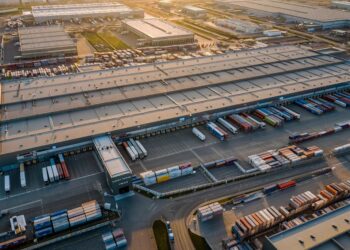
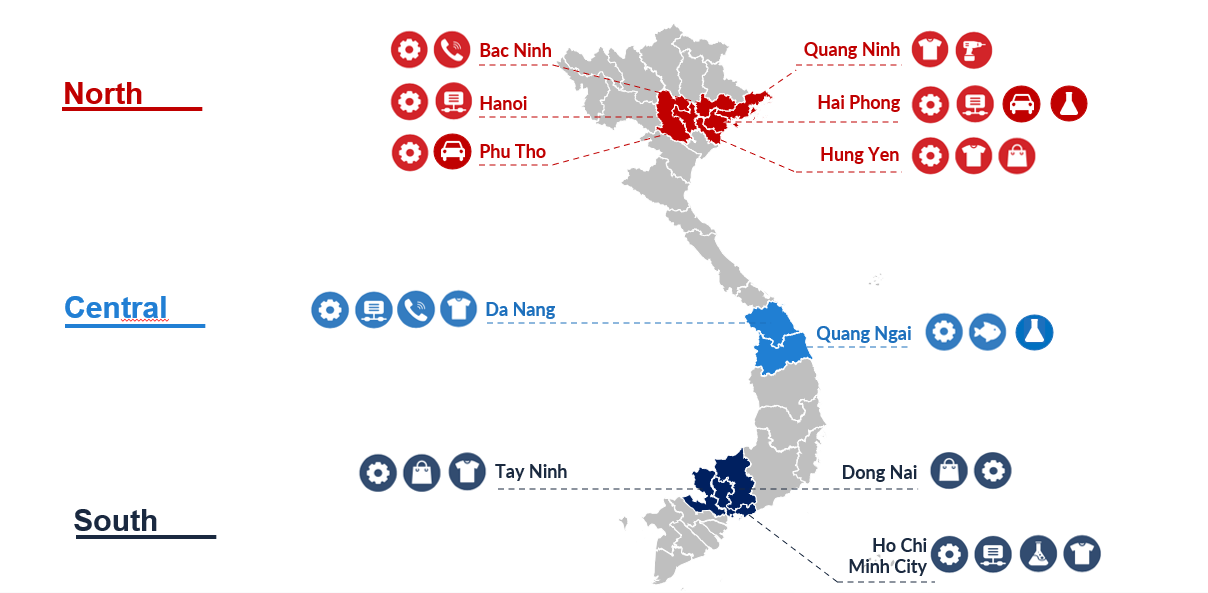
The northern industrial belt anchored by Hai Phong, Bac Ninh, Hung Yen, and Quang Ninh has firmly established itself as the primary destination for time-sensitive, component-intensive manufacturing operations that require tight integration with Chinese supply chains. The geographic advantage is compelling: sea freight from Hai Phong to Shenzhen takes just 2-3 days, while cross-border land logistics can complete component transfers within 24 hours. This proximity has made northern Vietnam the preferred “China+1” location for electronics, precision components, and semiconductor packaging and testing operations.
Samsung’s two factories in Bac Ninh Province now account for approximately 30% of global Samsung smartphone production, while Foxconn, Luxshare Precision, and other Taiwanese and Chinese contract manufacturers have expanded aggressively across the region. Industrial parks such as DEEP C, Yen Phong, and VSIP Hai Phong have developed complete electronics manufacturing clusters with increasingly sophisticated supplier ecosystems. However, success has bred its own challenges. Average industrial park rents in the north have risen more than 40% since 2020, with occupancy rates at prime locations exceeding 95%. Competition for skilled technical workers has intensified, and the concentration on electronics manufacturing creates single-sector dependency risks.
The planned Hanoi–Hai Phong–Quang Ninh economic corridor represents Vietnam’s response to these capacity constraints. The government’s provincial merger proposals aim to break down administrative barriers and enable coordinated infrastructure development, labor market planning, and industrial policy across the corridor. For investors, this signals a shift from evaluating individual provinces to assessing the entire corridor ecosystem — a significantly more complex but potentially more rewarding analytical framework that considers how infrastructure investments, workforce mobility, and policy coordination will evolve over the next five to ten years.
Central Vietnam: The Overlooked Frontier Offering First-Mover Advantages
Central Vietnam has long been the forgotten middle child of the country’s industrial landscape, overshadowed by the electronics clusters of the north and the diversified manufacturing base of the south. But this is changing rapidly. Cities like Da Nang and Quang Ngai are actively courting manufacturing investment, leveraging cost advantages that are increasingly difficult to find elsewhere in the country. Industrial land rents in the central region run at just 40-60% of southern levels, while labor costs are approximately 20-25% lower than in the north. The Da Nang Hi-tech Park and VSIP Quang Ngai are emerging as the region’s anchor industrial developments.
The central region’s value proposition centers on what might be called a “first-mover premium” — the opportunity for companies with long-term investment horizons to establish operations in an environment where costs are low, land is plentiful, and competition for resources is minimal. This is particularly attractive for manufacturers in sectors such as furniture, building materials, and agricultural processing, where large land footprints are required and logistics time sensitivity is moderate. Companies willing to invest in building supplier relationships and workforce development can secure significant cost advantages that will only grow as northern and southern locations become more expensive.
The challenges are equally clear. Supplier networks remain underdeveloped compared to the north and south, the number of international-standard industrial parks is limited, and international logistics connectivity still depends primarily on the major ports in the north (Hai Phong) and south (Cat Lai, Cai Mep). The Vietnamese government is addressing these gaps through port upgrades in Da Nang, central highway network improvements, and planned rail connections linking central industrial zones to northern and southern logistics hubs. These infrastructure investments are expected to materially improve central Vietnam’s industrial attractiveness within 3-5 years, potentially rewarding early movers with substantial appreciation in their strategic positioning.
Southern Vietnam: Long Thanh Airport Reshapes the Logistics Gravity Map
Southern Vietnam, centered on Ho Chi Minh City and extending through Dong Nai, Binh Duong, Tay Ninh, and Ba Ria-Vung Tau, remains the country’s largest FDI destination by volume. The region boasts Vietnam’s most mature industrial ecosystem, its most diversified supplier network, and its most extensive international market connections. Yet the south is simultaneously grappling with a triple squeeze of rising costs, worsening congestion, and tightening environmental regulations. Industrial land prices in the HCMC metropolitan area have surged 50-70% over the past five years, while Tan Son Nhat International Airport has long exceeded its design capacity, severely constraining air cargo logistics.
Long Thanh International Airport (LTIA), designed for an eventual annual capacity of 100 million passengers, is emerging as the transformative infrastructure project that will reshape southern Vietnam’s industrial geography. More than just relieving Tan Son Nhat’s congestion, LTIA is fundamentally altering the logistics gravity of the entire southern region. Dong Nai Province is leveraging the airport project to reposition itself as a high-tech and smart logistics hub, with provincial authorities explicitly prioritizing high-value, environmentally sustainable investments while actively discouraging labor-intensive, low-technology projects. A proposed Free Trade Zone around LTIA could offer tariff benefits and streamlined customs procedures for qualifying enterprises.
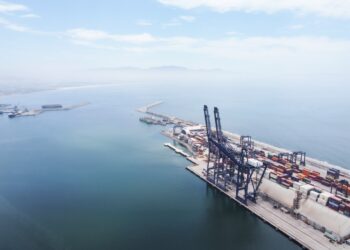
The HCMC–Binh Duong–Ba Ria-Vung Tau corridor planning represents the south’s evolution from a radial development model centered on Ho Chi Minh City to a multi-node networked approach. The expansion of the Cai Mep-Thi Vai deep-water port complex provides robust maritime hub capabilities, while highway and light rail networks connecting the corridor’s provinces are progressively eliminating inter-provincial logistics bottlenecks. The success of this corridor model will determine whether southern Vietnam can successfully navigate its cost-competitiveness transition toward higher-value manufacturing activities.
The Supply Chain Visibility Gap: A Structural Challenge Across All Regions
Cutting across Vietnam’s regional dynamics is a structural challenge that affects multinational operations throughout the country: the severe deficit in supply chain visibility. Current data indicates that fewer than 15% of multinational corporations have achieved real-time visibility beyond their Tier 1 suppliers. This means the vast majority of companies operating in Vietnam are essentially blind to the deeper tiers of their supply networks — unable to effectively identify and respond to potential supply disruptions, quality issues, or compliance risks lurking in their extended supply chains.
This visibility gap is spawning a growing ecosystem of digital supply chain solutions. In Ho Chi Minh City and Hanoi, a new generation of B2B SaaS platforms is emerging, focused on providing small and medium-sized Vietnamese suppliers with the digital tools needed to meet multinational buyers’ compliance standards and data-sharing requirements. Aggregator platforms are also gaining traction, consolidating fragmented small manufacturers into coordinated supplier networks capable of meeting international buyers’ volume and quality requirements. The proliferation of these digital tools will be critical to Vietnam’s evolution from a “low-cost manufacturing” destination to a “transparent, trustworthy manufacturing” partner.
For multinationals operating across Vietnam’s multiple industrial regions, investing in supply chain visibility technology has moved from a “nice to have” to an operational necessity. With ESG regulations tightening globally — particularly the EU’s Corporate Sustainability Due Diligence Directive and similar frameworks — the ability to achieve deep supply chain visibility will increasingly determine market access, compliance status, and brand reputation in Western markets. Companies that build visibility infrastructure early will gain a significant competitive advantage as these requirements intensify.
A New Investment Playbook: From Province Selection to Ecosystem Design
Vietnam’s accelerating regional divergence demands a fundamentally new approach to manufacturing investment. The traditional framework of comparing the north versus the south on cost versus scale dimensions is no longer adequate. Investment decisions must now incorporate multiple additional dimensions: industrial cluster maturity, forward-looking infrastructure positioning, policy environment stability, labor market sustainability, and upstream-downstream supply chain integration efficiency. Each of Vietnam’s three regions offers distinct advantages that can be combined into a diversified manufacturing portfolio rather than treated as mutually exclusive alternatives.
A critical nuance for investors is that Vietnam’s infrastructure development frequently outpaces its regulatory and legal framework evolution. Major projects like Long Thanh Airport, Free Trade Zone proposals, and provincial merger plans all signal future advantages, but there are meaningful time gaps between policy intent, pilot implementation, and operational reality. Sophisticated investors must distinguish between these three stages and calibrate their capital commitments accordingly, avoiding premature overcommitment based on policy promises that may take years to materialize. Meanwhile, regional FDI competition within ASEAN is intensifying — Thailand attracted a record $22.1 billion in FDI in 2025 and is on track to reach $25 billion in 2026.
For supply chain decision-makers, Vietnam in 2026 requires a new investment methodology — not selecting a single “best” province, but designing a cross-regional industrial portfolio that leverages each region’s comparative advantages while using digital tools to achieve cross-regional supply chain coordination and visibility. The companies that will benefit most from Vietnam’s next phase of manufacturing growth are those capable of navigating this complexity rather than simplifying it away. The era of “one Vietnam” manufacturing strategy is definitively over; the era of regional ecosystem design has begun.
Source: Vietnam Briefing