Skip to content

Strategy & Planning · Supply Chain · Warehousing & Transport

Explosive Pager Transmits Supply Chain Alerts

Attacks on Hezbollah Likely to Accelerate Trend of Shifting Production Back Home

Original source: Source information pending

Explosive Pager Transmits Supply Chain Alerts

Ask SCI.AI about this story

📋 本文要点

Attacks on Hezbollah Likely to Accelerate Trend of Shifting Production Back Home

This week in Lebanon, a deadly explosion occurred with the handheld pagers and walkie-talkies used by Hezbollah militants, showcasing advanced espionage skills but also exposing a significant vulnerability within the global supply chain.

The complexity of this supply chain is staggering. It may even exceed the regulatory capabilities of governments, businesses, and other relevant entities. Even the most sophisticated players often lack clarity on which critical components and raw materials they depend on or where the risks lie.

Supply chain disruptions during the pandemic clearly demonstrated that the longer the path involved in manufacturing any product, the higher the likelihood of issues arising, leading to increased risks of delays and cost overruns.

There is now an even more pertinent concern: the more complex the path, the greater the exposure to malicious activities.

Every stage in the manufacturing process and each additional company introduces opportunities for those with violent agendas to intervene and weaponize products.

“Companies must determine what level of security should be implemented within their supply chains,” said Hannah Kain, CEO of global supply chain firm ALOM, in an interview with DealBook. “We have just cranked up the dial on our paranoia scale.”

The article titled ‘Supply Chain Takes Center Stage After Lebanon Explosions’ was published on page 4 of Section B in the print edition of The New York Times on September 23, 2024.

—

Source website:

Ask SCI.AI Finished reading? Continue with SCI.AI. Explore the related policy, route, company and historical context. Continue asking
Stay ahead of supply chain shifts

One email a week: the stories that matter and new risk events — in English, free.

Prefer RSS? Articles Risk events

North American robot orders hit highest level since 2022 boom
Strategy & Planning

North American robot orders hit highest level since 2022 boom

North American robot orders climbed to their highest level since the 2022 boom and continued that trend into 2026, according to Association for Advancing Automation data reported by DC Velocity. Strong demand from semiconductor and electronics, pharmaceutical, and food and beverage industries offset declining automotive orders in the first half of 2026, with shipments up 21% and 24% year over year. Rocrich AGV, a joint venture of Logisnext Americas and Jungheinrich, supplies automated guided vehicles for warehouse automation. Shifting trade policies and a warehouse labor shortage intensified by tightened immigration policies are pushing more companies toward automation, while falling costs are making the technology accessible to small and medium-sized players.

Xeneta: Asia-US West Coast spot rates jump 343% on Iran war
Warehousing & Transport

Xeneta: Asia-US West Coast spot rates jump 343% on Iran war

Asia-U.S. West Coast container spot rates were 343% above their February 28 level in October, just 14% below the pandemic-era record, according to freight-rate intelligence provider Xeneta. The company forecasts a 5% decline in long-term contract rates for 2027, with the global container fleet expected to grow 6.8% while demand rises between 2.5% and 4%. Xeneta chief analyst Peter Sand traces the volatility to the Red Sea conflict in 2024, U.S. tariffs in 2025 and the Strait of Hormuz closure in 2026, and warns that fuel costs and route disruptions could still upend the outlook.

AI hardware demand lifts air cargo rates 30% year over year
Warehousing & Transport

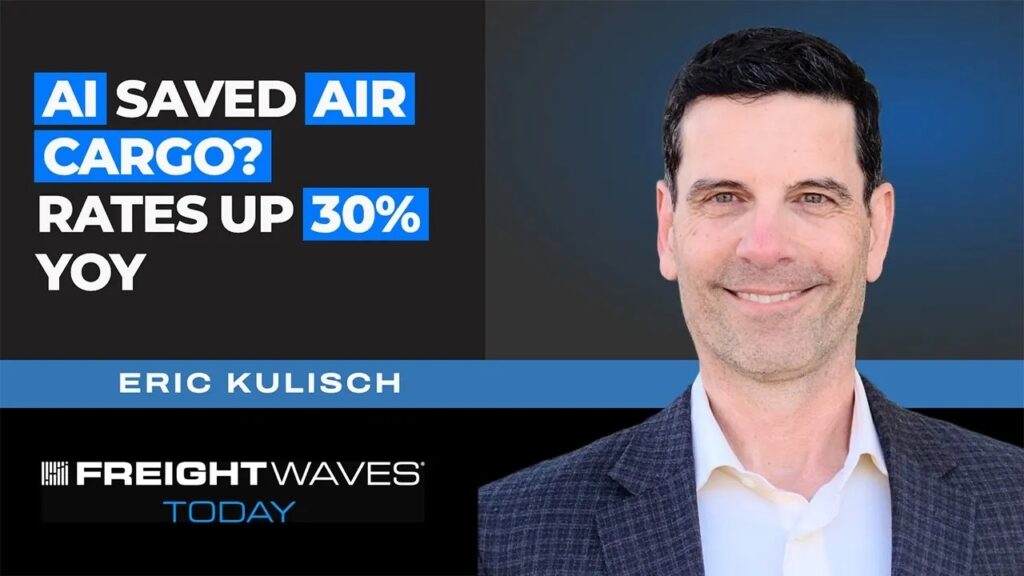
AI hardware demand lifts air cargo rates 30% year over year

Air cargo rates are up 30% year over year and volumes have grown about 6%, according to FreightWaves, as surging AI equipment demand offsets slower e-commerce and automotive flows. The strength has defied forecasts of a 2025 softening after a down 2024. Meanwhile, Walmart is deploying Wing and Zipline drones across nearly 300 stores; Zipline raised $1.5 billion and Wing plans a $125 million Texas factory ahead of anticipated FAA beyond-line-of-sight rules.

Welcome Back!

Login to your account below

Create New Account!

Fill the forms below to register

Retrieve your password

Please enter your username or email address to reset your password.

Scan to share via WeChat

Open WeChat and scan the QR code to share

QR Code

Add New Playlist