The Transformation of Freight Brokerage by Generative AI
Veteran brokers adapt to evolving technology and economic downturn challenges.
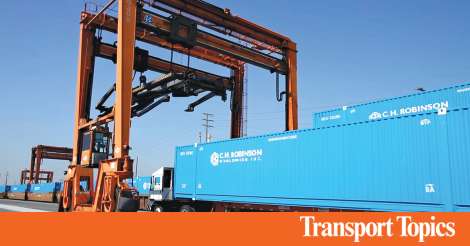
C.H. Robinson has automated “almost every step in transportation” with generative AI. (C.H. Robinson)
Although emerging “tech-first” companies have attracted significant attention in the digital freight brokerage space, market demand and technological innovation (particularly artificial intelligence and generative AI) are shaping efforts by both established and new players to develop robust digital tools, experts say.
Executives from Atlantic Logistics, C.H. Robinson, and Echo Global Logistics stated that technology has long been at the core of their operations, continuously developing and refining systems including proprietary software and third-party solutions. In Transport Topics’ list of the top 100 logistics companies in North America, C.H. Robinson ranks No. 2 and Echo Global Logistics is ranked No. 22.
“Echo and other companies—these established players—have been undergoing digital transformation for years,” Doug Waggoner, CEO of Echo Global Logistics, told Transport Topics. “We have optimized every step from quoting to invoicing and all processes in between.” J.B. Hunt ranks third on the list of the top 100 outsourced carriers in North America.
Waggoner and others noted that the pace and nature of digitalization are constantly evolving. “And we’ve always done it proprietary, but now there are third-party software companies building pools of tools for smaller brokers,” he said, adding that these companies are creating effective solutions. Waggoner also pointed out that similar technologies entering the market are driving further automation across the entire brokerage industry.

Waggoner
Brokers believe that their technological sophistication is often overlooked when digital innovators enter the industry. Echo Global Logistics founders come from a tech background, with most software engineers coming from Google, Amazon, and Microsoft, Waggoner noted.
“I just want to say we consider ourselves OGs (original leaders) in this field,” he joked.
Tech-First Approach
Megan Orth, senior director of digital connectivity at C.H. Robinson, explained that established players have been engaged in long-term and continuous projects aimed at digitizing and automating operations in freight brokerage.
“The freight industry is an evolving sector rather than a revolutionary or disruptive one,” she said via email. “Unlike other industries where digital startups could capture the market, in freight, they encountered highly technologized established players.”
Orth pointed out that Airbnb successfully captured the market by digitally connecting small business owners—such as those with B&Bs, small hotels, or rental properties. In the freight industry, companies like C.H. Robinson were already digitizing connections between large carrier and shipper networks long before pure-play tech freight brokers emerged. The notion that startups invented freight technology is a common misconception, Orth said. “They followed us into freight technology rather than the other way around.”
Orth added that any technology making smarter decisions relies on large data sets.

Orth
“Over time, the more data you add, the more tools learn and become smarter,” she said. “Our Navisphere platform captures 19 million transportation data points annually.”
Orth noted that C.H. Robinson has automated “almost every step in transportation” using generative AI.
“Generative AI is used to process large amounts of data and generate new content—such as translating languages or generating email responses,” she said, adding that even the most tech-savvy shippers still opt for a quick email to handle business, which means someone must read and reply to these emails. “Within one workday, we receive over 11,000 emails requesting truckload quotes. This is just one type of email.”
Orth explained that C.H. Robinson’s technology categorizes received emails, reads them, and replicates the steps humans take in handling customer requests. The technology is used daily to respond to more than 2,000 email quote requests—sometimes over 3,000—automating any transaction conducted via email.
Generative AI also helps C.H. Robinson “unlock the value of our 500,000 unstructured data points received daily,” Orth reported.

“Echo and other companies—these established players—have been undergoing digital transformation for years,” said Doug Waggoner, CEO of Echo Global Logistics. (Echo Global Logistics)
Unstructured data, such as text files, images, and videos, is described as “data that doesn’t fit neatly into rows and columns” and is more difficult to organize and analyze by both computers and humans.
Nathan Lease, a research vice president at Gartner, noted when reviewing events in freight brokerage that digital freight networks were digital brokers aiming to revolutionize the market a few years ago. He believes the size, fragmentation, and complexity of the trucking market make it “impossible to be completely transformed by technology alone.”
“They realized that technology alone couldn’t change the industry, and digital brokers needed to align with industry dynamics to remain relevant,” Lease said.
Addressing Challenges
Lease and others mentioned the current freight recession and its impact. “There is more capacity in the market,” he said, adding that spot markets have shrunk and become more competitive. Digital players must compete head-on with long-established industry companies who are adopting some of the industry’s longstanding practices.
“A good example is digital brokers leasing trailers and positioning them at origins for pre-loading,” Lease said. “The market demands trailer placement.”
Others also noted how market conditions accelerate or slow down digitization processes.
Ryan Schreiber, a former broker now chief growth officer of Metafora (an advisory firm focused on transportation technology), stated that startups bought their way into the market but they have also provided proof-of-concept for some strategies that traditional brokers are adopting.

Rob Hooper, CEO of Atlantic Logistics, said that freight management technology for shippers and customers “is the future of our industry. Uber’s acquisition of Transplace and its entry into this space was a smart move.”
Recently, Convoy, J.B. Hunt, and Uber Freight collaborated on a project to create a standardized freight dispatch system and promote its adoption. The project failed last year, but logistics company Flexport acquired Convoy technology and relaunched it as the Convoy platform this year to connect carriers with shippers and brokers.
Hooper said that this dynamic shows IT professionals are not necessarily good freight brokers.
“[Startups] have great technology trying to change the industry, but they come from an IT perspective, a tech perspective, and don’t understand how freight brokerage works,” he noted. “Part of it is due to their arrogance. They lack industry awareness and experience that could provide conditions for success.”
Despite this, Hooper stated that the entry of these technology companies and the threat they pose to traditional freight brokerage operations are accelerating change.
“We all have to embrace technology and leverage everything available,” he said to succeed. Atlantic Logistics is implementing Qued, a cloud-based AI-supported “intelligent workflow automation platform” designed to manage broker, 3PL, and carrier load appointment scheduling, Hooper noted as an example of ongoing digitization efforts, adding that Atlantic Logistics recently developed an LTL service.
“We know this is the future of our industry—it’s a one-stop shop,” he said. “Customers want to resolve all issues through one relationship rather than five: one for railroads, one for trucking, one for LTL, one for warehousing—they can outsource it and say, ‘Get it done.'”
Hooper concluded that the 3PL industry will adapt to digitization. “I think we’ll do well,” he said. “But we’ll see profit margins compressed as we become more efficient.”
Source: Transport Topics