With the strike of dockworkers at ports along the East Coast and Gulf Coast, economists are preparing for the potential impact this strike could have on the U.S. economy.
The strike, which began at 12:01 AM Tuesday, is a result of months-long deadlock between the union representing about 45,000 dockworkers and port operators. The action will virtually halt all activities in some of America’s busiest ports from Maine to Texas. The International Longshoremen’s Association (ILA) is pushing for wage increases beyond what the American Maritime Alliance, which represents port operators, has offered.
## Dockworkers Go on Strike
#### ILA President Says Workers Are “Making History” with Their First Strike in Nearly 50 Years
“I.L.A.! I.L.A.! You are making history because we are fighting for our families and rights. We deserve a part of all that money they have. We will do it. We will go out and sign a great contract. God bless us all.” “I.L.A.! Keep going! I.L.A.! Keep going!”
President Biden stated on Sunday that he does not intend to invoke the Taft-Hartley Act, passed nearly 80 years ago, to force dockworkers back to work.
According to Oxford Economics analysts, the strike could cost the economy between $4.5 billion and $7.5 billion per week, equivalent to about 0.1% of annual GDP. While these losses will be reversed after the strike ends, clearing the backlog each week may take a month.
Here is more information on how this strike might impact the economy.

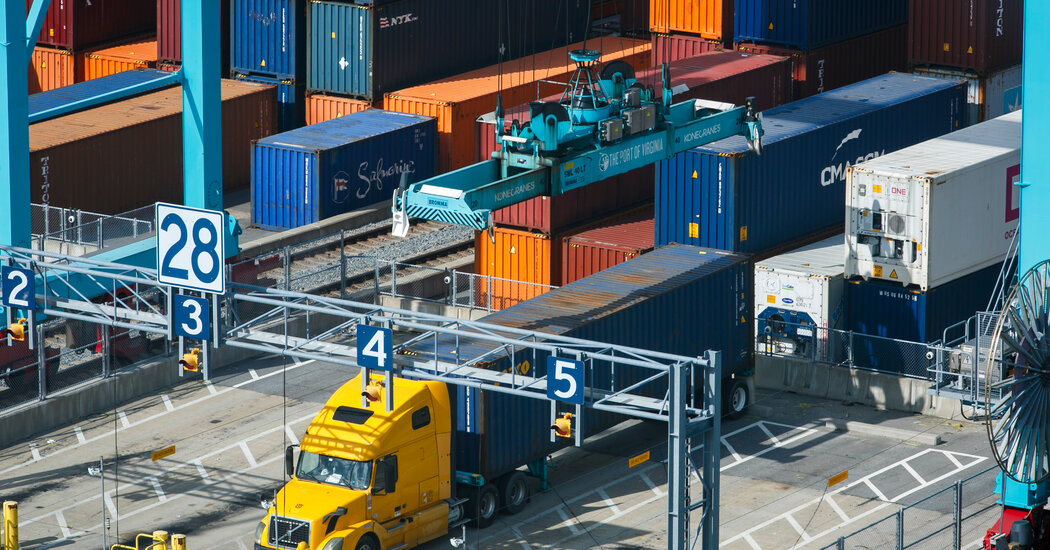
The strike could cost the economy between $4.5 billion and $7.5 billion per week. Image credit…Erin Schaff/The New York Times
## What Impact Could the Strike Have on the Economy?
Michael Pearce, Oxford Economics’ Deputy Chief U.S. Economist, says that transportation and warehousing will be hit first. In the early stages of the strike, tens of thousands of workers employed by companies serving ports may face temporary layoffs or reduced hours, affecting about twice as many people as those actually striking, around 100,000 in total.
Employees from trucking firms and food industries that rely on ports are one of the groups most geographically and economically tied to the striking workers. Mr. Pearce says this will lead to an immediate drop in income and related effects on output and local economies near the ports.
“There could be more localized economic impacts initially,” said Brian Puckorius, a supply chain practice partner at business consultancy West Monroe. “Within a week, it could have very significant implications for the entire supply chain.”
The longer the strike lasts, the greater the damage. While many industries are well-stocked and can absorb strikes lasting just days, Stifel investment bank says that multi-week stoppages could have “material impacts” on freight volumes, goods availability, and the broader economy.

Transportation and warehousing are expected to be hit first in the early stages of the strike. Image credit…Kristen Zeis for The New York Times
## Which Industries Will Be Affected Immediately?
Dozens of goods, including bananas and European alcoholic beverages, non-perishables like auto parts and furniture, and raw materials such as cotton and wood, are imported through East Coast and Gulf Coast ports and could be hit directly. Over 80% of containerized coffee imports and about 75% of banana imports pass through these ports, according to U.S. Census Bureau data.
Jason Miller, a supply chain management professor at Michigan State University, says that even the industries most dependent on these imports would not be significantly affected by strikes lasting two or three days. Ports often have to close temporarily due to extreme weather events like hurricanes without causing similar widespread damage.
But after one to two weeks of strike, “we will see impacts in the billions every day,” Mr. Miller said. Eventually, this could ripple through U.S. companies, including those not directly importing goods, such as the automotive industry.
A concern is time-sensitive products with short supply chains, like fresh produce and dairy, coffee, tea, and spices. These items are often imported most heavily through East Coast and Gulf ports. However, Mr. Miller notes that the vast majority of food consumed in America is domestically produced, so grocery store shelves will remain stocked. New York Governor Kathy Hochul said on Monday that overall food supplies would not be affected by the strike and urged residents not to hoard.

Many suppliers have taken steps to prepare for the strike, including pre-ordering goods or shifting freight to West Coast ports. Image credit…James Estrin/The New York Times
## How Prepared Are Businesses for This Disruption?
Companies have been taking measures for months, such as diverting freight to West Coast ports. In California, the Port of Long Beach saw its best month on record in August. Companies are also pre-importing goods, including holiday season items, much like they did during delays caused by the 2022 pandemic.
“We’ve prepared as much as we can for this,” Mr. Miller said.
However, West Coast ports cannot absorb all the freight that would normally pass through East Coast and Gulf ports. Transporting goods from West Coast ports to the East Coast by truck or rail could become a growing financial burden for businesses.
One bright spot is that pandemic-era supply chain bottlenecks are largely in the past. The New York Fed’s Global Supply Chain Pressure Index hovers around its long-term average. With supply chains normalizing, companies have rebuilt inventories, allowing many to withstand short-term disruptions, according to Mr. Pearce.

If the strike lasts longer than a few days, consumers may see some price increases. Image credit…Erin Schaff/The New York Times
## Will the Strike Become an Inflation Issue?
Economists say the strike is unlikely to spark inflationary pressures similar to those seen in 2021 and 2022. Given relatively robust supply chains and lower consumer demand (a key issue being that consumers had stimulus checks to spend in 2022), companies may absorb price increases in the short term.
If the strike lasts longer than a few days, consumers may see some price hikes. Large retailers like Walmart, one of the top U.S. importers exposed to the impact of the strike, might already be pricing in the costs of impending disruptions and rerouting, passing on some price increases to consumers, according to Mr. Puckorius at West Monroe.
But even a doubling of banana prices, many imported through a port in Delaware, would not significantly affect macroeconomic trends, said Mr. Miller. In the automotive sector, inventories have recovered, and demand is mainly supply-constrained, making significant inflationary shocks unlikely for car markets.
“I’m not particularly concerned from an inflation perspective,” Mr. Miller said.
If the strike extends into late October, it could start to impact inflation, according to Mr. Pearce. But core inflation remains relatively mild, he added, meaning “it just means a slightly smaller decline in goods prices than previously.”
Danielle Kaye is a business reporter and 2024 David Carr Fellow, aimed at nurturing early-career journalists. [More about Danielle Kaye](https://www.nytimes.com/by/danielle-kaye)
—
Source website: