Autonomous drones and self-driving delivery vehicles are teaming up to deliver your burritos.
On Tuesday, Wing, the drone delivery unit of Alphabet (Google’s parent company), and Serve Robotics, a sidewalk delivery robot manufacturer, announced a pilot partnership project in Dallas. Since April 2022, Wing has been delivering hot meals, beverages, household essentials, and other items locally.
Since August 2023, this drone delivery company has partnered with Walmart, the world’s largest retailer, to expand its services to approximately 1.8 million households in the Dallas-Fort Worth metro area of Texas.
The Federal Aviation Administration (FAA) has now authorized Wing and competitor Zipline to manage their own airspace in North Texas, allowing for beyond-visual-line-of-sight deliveries, which could potentially make the company’s delivery network one of the largest globally.
“We have been directly delivering food and other goods to consumers over the past five years, completing more than 400,000 commercial deliveries across three continents,” said Adam Woodworth, CEO of Wing. “We are capable of fast and efficient deliveries… Through this pilot partnership, Wing aims to reach more merchants in highly congested areas while supporting Serve’s expansion into new delivery territories.”
To support its expanding coverage area, which Walmart says will soon cover about 75% of the local population, Wing is enlisting Serve and its autonomous sidewalk robots.
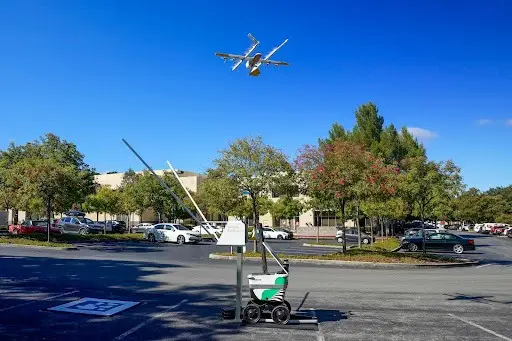
Over the next few months, some Wing deliveries will be picked up from restaurant curbs by Serve robots. This self-driving robot will travel several blocks to reach the Wing Autoloader, which can then load items from vehicles for drone pickup.
Typically, Wing relies on store employees to transport orders to the AutoLoader curb, but not all restaurants have space to install drone operation equipment.
Once a drone picks up an order, it can fly as far as 6 miles. According to both companies, the combined system will enable city-wide deliveries within 30 minutes.
“Serve and Wing share a vision for reliable and affordable robotic delivery at scale,” said Ali Kashani, CEO and co-founder of Serve. “Our end-to-end robot delivery solution is set to become the most efficient model for most delivery tasks.”
Wing believes that integrating Serve robots will make its deliveries faster while avoiding congestion by operating in both airspace and on sidewalks. Both vehicles are fully electric and, due to their automation, customers do not need to pay tips. Additionally, restaurants require no facility adjustments to accommodate Wing drones.
For example, at the Walmart Supercenter in Frisco, a Dallas suburb, Wing’s operations only require space equivalent to about two parking spots, which is minimal but aligns with the company’s aim for lean asset management.
Meanwhile, the company makes life easier for customers by integrating with DoorDash and Walmart apps, allowing them to place orders through familiar interfaces. Serve has already partnered with Uber Eats in Los Angeles, a market where Wing has yet to enter.
—
Source: FreightWaves