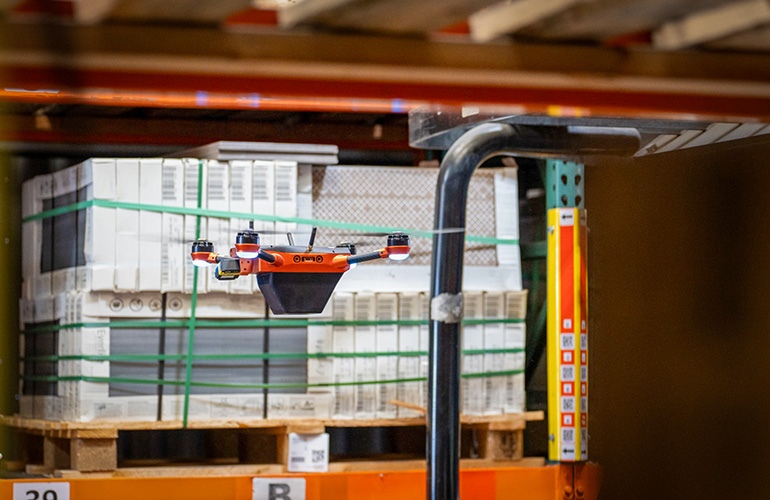
With obstacle detection, the lightweight Corvus One drone can fly safely without disrupting workflow or blocking aisles and can ascend to avoid collisions with personnel, forklifts, or robots. Source: Corvus Robotics
Corvus Robotics Inc. has completed an $18 million Series A and seed funding round led by S2G Ventures and Spero Ventures. Since its founding in 2017, the Mountain View, California-based company has been dedicated to developing and validating its inventory drone system.
To date, Corvus has maintained a relatively low profile in marketing and sales. With this financing, the company gains new financial backing and is hiring additional marketing, sales, and support staff to begin expanding its customer base.
Co-founder and CEO Jackie Wu told The Robot Report that “about one-quarter of Fortune 500 companies are on our client list”—good news for a company poised to take off.
## Corvus Drones Operate Without Infrastructure Modifications
Most warehouses have straight aisles packed from floor to ceiling with inventory. Learning how to autonomously fly up and down an aisle, you can repeat this operation throughout the entire warehouse.
However, due to the uniformity of warehouse aisles, autonomous vehicles like AMRs (Autonomous Mobile Robots) and aerial drones easily get lost because every aisle looks the same. When automatic systems lose their way, they must request operator assistance.
Most AMR and drone inventory providers simplify localization and disorientation issues by installing markers or AprilTags within warehouses to keep their machines oriented throughout the facility. All robots need to do is find the nearest tag to know where they are.
Corvus designs and manufactures its drones in the US. The company has developed custom localization and navigation algorithms that can map an entire facility without requiring additional infrastructure modifications like marker installations.
“Corvus Robotics aligns with our mission of investing in companies that truly transform how businesses operate,” said Marc Tarpenning, co-founder of Tesla and partner at Spero Ventures. “Apart from a landing pad, its drone-driven system requires no infrastructure, can be deployed quickly and easily, and is cost-effective to manage. It seamlessly integrates into existing warehouse environments.”
Austin Feagins, Senior Director of Solutions at Staci Americas, noted that “being able to conduct inventory checks 24/7 without operator assistance is truly revolutionary.”
## Drones Continuously Scan Warehouses
A pain point for warehouse managers is lost or misplaced inventory. The speed of e-commerce is accelerating, and the loss of items within facilities can impact total revenue and net profit.
Drone-based inventory systems like Corvus not only track item locations but also deploy to conduct spot checks on recent work, verifying that items are moving and being placed as expected.
Corvus drones are equipped with high-end barcode scanners capable of providing precise information about inventory data. These tools have been used by human employees for decades.
In addition to reading barcode data, the drone can use computer vision to locate pallets and count the number of items on a pallet. All this information is cross-referenced with the warehouse management system (WMS).
According to Wu, Corvus qualifies clients based on their existing WMS because inventory counts are useless without synchronized data interaction with order and shipping workflows.
The role of drones is to maintain the authenticity and traceability of order placement/replenishment and order picking processes. Supervisors can initiate spot checks at any time during or after a shift and request that drones verify item placements.
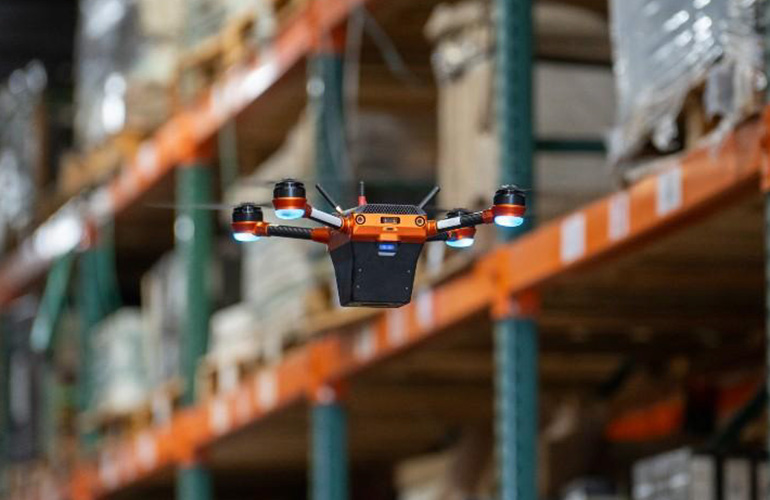
The Corvus One deploys fully autonomous drones to provide efficient inventory management for warehouses and production facilities. Source: Corvus Robotics
## Inventory System Suitable for Narrow Aisles
For distribution centers with high-rise storage, drones can access areas that traditional equipment like scissor lifts cannot reach easily. This extended coverage allows more efficient inventory management and retrieval, even in tight spaces.
Corvus drones can navigate aisles as narrow as 50 inches (127 cm) wide. The company states that the ability to fly in very narrow aisle (VNA) environments increases potential applications for drones.
Drones are particularly well-suited for use in narrower aisles where pivot trucks or other vehicle operations are less feasible. However, even businesses with more densely automated storage and retrieval systems (ASRS) may not need drones.
## Corvus One Update Enables “Dark” Operations
Corvus has also updated its Corvus One system to enable drones to fly and complete inventory scans in automated distribution centers. This means drones can be assigned to fly during facility downtime or in areas without human activity, with lights turned off to save costs. Each drone is equipped with its own light for onboard scanners and cameras.
Austin Feagins of Staci Americas said that “the dark operation capability of the Corvus One system allows our inventory team to correct inconsistencies before each production day during non-shift and pre-shift hours, limiting fulfillment delays and production impacts.”
Wu added, “The Corvus One system is a crucial component for end-to-end inventory visibility and optimization. We are growing rapidly, and our recent funding will help Corvus address the rapid adoption by customers while continuing to develop products with unique capabilities.”
—
Source Website: The Robot Report