Spain's Transport Ministry has set an average 26% minimum service level for rail freight during the 11 November 2026 general strike, but has issued no equivalent nationwide guarantee for road haulage. Fenadismer, the country's Federation of National Transport Associations, says the imbalance is hard to justify given that trucks carry more than 90% of Spain's freight while rail accounts for around 1%. The ministry has prioritised rail cargo tied to the automotive industry, fuel, steelmaking and waste. With less than 48 hours to go, no separate road-freight decision had been issued, and it remains unknown how many drivers will join the strike.
According to Trans.INFO, a nationwide general strike scheduled for 11 November 2026 in Spain could disrupt freight transport and supply chains, with the country’s Transport Ministry applying different minimum-service standards to rail and road haulage. Rail freight has been granted an average minimum service level of 26%, while road freight has no equivalent nationwide guarantee.
Ministry sets 26% floor for rail freight
Under a Transport Ministry decision dated 9 November, an average of 26% of scheduled rail freight services will operate during the strike. Higher service levels have been set for selected cargo categories, including shipments linked to the automotive industry, fuel, steelmaking and waste transport.
The ministry says the measures are needed to protect production continuity and prevent supply-chain disruption. It has given particular priority to freight flows whose interruption could affect industrial facilities and the availability of essential services.
Fenadismer, Spain’s Federation of National Transport Associations, does not challenge the need to protect rail freight. However, it stresses that no comparable nationwide guarantees have been introduced for road transport, despite the central role trucks play in supplying Spain’s economy.
Fenadismer questions truck-rail imbalance
In a statement issued on 9 November, Fenadismer said the authorities had protected part of the rail freight network but had not introduced nationwide measures guaranteeing a minimum level of truck transport. The federation says the decision is particularly difficult to understand given the modal split.
Citing figures used by the organisation, trucks carry more than 90% of Spain’s freight, while rail accounts for around 1%. On that basis, Fenadismer argues that leaving road haulage without a nationwide minimum-service floor exposes the larger share of the country’s cargo flows to interruption.
“The ministry has protected part of the rail freight network but has not introduced nationwide measures guaranteeing a minimum level of truck transport.” — Fenadismer, Spain’s Federation of National Transport Associations
The federation is especially critical of the ministry’s reasoning regarding rail shipments of municipal waste and dangerous goods, which were classified as socially important. The ministry also argued that replacing rail freight with trucks could cause unacceptable congestion on major roads during the strike.
Road freight lacks a strike-by-strike decision
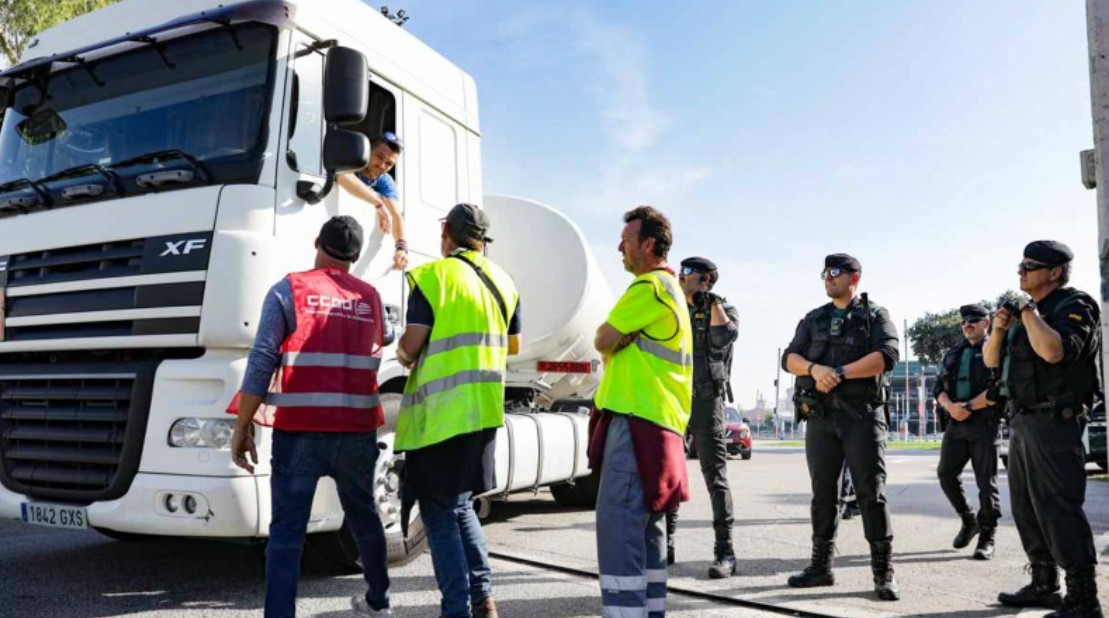
Fenadismer disputes the ministry’s congestion logic. In its view, if professional drivers take part in the protest, the number of trucks on the roads could actually fall. The organisation also argues that if the authorities are anticipating blockades or serious traffic disruption, they should take additional steps to protect deliveries of goods essential to households and businesses.
The situation is also shaped by Spain’s rules on minimum services during strikes. Passenger transport is covered by general provisions set out in Royal Decree 635/1984, on which basis the ministry has set minimum service levels for bus services, among others. Freight trains have also been given protection.
Road freight is treated differently, however, with a separate decision required for each individual strike. Fenadismer says that, less than 48 hours before the protest was due to begin, the ministry had still not issued such a decision, leaving truck transport without nationwide protective measures.
Scale of disruption remains unknown
It is not yet known how many drivers and employees of transport companies will join the strike on 11 November. The lack of nationwide minimum-service rules does not automatically mean that road freight operations will stop, but carriers fear supply disruptions and are calling for essential freight movements to be protected against possible interruptions.
Fenadismer stresses that trucks make daily deliveries to manufacturing plants, distribution centres, shops and other customers, so any disruption could affect far more than the transport industry itself. The organisation is calling on the authorities to recognise the importance of road haulage to supply continuity.
For companies arranging transport to or from Spain, 11 November will therefore be a higher-risk day for operational disruption, although the actual scale of the impact remains unknown.
Source: Trans.INFO
Compiled from international media by the SCI.AI editorial team.