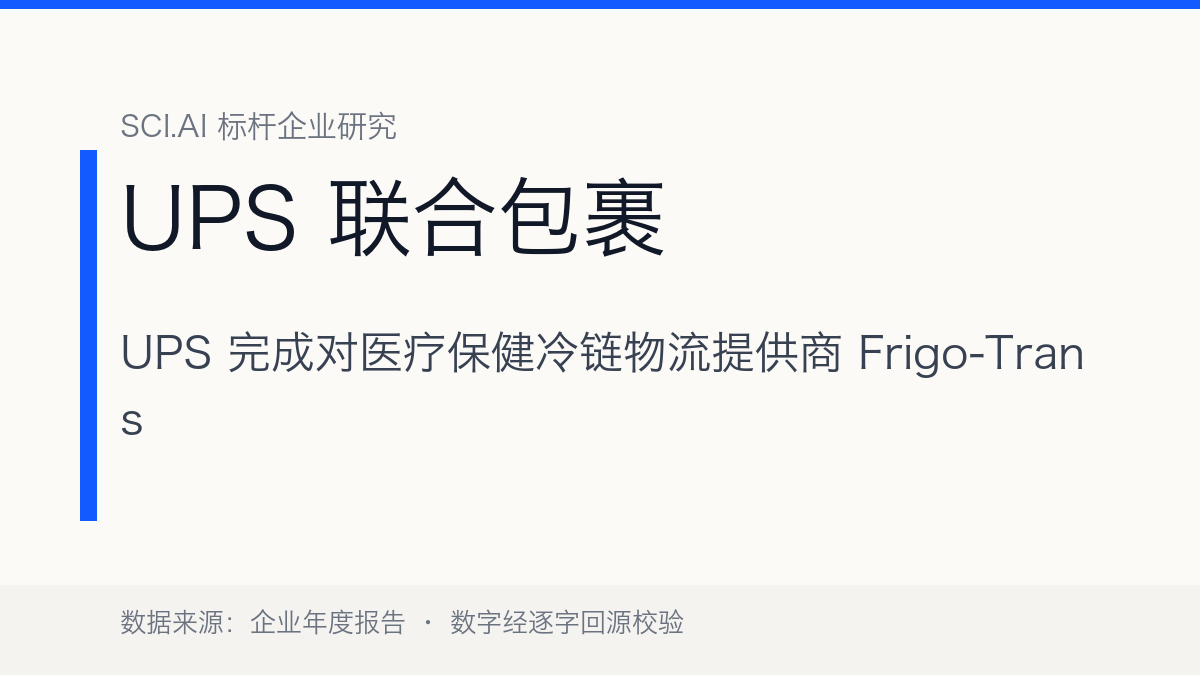
UPS finalizes the purchase of German healthcare logistics specialists Frigo-Trans and BPL, adding temperature-controlled warehousing from -196°C to ambient and pan-European cold-chain transport to its Healthcare division.
Background
On 9 January 2025, UPS announced that it had completed the acquisition of Frigo-Trans and its sister company BPL, two German healthcare logistics providers specializing in temperature-controlled supply chain solutions. The transaction, first disclosed in September 2024 without a purchase price, marks a deliberate expansion of UPS Healthcare’s European infrastructure at a moment when pharmaceutical and biotech clients are demanding increasingly sophisticated cold-chain capabilities. The announcement arrived against a backdrop of strategic turbulence for the Atlanta-based carrier: in the first quarter of 2026, UPS reported revenue of 212 billion U.S. dollars, slightly above Wall Street expectations, yet the company maintained its full-year revenue forecast at 897 billion U.S. dollars and an adjusted operating margin of approximately 9.6 percent. That same quarter, UPS acknowledged that its domestic U.S. margins and EBIT had underperformed internal targets, with Evercore ISI analyst Jonathan Chappell noting that the shortfall stemmed from per-package revenue trends that had previously driven outperformance. Against this operational pressure, the Frigo-Trans and BPL acquisition represents a capital allocation decision toward higher-margin healthcare verticals rather than volume-driven parcel growth.
Frigo-Trans, headquartered in Fussgönheim, Germany, operates a network of temperature-controlled warehousing facilities spanning cryogenic storage at -196°C through ambient storage at +15° to +25°C, coupled with pan-European cold-chain transportation services. Its service portfolio extends to packaging, handling, and inventory management, with a particular focus on pharmacy-centric distribution networks across Europe. BPL, based in Düsseldorf, complements this asset base with freight forwarding capabilities for time- and temperature-sensitive shipments, managing a network of air and ocean carriers alongside customs clearance services. The two entities together offer a contiguous healthcare logistics capability that UPS previously lacked at this scale in Europe.
The acquisition also follows an earlier capital commitment in the temperature-controlled space. On 22 June 2026, UPS announced an investment of 48 million U.S. dollars to build temperature-controlled facilities, a figure that now contextualizes the broader capital intensity of UPS Healthcare’s European infrastructure strategy. While the Frigo-Trans and BPL purchase price was not disclosed, the 48 million U.S. dollar facility investment signals management’s willingness to deploy substantial capital toward healthcare-specific assets.
Analysis
The operational logic of the acquisition rests on the complementarity between Frigo-Trans’s physical infrastructure and BPL’s freight forwarding and customs capabilities. Frigo-Trans provides the fixed assets—warehousing and last-mile cold distribution—while BPL contributes the variable network of international carrier relationships and regulatory compliance for cross-border pharmaceutical movements. For supply chain practitioners in procurement and freight forwarding, this combination addresses a persistent pain point in European pharma logistics: the fragmentation between storage and transport compliance. A single shipment of temperature-sensitive biologics may cross multiple jurisdictions with differing GDP (Good Distribution Practice) requirements; the integration of BPL’s customs clearance with Frigo-Trans’s warehousing creates a unified control point that reduces handoff risk.
From UPS Healthcare’s existing footprint perspective, the deal adds to a global network that already encompasses 17 million square feet of cGMP- and GDP-compliant healthcare distribution facilities. The Frigo-Trans network specifically extends cryogenic capabilities down to -196°C, a temperature range critical for cell and gene therapies that require liquid nitrogen storage. This is not merely incremental capacity but qualitatively distinct infrastructure that positions UPS to handle advanced therapeutic modalities that conventional 2-8°C cold chains cannot support. For procurement officers sourcing logistics partners for clinical trial materials or commercialized gene therapies, this capability expansion directly broadens the addressable market that UPS Healthcare can serve.
The timing of the acquisition completion in early 2025 also intersects with UPS’s broader corporate restructuring. The company has been executing a network transformation that generated approximately 600 million U.S. dollars in savings during the first three months of 2026, achieved through facility consolidations and the planned reduction of Amazon-related volume. CEO Carol Tomé has characterized this period as a “critical transformation,” with the company anticipating an inflection point in mid-2026 when the Amazon volume reduction program concludes. Within this restructuring, the Frigo-Trans and BPL assets represent a countercyclical investment: while UPS contracts its general parcel network, it expands in healthcare, a segment characterized by higher margins, stricter regulatory requirements, and greater customer stickiness.
The labor dimension of UPS’s restructuring provides additional context. The company reached a settlement with its union in April 2026, agreeing to cap voluntary buyouts for drivers at 7,500 employees, with associated severance and consulting costs of 12 billion U.S. dollars. This workforce reduction in the core U.S. parcel network contrasts with the specialized staffing requirements of healthcare logistics, where GDP compliance, temperature monitoring, and chain-of-custody documentation demand different skill sets. The Frigo-Trans and BPL acquisition thus brings not only physical assets but also personnel with European healthcare logistics expertise that would require years to develop organically.
Market reaction to UPS’s strategic direction has been mixed. Despite first-quarter 2026 earnings per share of 1.07 U.S. dollars exceeding the analyst consensus of 1.03 U.S. dollars, UPS shares declined 4.4 percent in pre-market trading following the earnings release, reflecting investor skepticism about the pace of margin recovery. The stock had gained 9.1 percent year-to-date through the prior trading session, trailing the broader market. The healthcare vertical expansion, while strategically sound, must now demonstrate its ability to offset margin pressure in the core U.S. domestic business.
Implications for Practitioners
For procurement professionals in pharmaceutical and biotech companies, the consolidated UPS-Frigo-Trans-BPL entity alters the competitive landscape for European cold-chain tenders. The combination of UPS’s global tracking infrastructure—specifically the UPS Premier visibility service—with Frigo-Trans’s temperature-controlled warehousing and BPL’s customs brokerage creates a single-source option for complex cross-border healthcare logistics. Practitioners should evaluate whether existing multi-vendor arrangements remain cost-competitive against this integrated offering, particularly for shipments requiring multiple temperature zones or cryogenic handling.
Freight forwarders and trade specialists should note the regulatory implications of the acquisition. BPL’s GDP-compliant operations and customs clearance capabilities, when fully integrated with UPS’s global quality management system, may accelerate customs processing for pharmaceutical shipments entering or transiting the European Union. This matters for time-sensitive clinical trial materials where customs delays can compromise trial protocols. Practitioners should monitor whether UPS Healthcare introduces standardized service-level agreements across the combined network that specify temperature excursion thresholds, documentation requirements, and liability allocation—areas where pharmaceutical shippers have historically negotiated on a provider-by-provider basis.
The 48 million U.S. dollar temperature-controlled facility investment announced in June 2026, viewed alongside the Frigo-Trans and BPL acquisition, suggests a multi-year capital commitment rather than a one-time transaction. For supply chain planners, this implies that UPS Healthcare will likely have available capacity for new business wins in the 2026-2027 timeframe, potentially offering competitive pricing to fill newly acquired or constructed assets. Conversely, practitioners with existing Frigo-Trans or BPL contracts should anticipate contract renegotiation as these operations migrate onto UPS systems and pricing structures.
Finally, the acquisition serves as a benchmark for competitor responses. With UPS consolidating healthcare cold-chain capabilities across warehousing, transport, and customs, rival logistics providers may face pressure to acquire comparable assets or risk exclusion from pharma RFPs requiring end-to-end temperature assurance. For trade practitioners monitoring carrier consolidation trends, the deal reinforces that healthcare logistics is becoming a distinct competitive arena where regulatory expertise and specialized infrastructure matter more than parcel volume scale.
Source: 来源见素材(Thu)、来源见素材(Tue)、来源见素材(UPS)宣布将投资4800万美元)