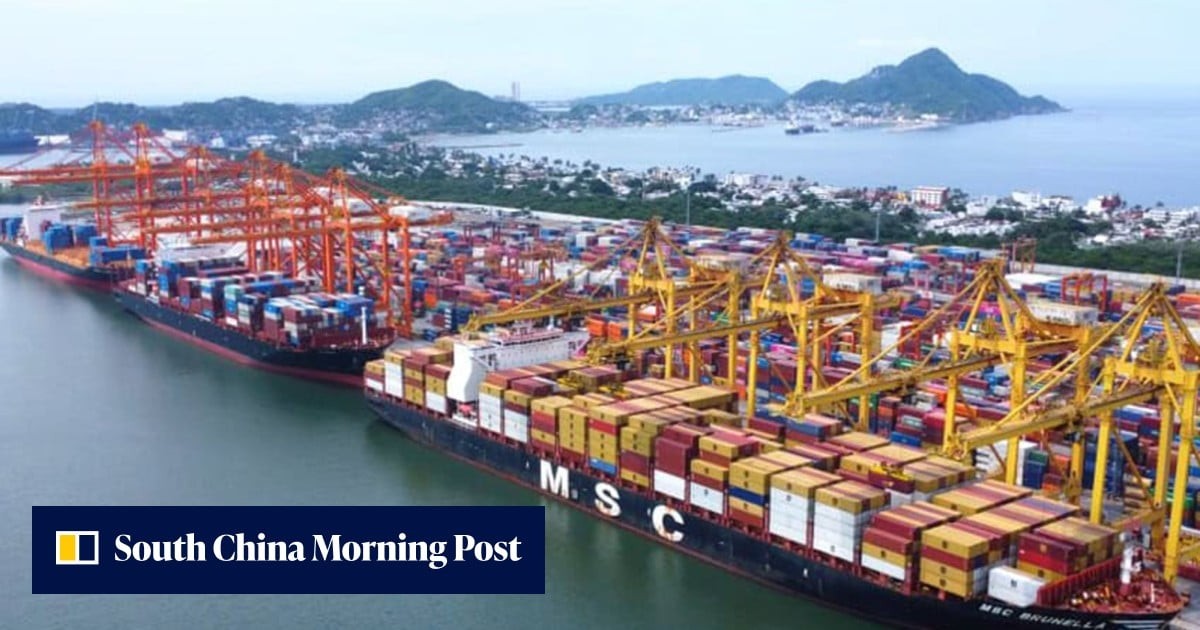
According to www.scmp.com, China’s Ministry of Commerce formally dismissed a White House report accusing Chinese exporters of rerouting goods through Mexico and other countries to evade U.S. tariffs — a claim the ministry labeled a ‘false narrative’ grounded in ‘unilateralism and protectionism’.
Beijing’s Formal Rejection
At a regular press briefing in Beijing on Thursday, He Yadong, spokesman for China’s Ministry of Commerce, issued a point-by-point rebuttal of the U.S. government’s findings. He emphasized that the report ‘ignored facts and distorted reality by treating normal international trade and investment as fraud’. According to the source, He explicitly rejected the characterization of cross-border supply chain activity as illicit diversion, underscoring that multinational production networks operate under standard commercial logic and WTO-compliant frameworks. The ministry stated that Washington’s framing served not to clarify trade patterns but to advance a political agenda aimed at ‘suppressing and blocking Chinese products’.
The spokesperson further argued that U.S. tariff policy itself — particularly the high differentiated tariffs imposed after 2018 — constitutes the principal threat to global supply chain stability. He stressed that such measures disrupt sourcing continuity, raise input costs for American manufacturers, and erode trust among trading partners. In response, China demanded an immediate end to what it termed ‘irresponsible accusations’, affirming its commitment to developing commercial cooperation ‘on the basis of equality and mutual benefit’ with all nations — including the United States, Mexico, and third-country partners engaged in lawful trade and investment.
This diplomatic pushback occurred within hours of reports emerging that Mexico — identified in the White House document as a ‘named hub’ for transshipped goods — was preparing new restrictions targeting Chinese imports. Though the source does not specify the nature or timeline of Mexico’s planned curbs, the proximity of the announcements underscores intensifying coordination among U.S. allies on trade enforcement, even as Beijing challenges the factual foundations of those efforts.
Disputed Economic Claims
The White House report cited in the article estimates that U.S. economic losses from trade re-routing amount to up to US$150 billion in lost output and 450,000 American jobs. However, the source text explicitly concedes these figures are ‘model-based illustrations’ rather than empirically verified outcomes. It further acknowledges that the documented shift in U.S. import sourcing after 2018 ‘does not prove all displaced Chinese trade was illegally diverted’. This internal qualification weakens the report’s causal claims and highlights methodological limitations that Beijing seized upon in its rebuttal.
He Yadong’s statement directly contested the attribution of domestic U.S. economic difficulties to external actors, accusing Washington of ‘blaming external factors for its own economic problems’. That critique targets both the report’s analytical framework and its rhetorical strategy: using aggregated macroeconomic estimates to imply deliberate evasion, while omitting evidence of legitimate supply chain adaptation — such as foreign direct investment, regional value chain integration, and tariff engineering compliant with origin rules. The ministry’s position rests on the premise that trade flows respond rationally to price signals, including tariffs, and that such responses fall well within internationally accepted norms.
The dispute thus centers not only on data interpretation but on foundational assumptions about trade governance. Where the U.S. report treats tariff avoidance as inherently suspect, China asserts that optimizing across jurisdictions is a routine feature of global commerce — one enabled by free trade agreements, bilateral investment treaties, and decades of WTO jurisprudence. The 2018 inflection point referenced throughout the source marks the onset of Section 301 tariffs, which reshaped sourcing decisions across sectors from electronics to automotive components, prompting widespread diversification beyond China without necessarily violating customs laws.
Geopolitical Implications and Next Steps
The timing of China’s response — delivered just hours after news broke of Mexico’s impending restrictions — signals coordinated diplomatic signaling across multiple fronts. While no details about Mexico’s proposed measures are provided in the source, the fact that it was singled out as a ‘named hub’ in the White House report implies that U.S. authorities have identified specific ports, logistics corridors, or manufacturing zones where Chinese-origin goods undergo minimal processing before re-export to the United States. Such designations often precede regulatory action, including enhanced customs inspections, stricter origin verification, or revised de minimis thresholds.
Beijing’s insistence on ‘equality and mutual benefit’ signals its intent to counterbalance U.S.-led pressure through strengthened ties with alternative partners — including countries in Latin America, Southeast Asia, and Africa — without abandoning engagement with Mexico or the United States. The ministry’s language avoids escalation but leaves open avenues for retaliatory measures should new restrictions materialize. Notably, the source makes no mention of pending Chinese counter-tariffs or export controls, focusing instead on diplomatic rebuttal and normative appeals to multilateral trade principles.
Ultimately, the exchange reflects a broader contest over trade rulemaking authority. With US$150 billion and 450,000 jobs invoked as stakes — albeit as illustrative projections — the dispute transcends technical customs enforcement and enters the realm of strategic economic narrative. How third countries interpret and act upon these competing accounts will shape the resilience, fragmentation, and legal coherence of global supply chains in the years ahead.
Source: South China Morning Post
Compiled from international media by the SCI.AI editorial team.