Americold isn’t an ocean carrier, a port operator or a railroad. But it is leveraging partnerships with those entities to build a North American network.
A partnership model, not vertical integration
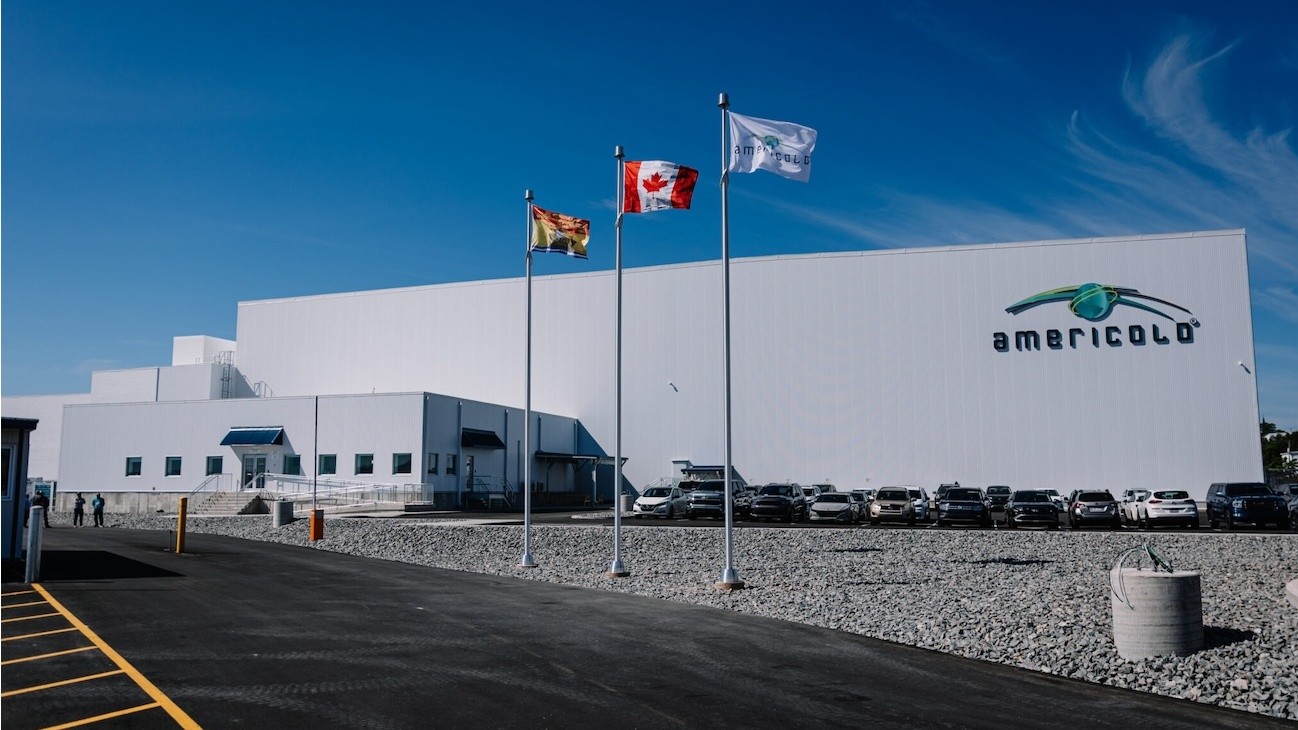
That’s the thesis behind the Atlanta-based company’s newest facility, a roughly US$80 million import-export hub that formally opened in June at one of the fastest-growing container gateways on the Atlantic seaboard.
The Port Saint John project is the first to bring all three of Americold’s strategic partners together in one place: Dubai’s DP World, which runs the box terminal; CPKC (NYSE: CP), whose rail line connects the port to Central Canada and beyond; and Americold itself, which owns and operates the cold chain infrastructure sitting between them.
“The fact that we’re partnering with folks who, every step along the way, what they’re doing is their core competency, I think is going to build a lot of resilience into this solution and partnership model,”
— Rob Chambers, CEO of Americold, since Sept. 1, 2025
Americold Realty Trust (NYSE: COLD) operates around 230 temperature-controlled facilities worldwide, the majority — about 200 — in North America, with the rest spread across Europe, Australia, New Zealand, South America and, through a joint venture, the Middle East. It went public in 2018.
Why Saint John
By population or conventional site selection, Saint John — long an energy and manufacturing center on New Brunswick’s Bay of Fundy — would not top the list. Americold’s Matthew Moore, who leads global market strategy, said the company looked past the map and at the inefficiencies in how temperature-sensitive goods actually move.
“If we just went to our customers and said, ‘Hey, where should we build?’ it’d be Dallas. It would be the traditional major metro markets,” Moore said. “Probably not too many people would say Kansas City or Port Saint John.”
What changed the calculus was the confluence of investment. Chambers cited close to $750 million in public and private capital flowing into the port over the past decade. That includes DP World’s $247 million West Side modernization that opened in January 2025 and lifted terminal capacity from 150,000 twenty foot equivalent units to 1 million TEUs annually. Container throughput hit a record 239,364 TEUs in 2025, up 29.4% year over year and up 175% since 2021.
Doug Smith, chief executive of DP World Canada, has been vocal about a target of 1 million TEUs at the gateway, or roughly four times current volume.
“It made our decision to invest the $80 million into a facility here much easier because we saw multiple hundreds of millions of dollars in investment by our partners,” Moore said. “For certain goods in and out of the area, it was more efficient to go in and out of Port Saint John than to deal with the uncertainty of Montreal, the labor shortages, or going all the way up to Halifax and having to come by road all the way around.”
A new Canadian gateway
Today, much of the temperature-controlled product destined for Canada moves through Philadelphia or Newark, N.J., and is then trucked across the border and through customs. The Saint John facility, which is the only temperature-controlled storage in Eastern Canada directly connected to a port without drayage, is meant to shorten that path.
The facility, Americold’s sixth in Canada, provides about 22,000 pallet positions and is designed to support high-throughput import and export. Moore said the trade lanes it will serve run to Europe both ways, to South America for protein imports, and potentially all the way to Australia.
The shipping lines calling Saint John today include the Gemini Cooperation, the Hapag-Lloyd–Maersk (OTC: AMKBY) alliance launched in February 2025. Moore said Gemini’s service comes up from South America, with Port Saint John its last port of call in North America before continuing to Europe and return. CMA CGM of France also moves some volume through the port.
The cold chain gap
Temperature-sensitive cargo represents about 10% of total global trade flows, Moore said, and the cold chain remains markedly less mature than the dry-freight networks dominated by global forwarders and logistics providers such as DHL, DSV and CEVA Logistics, a unit of CMA CGM.
“You still have a relatively inefficient cold chain compared to the rest of the regular goods that move around, and that’s probably because they just don’t get the high priority that some of the other goods get,” Moore said.
Americold is one of perhaps two players with genuinely global scale in the space, Chambers said, and it has rolled out a single operating system across its sites so customers get a standard experience wherever they ship. But cold chain integrity can be undone the moment a pallet leaves the warehouse on a non-refrigerated truck or railcar, which is why the company believes the partnership model matters.
“You can’t just have one node of it and then immediately violate cold chain integrity as soon as it leaves your facility. Then you’ve not added any value,”
— Rob Chambers, CEO of Americold
Automation where it pays
The Saint John build is conventional, but automation is very much on Americold’s agenda elsewhere. The company is set to open a large automated facility in the Dallas–Fort Worth market at Blue Mound, rail-served by Union Pacific, between November and December 2026.
In an automated building, a 40- to 50-foot clear height becomes 140 feet, with an automated storage and retrieval system, or ASRS, using cranes to stack pallets across 12 to 14 levels. Subsystems can automate trailer unloading, layer picking and repalletizing. Americold runs in-house engineers who do time-and-motion studies to determine when the return is there.
“A few years ago, it was a heavy trend to automate for automation’s sake,” Chambers said. “Americold’s not going to do that. We have the capability and the analytics to determine when to automate.” The result, he said, is a mix of fully automated, semi-automated and fully conventional facilities.
That deliberate approach also explains why retrofitting older, urban, space-constrained port warehouses is so difficult. “You wouldn’t take a 40-foot facility and turn it into a 140-foot facility — you’d scrape it and rebuild it,” Chambers said.
Source: FreightWaves
Compiled from international media by the SCI.AI editorial team.