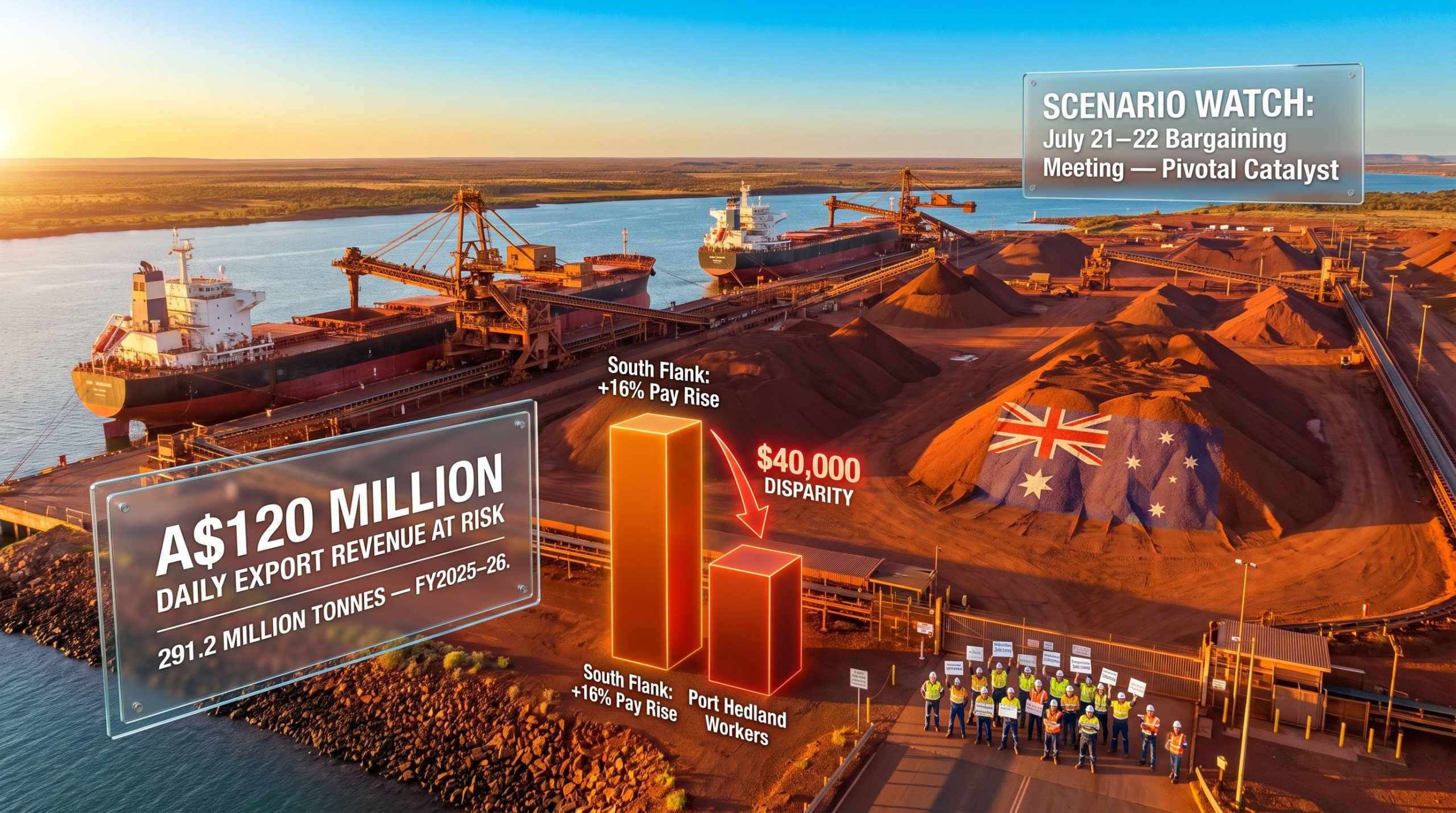
According to discoveryalert.com.au, an eight-hour industrial action at BHP’s Port Hedland terminal on 16 July 2026 disrupted two bulk carrier loading cycles and placed A$120 million in daily iron ore export revenue at risk — equivalent to USD $83 million.
Port Hedland’s systemic chokepoint
Port Hedland is the sole export gateway for all of BHP’s Western Australian iron ore production — with no alternative berths, redundant pathways, or bypass options. In the fiscal year ending June 2026, BHP’s WA operations produced 291.2 million tonnes of iron ore on a 100% basis, representing a substantial share of the global seaborne trade volume of 1.5 billion tonnes annually. The port functions not only as a logistics hub but as a pricing anchor: vessel scheduling data from Port Hedland directly informs freight rate calculations, laycane windows, and demurrage cost estimates used by steel mills in China, Japan, and South Korea.
The absence of operational redundancy distinguishes Port Hedland from rival hubs. Rio Tinto, for example, operates across two terminals — Dampier and Cape Lambert — granting it built-in flexibility that BHP structurally lacks for its Pilbara volumes.
Wage dispute rooted in internal inequity
The strike emerged from protracted enterprise agreement negotiations between BHP and three unions covering approximately 450 employees in the Port Hedland maritime workforce. Bargaining commenced in October 2025, spanned nine sessions over roughly seven months, and remained unresolved ahead of the 16 July 2026 action. A final pre-strike meeting occurred on 14 July, with the next scheduled session set for 21–22 July 2026.
Workers are demanding a $25,000 annual pay increase, citing remuneration disparities of up to $40,000 between their roles and equivalent positions at BHP’s South Flank and Mining Area C sites — where staff received a 16% pay rise under separate enterprise agreements. This internal benchmark, established by BHP’s own compensation decisions, forms the core of the unions’ moral and negotiating leverage.
Coordinated multi-union action
The industrial action was coordinated across three unions operating as a combined bargaining bloc:
- WMWA (Western Mine Workers Alliance — a partnership of the Australian Workers Union and the Mining and Energy Union’s WA branches), covering mining and port operations
- ETU (Electrical Trades Union), covering electrical and instrumentation trades
- AMWU (Australian Manufacturing Workers’ Union), covering maintenance and manufacturing trades
Approximately 150–200 of the 450 covered employees participated in the initial eight-hour strike. The cross-trade nature of the stoppage — spanning maritime, electrical, and maintenance functions — prevented partial operational mitigation through redeployment, amplifying disruption impact.
Economic cost of precision timing
The strike was deliberately timed to coincide with a double-up day — a scheduled maintenance overlap period — and ran from 14:00 to 22:00 AWST (06:00 to 14:00 GMT). This window targeted exactly two bulk carrier loading cycles. According to economic modeling cited in the report:
- Export revenue loss from the two disrupted shipments: A$53 million (USD $37 million)
- Western Australian government royalty loss from those vessels: ~A$4 million
- Broader daily royalty exposure if full operations halt: ~A$7 million
The Western Australian Chamber of Minerals and Energy estimated the combined export revenue and royalty loss from the two affected shipments at A$57 million — a figure expected to draw immediate attention from state government officials.
Source: discoveryalert.com.au
Compiled from international media by the SCI.AI editorial team.