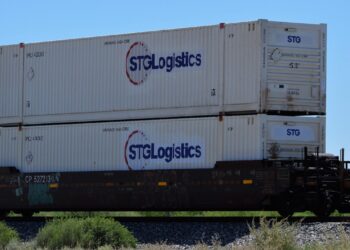
According to theloadstar.com, container freight spot rates on key ocean lanes edged upward this week amid firm demand and pending carrier-led price hikes — though forwarders remain skeptical about sustainability, citing widespread discounting and readily available vessel space.
Asia-Europe Rates Rise Amid Peak Season Test
The World Container Index (WCI) recorded a 5% weekly gain on the Shanghai-Rotterdam route, reaching $4,933 per 40ft, while the Shanghai-Genoa leg rose 2% to $6,463 per 40ft. Next week marks an “acid test” for the Asia-Europe peak season, with multiple general rate increases (GRIs) scheduled for implementation across North Europe and the Mediterranean starting 15 July 2026.
Carrier targets vary widely: MSC aims for $7,700 per 40ft to both regions; CMA CGM targets $7,000 to North Europe and $7,900–$8,500 to the Mediterranean. Yet only four blank sailings are planned on the Asia-Europe trade next week — insufficient to tighten capacity meaningfully. As Linerlytica observed, “Carriers have started to roll-back their rates to North Europe, with spot rates for first-half July sailings failing to breach $6,000 per 40ft.”
“The Gemini partners remain at the bottom of the range, with rates as low as $4,800 per 40ft on offer against rivals’ rates of $6,000–$6,500 per 40ft.” — Linerlytica, maritime consultancy
Suez Return Accelerates with Majestic Maersk Transit
Maersk confirmed that its 18,300 teu vessel Majestic Maersk successfully transited the Bab Al Mandeb straits on 10 July 2026, en route to the Suez Canal for a northbound transit scheduled on 12 July. The vessel operates on the Gemini Asia-Med Loop 3 service — a joint rotation with Hapag-Lloyd — and marks the first headhaul Suez crossing by a Gemini partner since security concerns escalated in the Red Sea.
The Asia-Med Loop 3 (Maersk AE15 / Hapag-Lloyd SE3) follows this port rotation: Qingdao → Kwangyang → Ningbo → Tanjung Pelepas → Port Said → Damietta → Colombo → Singapore. Its shuttles connect Mediterranean gateway ports with Gemini’s Egyptian transhipment hubs. Maersk stated the move “comes following thorough assessments of the security situation in the Red Sea area and marks a step towards a gradual return to the trans-Suez corridor.” The redeployment is expected to free up at least two vessels for reallocation elsewhere.
In parallel, Maersk announced that its US East Coast–Middle East MECL services — operated independently of the Gemini Cooperation — will also fully resume Suez transits this month.
Transpacific Rates Flatline Amid Demand Uncertainty
On the transpacific, WCI data showed the Shanghai–Los Angeles route rose 2% week-on-week to $6,482 per 40ft, while Shanghai–New York held flat at $7,904 per 40ft. A new wave of GRIs and peak season surcharges (PSSs) takes effect on 15 July, but early signals suggest weakening pricing power. Freight Right, a US West Coast forwarder, reported that “some carriers are beginning to offer small reductions of around $100–$200 week on week”, warning that further hikes “could risk stopping demand altogether.”
“The near-term outlook points to a market that is likely to hold steady or gradually decline, rather than move higher. The recent peak appears to have been reached, and without a rebound in volume, carriers may have limited room to defend current rate levels for long.” — Freight Right, US West Coast forwarder
Freight Right added that carriers are expected to manage any decline carefully, avoiding aggressive cuts unless booking activity deteriorates further — making the next one-to-two weeks critical for determining whether August delivers a meaningful peak season or settles into a softer summer pattern.
Source: The Loadstar
Compiled from international media by the SCI.AI editorial team.