
Skip to content

Procurement · Supply Chain Finance

Analysis

Apple acquires Broadcom AI team for $3 billion, boosts U.S. chip supply chain

Apple has acquired Broadcom’s AI chip design team for $3 billion, integrating approximately 1,200 engineers into its Silicon Engineering Group. The move supports Apple’s goal of sourcing 50% of its custom silicon from U.S. fabs by 2030 and includes a $1.5 billion, five-year U.S. R&D investment. The company plans to qualify three new U.S.-fabricated chip processes by 2027 and will conduct final test and assembly in San Jose, California. This reflects a broader industry shift toward on-device AI hardware and domestic semiconductor supply chain resilience.

Original source: eetimes.com

Apple acquires Broadcom AI team for $3 billion, boosts U.S. chip supply chain

Ask SCI.AI about this story

According to www.eetimes.com, Apple has acquired Broadcom’s AI chip design team for $3 billion, a move explicitly aimed at accelerating on-device artificial intelligence capabilities and strengthening domestic semiconductor manufacturing infrastructure in the United States.

Strategic acquisition targets AI hardware development

The deal centers on Broadcom’s high-performance AI accelerator design unit, which specializes in low-power, heterogeneous compute architectures optimized for edge inference. Apple confirmed it will integrate the team—approximately 1,200 engineers—into its Silicon Engineering Group, headquartered in Austin, Texas. This marks Apple’s largest talent acquisition in silicon design since its 2020 acquisition of Intel’s smartphone modem business. According to the report, the team brings expertise in advanced packaging, chiplet integration, and custom neural processing units (NPUs) capable of handling multimodal AI workloads locally—without cloud dependency.

U.S.-focused supply chain investment

Apple pledged to invest $1.5 billion over five years to expand its U.S.-based semiconductor R&D footprint, including new facilities in Arizona and New York. The company stated it will collaborate with the U.S. Department of Commerce to align with the CHIPS and Science Act incentives, targeting qualification of three new U.S.-fabricated chip processes by 2027. This effort directly supports Apple’s publicly stated goal of sourcing 50% of its custom silicon from U.S. fabs by 2030.

Industry context and competitive implications

The acquisition follows similar moves by other major tech firms: Google acquired DeepMind in 2014, and Microsoft invested $10 billion in OpenAI in 2023. However, Apple’s approach diverges by prioritizing vertical integration of AI hardware rather than licensing or cloud-based models. As one industry analyst noted, “This isn’t about generative AI APIs—it’s about building the silicon foundation for real-time, privacy-preserving intelligence across every device.”

Supply chain practitioner impact

For supply chain professionals, the shift signals growing demand for U.S.-certified advanced packaging capacity, particularly for fan-out wafer-level packaging (FOWLP) and 2.5D interposer technologies. Apple’s requirement that all acquired Broadcom-designed chips undergo final test and assembly at its San Jose, California facility—rather than outsourcing to Asia—introduces new validation protocols for domestic Tier 2 and Tier 3 suppliers. Practitioners must now track qualification timelines for U.S.-based OSAT (outsourced semiconductor assembly and test) partners, including those recently certified under the CHIPS Act’s $39 billion in direct funding.

Source: EE Times

Compiled from international media by the SCI.AI editorial team.
Ask SCI.AI Finished reading? Continue with SCI.AI. Explore the related policy, route, company and historical context. Continue asking
Stay ahead of supply chain shifts

One email a week: the stories that matter and new risk events — in English, free.

Prefer RSS? Articles Risk events

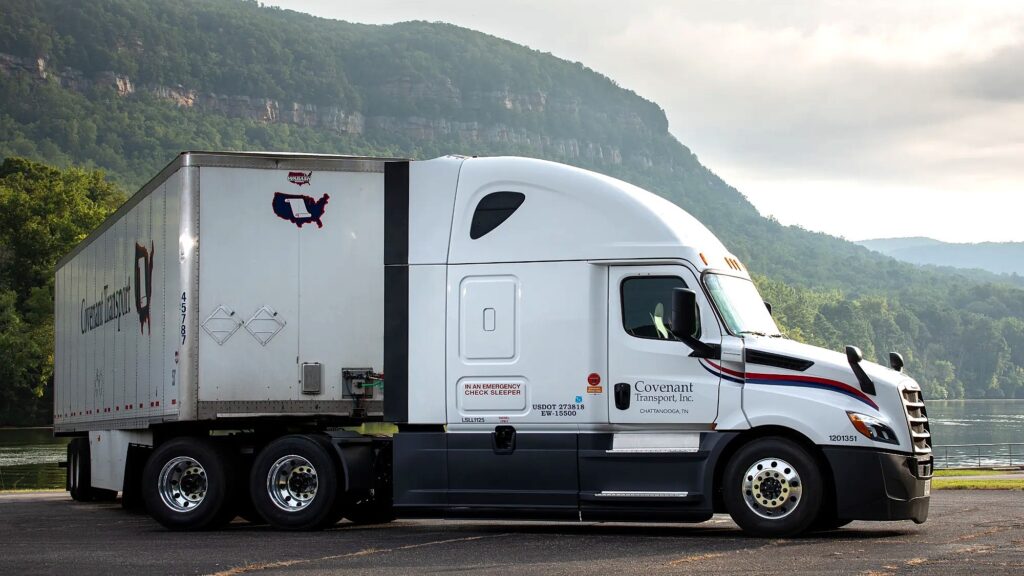
Covenant Logistics Q3 revenue rises 19.2% on managed freight
Procurement

Covenant Logistics Q3 revenue rises 19.2% on managed freight

Covenant Logistics Group posted a 19.2% year-over-year rise in third-quarter revenue to $353.9 million, powered by a 68.4% surge in its Managed Freight segment to $121.6 million. Freight revenue excluding fuel surcharges climbed 17.2% to $315.1 million, and adjusted earnings per diluted share rose 13.6% to 50 cents. Net income reached $10.7 million, or 40 cents per share. The truckload fleet shrank 8.9% to 2,186 tractors even as revenue per total mile jumped 19.8% to $3.03. Expedited revenue fell 12% as the carrier shifted tractors into committed capacity agreements.

83% of supply chain staff unprepared for AI, adoption scores 1.94
Supply Chain Finance

83% of supply chain staff unprepared for AI, adoption scores 1.94

Supply chain organizations are adopting artificial intelligence faster than they are preparing workers to use it, according to research from the Association for Supply Chain Management and the Digital Supply Chain Institute. The Oct. 14 report found 83% of respondents consider their workforce unprepared, while 91% plan to use AI to support employees and only 14% feel fully prepared. Average adoption across 13 supply chain functions scored 1.94 on a five-point scale, with demand planning highest at 2.28 and reverse logistics lowest at 1.59. AI-ready organizations reported a 71% project success rate versus 28% for unprepared ones. Skills shortages and unclear business cases tied as top barriers at 33% each.

Griffin flags AI bubble as Anthropic posts $80.7B loss
Supply Chain Finance

Griffin flags AI bubble as Anthropic posts $80.7B loss

Citadel founder Ken Griffin told the Future of Global Markets Conference in New York on October 20 that companies are questioning whether AI spending justifies its cost. The stakes are visible in Anthropic's draft IPO prospectus, which Reuters reported shows an $80.7 billion net loss for the first half of 2026, including a $72 billion noncash charge, alongside commitments of at least $518 billion over a decade for cloud and computing infrastructure. For supply chain operators, the question is whether AI-enabled TMS, WMS and planning tools change operating decisions — freight cost, throughput, inventory — rather than simply speeding up individual tasks.

Welcome Back!

Login to your account below

Create New Account!

Fill the forms below to register

Retrieve your password

Please enter your username or email address to reset your password.

Scan to share via WeChat

Open WeChat and scan the QR code to share

QR Code

Add New Playlist