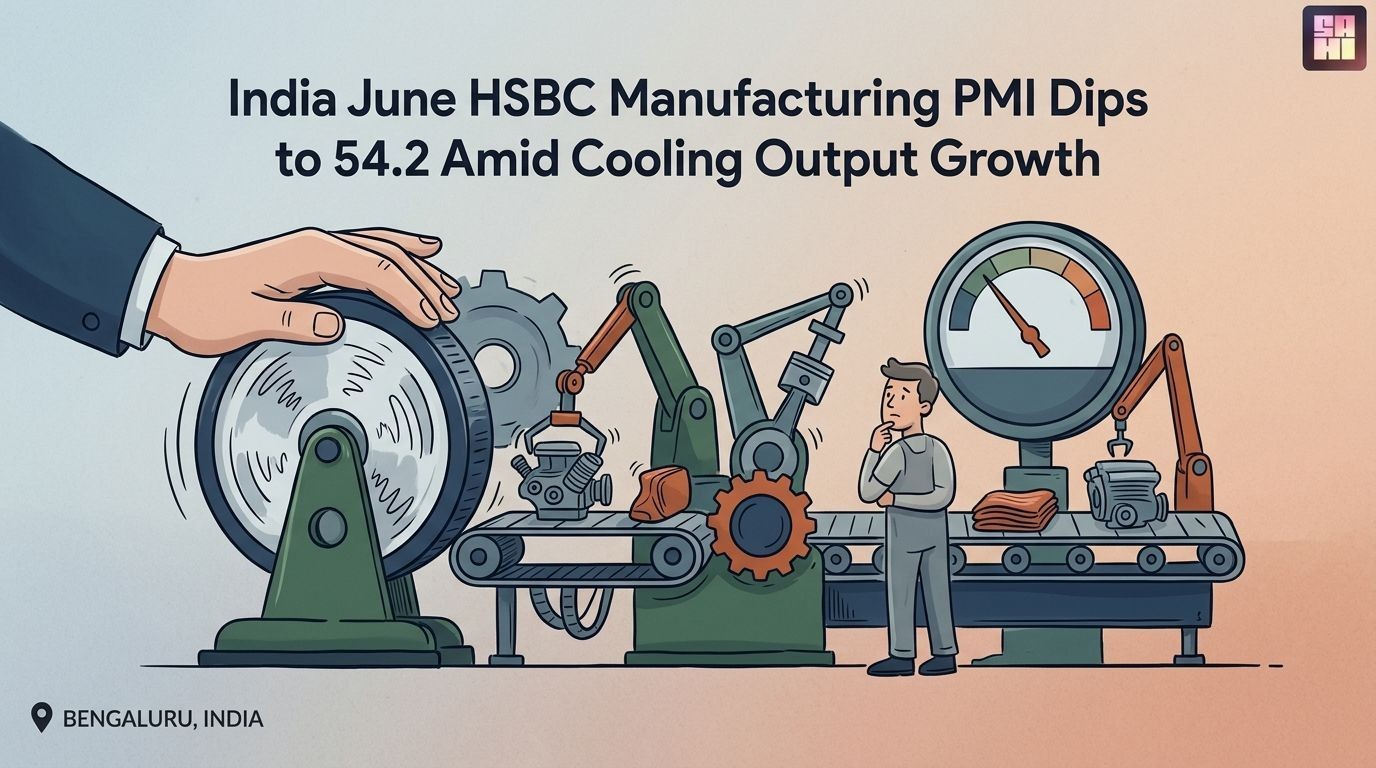
According to www.sahi.com, India’s HSBC Manufacturing Purchasing Managers’ Index (PMI) fell to 54.2 in June 2026 from 54.5 in May 2026 — a decline of 30 basis points — signaling continued expansion but at a marginally slower pace.
Expansion Continues, Momentum Moderates
The index remained well above the 50.0 threshold for the 60th consecutive month, confirming sustained sectoral growth. However, the 30 bps dip reflects a plateauing of the post-election manufacturing surge and broader consolidation in industrial activity following a strong start to the fiscal year.
This moderation aligns with seasonal patterns: June typically sees reduced logistical efficiency and labor availability in key industrial hubs including Pune and Noida due to monsoon onset. The source states that “a slight moderation is expected as global supply chains recalibrate” amid high-capacity utilization across Indian manufacturing facilities.
Output, Costs, and Export Resilience
Output growth cooled slightly, while input cost pressures persisted — identified as a key drag on momentum. Despite the headline dip, new export orders showed resilience, underscoring strength in external demand. Business confidence levels remain elevated, per the report, even as current output metrics eased marginally.
The ₹1.78 lakh crore Goods and Services Tax (GST) collections in May 2026 — up 11% year-on-year — reinforce underlying economic vitality. Meanwhile, the Reserve Bank of India maintained its repo rate at 6.5% in its June 2026 policy meeting, citing the need to durably align inflation with the 4% target.
Market and Policy Implications
The marginal PMI easing may trigger a neutral equity market response, particularly for industrial and automotive stocks. Capital allocation signals point toward high-efficiency manufacturers capable of sustaining margins amid modest volume cooling. In fixed income markets, the data suggests the RBI has additional breathing room on interest rates.
Trading signals indicate a near-term (0–3 months) neutral bias, with overweight positions recommended in Capital Goods, Chemicals, and Industrial Machinery, and underweight positions advised for Automotive and Consumer Durables. Trigger factors cited include June GST collection trends, crude oil price stability at $82/barrel, and monsoon coverage finalization across central India.
Risks and Structural Drivers
Key risks highlighted include sticky input price inflation — which could squeeze SME margins — global demand slowdown affecting exports, and monsoon-related logistical disruptions in the upcoming quarter. Yet structural tailwinds remain robust: the ‘China Plus One’ strategy continues to redirect global manufacturing investment toward India, while domestic infrastructure spending provides sustained demand support.
The report emphasizes that “the 54.2 print should not be viewed as a sign of weakness, but rather as a stabilization.” It notes that Indian manufacturing’s fundamental growth story remains intact, anchored by domestic demand and consistent policy backing — supporting a long-term bullish outlook for the sector.
Source: sahi.com
Compiled from international media by the SCI.AI editorial team.