Deal or no deal, logistics operators are expanding their Gulf land bridge offerings with DHL, GWC, and Oman Air Cargo all pumping further capacity into the region as shocks from the US/Israeli war against Iran continue to be felt across global supply chains.
Oman Air launches daily Muscat–Dubai Road Feeder Service
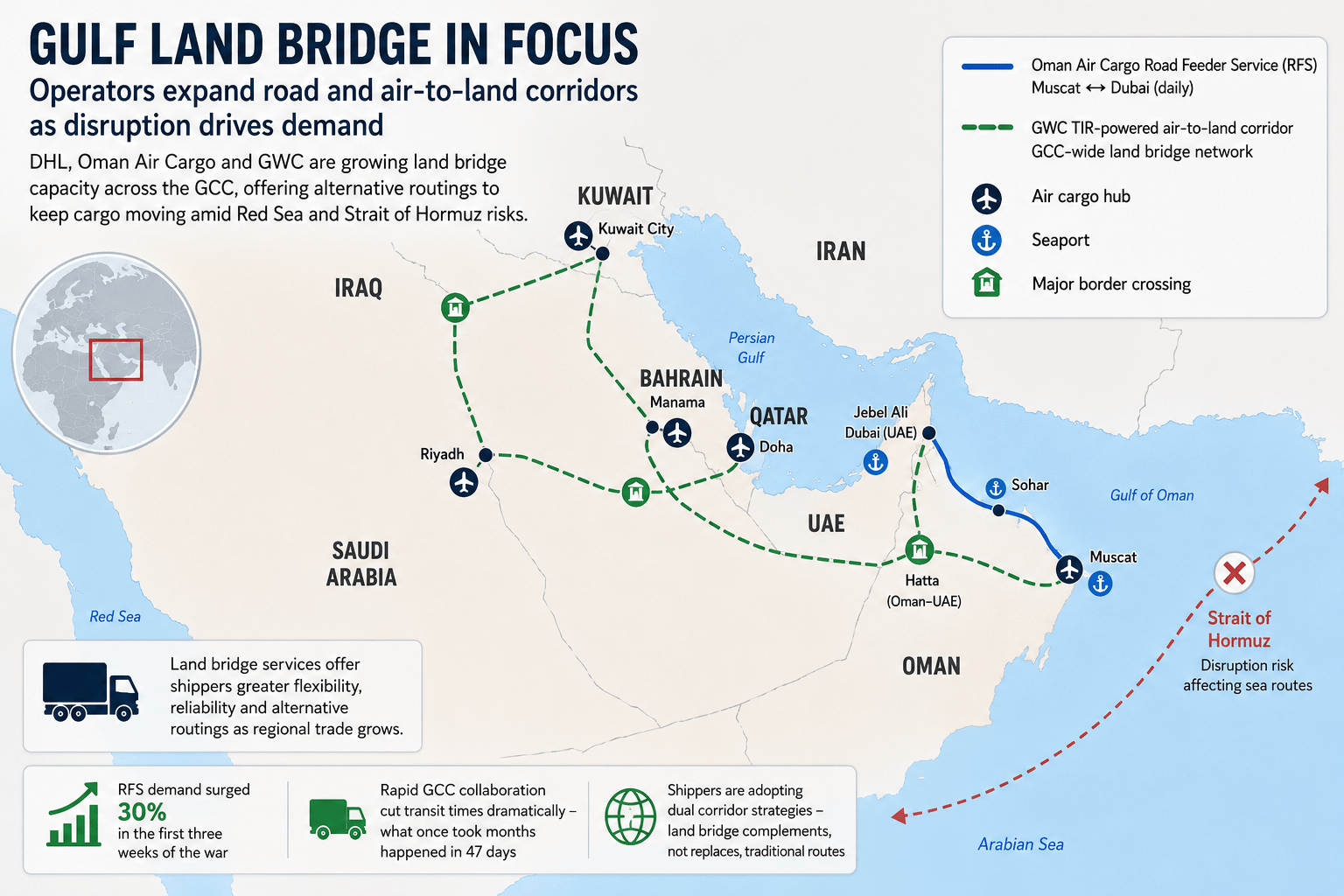
Oman Air Cargo this week launched a new daily Road Feeder Service (RFS) between Muscat and Dubai, with Qatar-based Gulf Warehousing Company (GWC) introducing a TIR-powered air-to-land logistics corridor for the Gulf.
Head of cargo for the carrier, Michael Duggan, said:
“This new service creates greater flexibility for cargo movement between Dubai and Muscat by complementing traditional air freight operations and enabling the transport of a wider range of cargo types. As regional supply chains continue to evolve, Oman Air Cargo remains focused on delivering reliable, customer-centric transport solutions that support trade across the Middle East.” — Michael Duggan, Head of Cargo, Oman Air Cargo
DHL Europe CEO confirms surge in Gulf road freight demand
Speaking to The Loadstar on Wednesday, DHL Express’ chief executive officer for Europe, Mike Parra, said that he too has noted a marked uptick in demand for the company’s regional road freight connectivity in the Gulf.
“With what has happened in the Middle East, with all the uncertainty, and with the Strait of Hormuz closure, we have seen a real necessity to leverage not only our heavyweight express product, but to leverage our network.” — Mike Parra, CEO for Europe, DHL Express
“When you have the network we have in the Middle East, on the ground and in the air, and have our capability to pivot – for instance from Bahrain to Muscat and Riyadh, which we did – and our road network in Europe, you become the logistics supplier of choice.” — Mike Parra, CEO for Europe, DHL Express
Regional coordination accelerates corridor maturation
DHL may have been one of the early leaders on this pivot to the new Gulf overland trade corridor, but its rapid maturation into an established corridor in just four short months was made possible by determined and speedy work from regional governments.
Saudi-based Flow Progressive Logistics’ chief executive Achraf Ellili noted that every authority contributed to have the entire ecosystem working together,
“meaning things that we thought would take ages to happen have happened in 47 days.” — Achraf Ellili, CEO, Flow Progressive Logistics
Praising the rapid collaboration between GCC countries to improve the customs and border crossing processes for trucks, Saudi Automobile & Touring Association executive manager Hasan Almanasif called for operators to “take advantage” of the opportunity.
RFS demand jumps 30% amid conflict; long-term viability emerges
Nor is the carrier alone in tapping up the opportunity — and it is a massive one with demand for RFSs surging 30% in the first three weeks of the war — with GWC’s new service, in which it uses its network to coordinate services from regional providers.
Of course, the route’s long-term prospects continue to be challenged, with expectations that when the war definitively ends, carriers and shippers will revert to their traditional approaches, but hopes of a speedy resolution to the conflict continue to be dashed.
Earlier today, news broke that just before boarding a plane to fly to negotiations US vice president JD Vance would no longer be attending the summit in Switzerland as talks had been abandoned.
The reason for this cancellation has not yet been made public, but despite the ceasefire MoU signed on Wednesday stressing that attacks on Lebanon by the US and Israel were to halt immediately, Israeli forces have persisted.
Indeed, those strikes began almost simultaneously with the news that President Trump had signed the MoU, prompting one forwarder to tell The Loadstar,
“How fucking long [was that]?” — anonymous forwarder, speaking to The Loadstar
in reference to the length of time in which hostilities were paused.
Stress-tested corridor gains strategic credibility
Such chaos offers the landbridge long-term prospects. Mr Ellili noted that with shippers having now experienced the route’s reliability, he expected them to “keep a percentage of their volumes moving this way now that it has been stress tested at scale”.
“It is optionally now viable. Shippers require a dual corridor strategy and the GCC is now able to offer this. Jebel Ali will remain world class, but it’ll no longer be the only gateway. This new one has been stress-tested it is there, and it is complementary.” — Achraf Ellili, CEO, Flow Progressive Logistics
The Gulf land bridge map illustrates the evolving multimodal network linking Muscat, Dubai, Riyadh, Bahrain, and Doha via coordinated air, road, and customs infrastructure — a system accelerated by the Strait of Hormuz closure and sustained through 2026.
Source: The Loadstar
Compiled from international media by the SCI.AI editorial team.