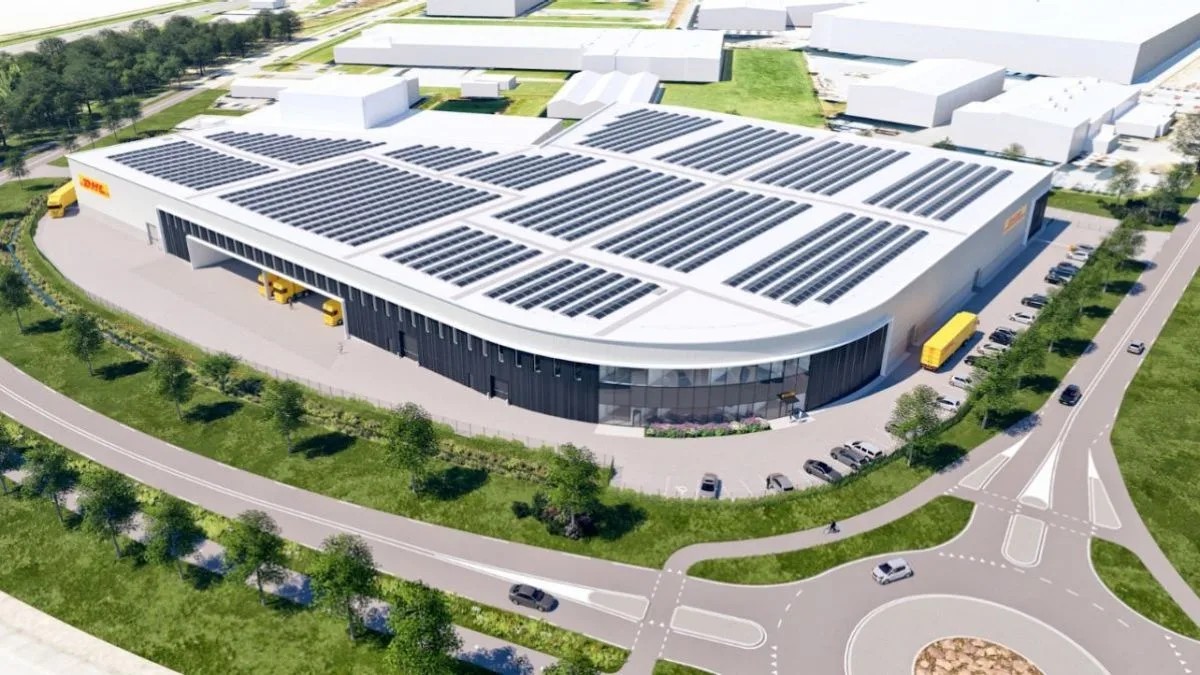
According to www.emeoutlookmag.com, DHL Supply Chain has begun construction on a new European Battery Logistics Hub in Holtum, Limburg, the Netherlands — a strategic expansion targeting high-voltage batteries and battery energy storage systems (BESS) for electric vehicles and grid-scale energy applications.
Accelerating Battery Capabilities
The facility will add 17,000 square metres of specialist storage and service space, co-located with DHL’s existing automotive operation in Holtum to form an integrated logistics campus. Scheduled to become operational in early 2027, the hub is positioned to serve end-to-end e-mobility and energy system supply chains across the Netherlands, Germany, Belgium, and surrounding markets. Its location provides direct access to major motorway corridors linking the Benelux region and Germany, as well as a nearby container and barge terminal on the Juliana Canal. This multimodal connectivity supports more resilient and sustainable distribution networks — a critical requirement for temperature- and safety-sensitive battery shipments.
Supporting the Full Battery Lifecycle
Designed to meet stringent regulatory requirements for battery handling, the hub will deliver compliant storage, diagnostics and testing, charging and conditioning, refurbishment, reverse logistics, and preparation for recycling. These technical and logistical capabilities are intended to help customers manage the entire battery lifecycle efficiently while advancing circular supply chain practices. According to Rainer Haag, CEO of DHL Supply Chain Europe, “The transformation of mobility and energy systems is a key driver of change in global supply chains.” He added:
“By expanding our battery logistics capabilities in Holtum and closely linking them with our existing automotive expertise on site, we are creating a scalable one-stop shop solution for the EV sector. This investment directly supports DHL Group Strategy 2030, where New Energy is a decisive growth driver for our business across Europe.”
Investing in New Energy Infrastructure
The project forms part of DHL Group’s broader Strategy 2030, which identifies electric mobility, renewable energy integration, and circular supply chains as core growth pillars. The Holtum campus exemplifies this commitment through physical infrastructure investment and cross-functional service integration. John Scherders, CEO of DHL Supply Chain Benelux, emphasized regional impact:
“For the Netherlands and the region around Holtum, this development reinforces the site’s strategic importance as a logistics and new energy hub. By connecting the new battery operation with our existing automotive and spare parts site right next door, we are creating a centre of excellence that allows us to offer seamless logistics and technical services for electric mobility and energy storage customers across Europe.”
Industry context underscores the urgency: EU battery demand is projected to grow by 400% between 2023 and 2030 (European Commission, 2024), driven by binding targets requiring 100% zero-emission new car sales by 2035. Meanwhile, BESS installations in Europe surged 68% year-on-year in Q4 2025 (IEA Global Energy Review, March 2026). For supply chain professionals, this means rising demand for certified hazardous-goods handling, real-time state-of-charge monitoring, and traceability-compliant reverse logistics — capabilities now being scaled at Holtum. DHL’s move follows similar expansions by Maersk, which opened a dedicated battery logistics facility in Antwerp in Q3 2025, and FedEx, which launched EV battery transport certification programs across 12 EU countries in early 2026.
Source: www.emeoutlookmag.com
Compiled from international media by the SCI.AI editorial team.