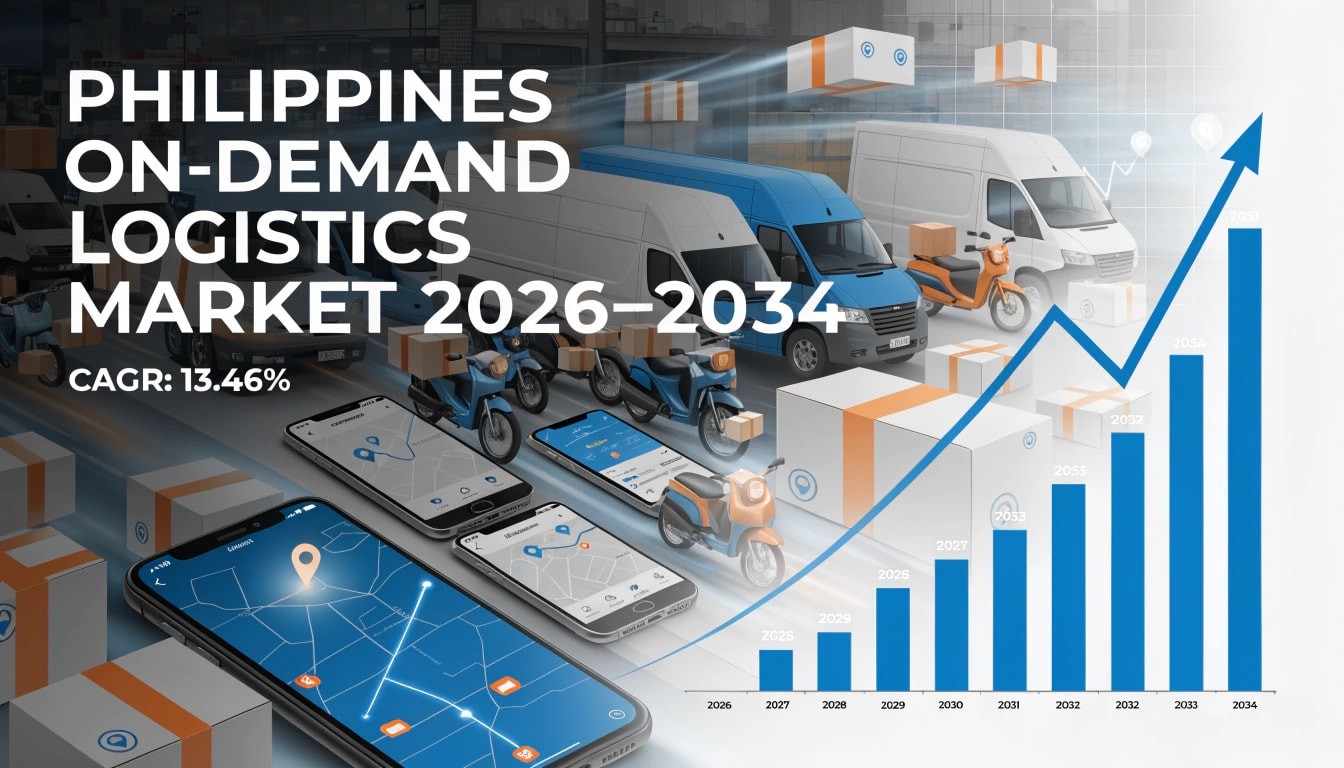
According to vocal.media, the Philippines on-demand logistics market reached USD 1.1 Billion in 2025 and is projected to grow to USD 3.6 Billion by 2034, reflecting a compound annual growth rate (CAGR) of 13.46% during 2026–2034. This rapid expansion is rooted in structural shifts across digital commerce, infrastructure, and consumer behavior — all converging to reshape last-mile delivery expectations and operational models for supply chain professionals operating in or serving the Philippine market.
Core Market Drivers
The source identifies five interlocking drivers fueling this transformation:
- Rapid e-commerce expansion: Online shopping is intensifying demand for fast, reliable fulfillment — pushing logistics providers toward on-demand models.
- High smartphone and internet penetration: Widespread mobile access enables seamless ordering and real-time tracking, underpinning app-based delivery platforms.
- Growing demand for faster last-mile delivery: Urban consumers and businesses increasingly prioritize same-day and instant delivery options.
- Infrastructure development and government support: Ongoing investments in roads, ports, and airports are reducing delivery timelines and improving network reliability.
- Adoption of digital logistics technologies: Real-time tracking, route optimization algorithms, and mobile logistics platforms are enhancing both operational efficiency and customer transparency.
Market Context and Recent Developments
The broader Philippines freight & logistics market was valued at approximately USD 19.1 billion in 2025, providing foundational scale for on-demand specialization. As of April 2026, a new 4,000-acre industrial hub in Luzon is accelerating demand for real-time and last-mile solutions. Meanwhile, wholesale & retail accounts for ~30.9% of logistics demand, reinforcing e-commerce as the dominant catalyst. Road transport remains dominant — representing ~67.45% of the transport structure — which supports agile, app-enabled urban delivery models. The Philippines ranks 21st among emerging logistics markets with a score of ~4.96, indicating measurable progress in logistics efficiency. Notably, cold-chain and specialized delivery segments are emerging, though ~91.6% of current logistics activity remains non-temperature-controlled, signaling significant white-space opportunity for premium on-demand services.
Strategic Opportunities for Supply Chain Professionals
For global supply chain practitioners, the Philippines’ on-demand logistics evolution presents concrete, actionable opportunities:
- Scaling same-day and instant delivery capabilities in Metro Manila, Cebu, and Davao — where density and connectivity enable high-frequency fulfillment;
- Integrating AI and automation into dispatch and route planning to reduce cost-per-delivery while meeting rising SLA expectations;
- Designing regional and rural delivery networks that leverage hybrid models (e.g., micro-fulfillment hubs + motorcycle couriers) to extend reach beyond major cities;
- Evaluating partnerships with local and global logistics players expanding capacity and technology investment — a trend explicitly noted in the source;
- Assessing cold-chain readiness: with only ~8.4% of logistics currently temperature-controlled, early adoption of compliant infrastructure offers first-mover advantage in healthcare, pharmaceuticals, and fresh food verticals.
As the Philippines’ digital economy matures, on-demand logistics is no longer a niche service but a core enabler of competitiveness — particularly for brands reliant on speed, visibility, and flexibility in customer fulfillment.
Source: vocal.media
Compiled from international media by the SCI.AI editorial team.