According to roboticsandautomationnews.com, industrial robot maker KUKA has unveiled its ‘Automation 2.0’ strategy — a technology direction integrating artificial intelligence with industrial automation systems to enable more adaptive, autonomous operations in manufacturing environments.
From Rule-Based to Intent-Based Automation
The strategy, presented at the April 2026 Nvidia GTC event, marks a shift from traditional, rule-based automation toward what KUKA describes as ‘intent-based’ systems. These systems translate high-level human goals into automated actions without requiring step-by-step programming. Instead of specifying each motion or sequence, users define an outcome, and the system determines how to achieve it. This transition is enabled by advances in AI models, simulation tools, and compute infrastructure spanning edge devices and cloud-based systems.
“Robots and automation systems are evolving from programmable machines to intelligent collaborators, capable of learning, adapting and operating safely alongside humans.” — Christoph Schell, KUKA Group CEO
KUKA AMP: Unified Software Platform for AI Orchestration
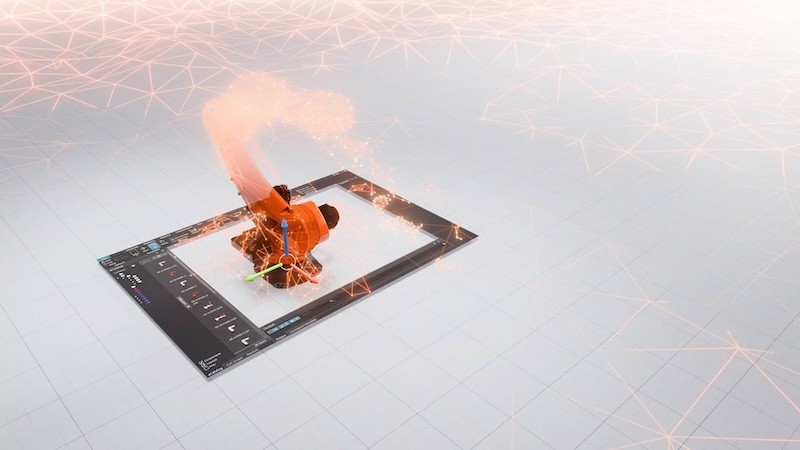
A cornerstone of Automation 2.0 is the newly unveiled KUKA AMP (Automation Management Platform), introduced publicly for the first time at GTC. Designed as a software layer that sits above existing automation systems, KUKA AMP connects hardware, software, and simulation tools into a unified environment. It reflects a move toward software-defined automation — where orchestration, optimization, and real-time decision-making increasingly occur at the software level. KUKA states this architecture will allow manufacturers to deploy and scale automation faster while enabling greater flexibility in configuring and adjusting production processes.
Automation 1.0 Remains Foundational
Despite the emphasis on AI, KUKA explicitly positions Automation 2.0 as an extension — not a replacement — of legacy systems. According to the report, Christoph Schell emphasized: “As we move toward Automation 2.0 and Physical AI, Automation 1.0 remains essential – for KUKA and for the entire industry. Proven, rule-based automation continues to deliver the stability and productivity our customers rely on, especially in high volume and safety critical environments. We’re not replacing it. We’re expanding it with intent-based and AI driven capabilities.” This reflects the industry-wide reality that deterministic, certified automation remains indispensable in production lines demanding reliability, repeatability, and functional safety compliance.
R&D Investment and Global Capabilities
KUKA’s AI push is backed by record R&D spending: €213 million in 2025 — its highest level to date. The company is also expanding its software and AI expertise geographically, including establishing a center of excellence in Silicon Valley and launching new research and training facilities in Asia. China remains a pivotal market: the source states KUKA reported revenue from the region exceeded €1 billion for the first time, underscoring both demand scale and competitive intensity in industrial robotics.
Industry Context for Supply Chain Professionals
For global supply chain professionals, KUKA’s strategy signals accelerating convergence between physical logistics infrastructure and AI-driven adaptability. Unlike standalone warehouse management systems or AMRs optimized for fixed paths, Automation 2.0 targets dynamic process orchestration — such as reconfiguring assembly sequences in response to component shortages or shifting quality inspection protocols based on real-time sensor data. This mirrors parallel moves by peers: ABB launched its AI-powered ‘Digital Twin for Operations’ in 2025, while Fanuc partnered with NVIDIA in 2024 to embed large language models into robotic controllers. Practically, supply chain teams evaluating automation must now assess not only hardware specs and throughput metrics but also software extensibility, AI model update cadence, and integration depth with MES and ERP platforms. Hybrid deployment — where AI layers augment rather than replace legacy PLC-controlled lines — will likely dominate near-term adoption due to validation timelines, workforce upskilling needs, and cost constraints in Tier-1 automotive and electronics manufacturing.
Source: Robotics & Automation News
Compiled from international media by the SCI.AI editorial team.