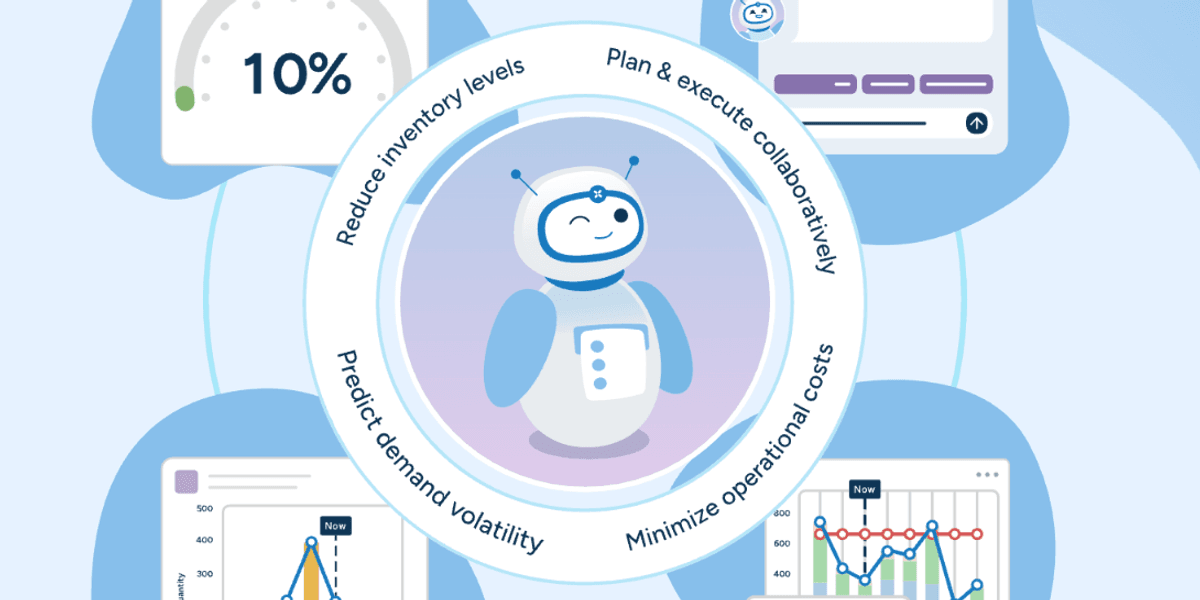
According to www.dcvelocity.com, only 10% of retail and manufacturing leaders say they would trust artificial intelligence to make fully independent supply chain decisions — a finding from new research by Relex Solutions.
Human Oversight Remains Non-Negotiable
The study underscores a clear boundary in AI adoption: while leaders widely accept AI as a decision-support tool, they remain unwilling to delegate final authority to algorithms. This reflects broader industry patterns observed across logistics technology deployments — for example, Maersk’s remote container management systems and Amazon’s warehouse robotics both operate under continuous human supervision, with AI flagging anomalies but humans approving interventions or reroutes.
This stance aligns with established benchmarks. Gartner’s 2025 Hype Cycle for Supply Chain Technology notes that autonomous decision-making systems remain in the ‘Trough of Disillusionment’, whereas AI-augmented planning tools sit firmly in the ‘Slope of Enlightenment’. Similarly, a 2024 MIT Center for Transportation & Logistics survey found that 87% of shippers use AI for demand forecasting or inventory optimization, yet fewer than 12% permit algorithmic re-routing of shipments without manual confirmation.
Practical Implications for Supply Chain Professionals
Research Methodology & Sample Composition
The study was conducted by independent research firm Researchscape in January 2026, surveying 514 decision-makers across retail, manufacturing, wholesale, and supply chain sectors globally. Results were weighted by countries’ nominal GDP to ensure broad representativeness. Among respondents, 42% were from large enterprises with annual revenue exceeding billion, 31% from mid-sized companies (00 million to billion), and 27% from small businesses (under 00 million). Geographically, North America accounted for 38%, Europe 29%, Asia-Pacific 22%, and other regions 11%.
Detailed Breakdown of AI Application Scenarios
The research further delineates current AI adoption across supply chain functions:
- Demand Forecasting & Sales Planning: 67% of surveyed companies have deployed AI-driven forecasting models, with the highest adoption in retail (78%) followed by manufacturing (61%);
- Inventory Optimization & Replenishment Decisions: 47% are using or planning to implement AI for dynamic safety stock calculation, seasonal stocking strategies, and cross-channel inventory allocation;
- Logistics Routing & Carrier Selection: 41% apply AI to optimize transportation routes, loading plans, and carrier scoring, particularly for cross-border logistics involving tariff simulation and compliance risk alerts;
- Supplier Risk Management: 29% of manufacturers utilize AI to monitor supplier financial health, geopolitical risks, and raw material price fluctuations for early warning;
- Sustainability Metrics Tracking: 23% employ AI for carbon emission calculations, circular economy material tracking, and green supplier certification.
Sector-Specific Priorities & Investment Trends
Retail and manufacturing exhibit distinct AI focus areas:
Retail Sector (45% of sample) prioritizes end-demand volatility. 30% of retail executives cite “adapting to sudden consumer demand shifts” as their top challenge, leading to AI investments in real-time demand sensing, promotion effectiveness prediction, and omnichannel inventory visibility. A representative case is a global fast-fashion brand that reduced its new product launch-to-replenishment cycle from 14 to 5 days using AI, cutting stockouts by 37%.
Manufacturing Sector (38% of sample) focuses on upstream stability. 57% of manufacturing leaders identify raw material procurement disruption as the most vulnerable supply chain link, while 34% mention growing regulatory compliance pressures. Consequently, AI applications lean toward supplier performance forecasting, alternative sourcing discovery, and compliance documentation automation. For instance, an automotive parts supplier shortened supplier risk assessment response time from 3 weeks to 48 hours with AI assistance.
Trust-Building Pathway & Implementation Recommendations
Jani Tuomala, Chief Product Officer at RELEX Solutions, proposes a “gradual trust-building” framework in the report:
- Transparency Phase: Demonstrate AI reasoning in low-risk scenarios (e.g., historical data analysis) with fully traceable decision logic;
- Collaboration Phase: Establish human-in-the-loop workflows for medium-risk scenarios (e.g., safety stock recommendations), requiring AI to provide multiple options with confidence scores;
- Supervision Phase: Retain human final approval for high-risk scenarios (e.g., supplier switching suggestions) while allowing AI to execute routine operations within predefined boundaries;
- Authorization Phase: Grant limited autonomy only in highly standardized, historically stable scenarios (e.g., regular replenishment order generation), with real-time monitoring and circuit-breaker mechanisms.
This framework aligns closely with Deloitte’s 2025 “Controlled Autonomy” concept in its Supply Chain Digital Transformation whitepaper, emphasizing that technology deployment must evolve in sync with organizational processes, workforce skills, and governance systems.
Implications for Chinese Supply Chain Enterprises
Considering China’s supply chain development context, the study reveals three key insights:
First, avoid “full automation” overreach. While Chinese manufacturing is at a critical stage of intelligent upgrading, the research cautions that even in AI-advanced Western markets, companies remain cautious about fully autonomous decision-making. Domestic enterprises should prioritize AI-augmented tools—such as intelligent production scheduling assistance, quality defect prediction, and logistics cost optimization—over pursuing opaque, fully automated systems.
Second, strengthen “explainability” capability building. With regulations like the “Interim Measures for the Management of Generative AI Services” coming into effect, AI decision transparency is becoming a compliance necessity. Companies need to invest in explainable AI (XAI) technologies to ensure AI recommendations can be traced to specific data sources, business rules, and historical cases, meeting internal audit and regulatory requirements.
Third, cultivate “human-AI collaboration” roles. AI will not replace supply chain planners but will redefine their responsibilities. Future demand will be for “AI supervisors” who understand business logic, can fine-tune AI models, and design human-AI interaction workflows. Enterprises should proactively develop corresponding training systems and career pathways.
For practitioners, this means investment priorities should emphasize human-in-the-loop (HITL) architectures, not fully agentic workflows. Systems must be designed to surface explainable recommendations — e.g., why AI suggests shifting 20% of orders from ocean to air freight — with audit trails, version-controlled logic, and role-based approval gates. Teams should also formalize AI governance protocols covering data lineage, model drift monitoring, and escalation thresholds (e.g., “if forecast error exceeds 22%, pause auto-replenishment and alert planner”).
Relex Solutions’ findings highlight that trust is earned incrementally: starting with high-visibility, low-risk applications like dynamic safety stock calculation or carrier scorecarding builds organizational confidence before scaling to prescriptive actions such as automated supplier allocation or real-time network rebalancing.
“Only 10% of retail and manufacturing leaders say they would trust AI to make fully independent supply chain decisions” — Relex Solutions
Source: dcvelocity.com
This article is AI-assisted and published after review by the SCI.AI editorial team.