According to siliconangle.com, Amazon.com Inc. has acquired Rivr Technologies AG, a Swiss developer of autonomous last-mile delivery robots.
Rivr Two Robot Capabilities and Design
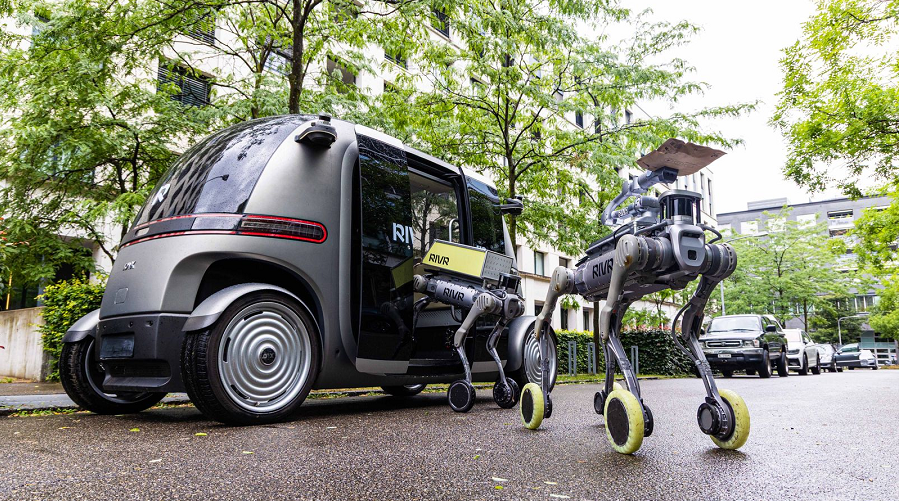
Rivr’s flagship product, the Rivr Two, is a four-legged robot that rolls on wheels and is purpose-built for last-mile delivery—the final leg between logistics hubs (e.g., warehouses or stores) and end customers. It can carry more than 60 pounds of parcels or food in an internal compartment and travel at up to 8.7 miles per hour—roughly twice walking speed. The robot is engineered to navigate urban environments: it stops at red lights, opens gates, and climbs stairs. Safety features include high-visibility lighting, instant object-proximity stopping, and a physical deactivation button.
Deployment Models and Amazon’s Prioritization
Amazon plans to prioritize the latter model. As reported by CNBC, the company has informed its third-party logistics contractors that it will collaborate with them to field-test Rivr’s technology. In an internal memo, Amazon stated:
“We are in the early stages of this journey, and as we progress, we will engage you and our teams to help us field test this technology, gathering real-world insights and incorporating your feedback into how we scale this technology in the future.”
AI Training Framework and Broader Supply Chain Applications
Rivr’s artificial intelligence software uses a hybrid training framework combining supervised and unsupervised learning. Supervised learning relies on annotated datasets; unsupervised learning does not. Rivr claims this approach enables rapid adaptation across robot form factors—demonstrating in one internal project that its software could be ported to a new robot platform in just one week. Given Amazon’s existing fleet of more than 1 million warehouse robots, this AI capability may accelerate upgrades in intralogistics automation. The acquisition also complements Amazon’s $1.2 billion 2020 acquisition of Zoox Inc., a self-driving vehicle startup now testing autonomous SUVs in multiple U.S. cities. Integration of Zoox-powered vans with Rivr Two robots could enable end-to-end autonomous last-mile workflows.
Industry Context and Practitioner Implications
This move aligns with broader industry acceleration in autonomous last-mile solutions. In 2023, Nuro deployed its R3 robot commercially with Kroger and Domino’s in Houston and Phoenix; Starship Technologies reported over 4 million autonomous deliveries globally since launch, operating in 30+ countries including Germany, Finland, and the U.S. Meanwhile, major logistics providers—including DHL, UPS, and FedEx—have piloted sidewalk and curb-side delivery robots in select metro areas. For supply chain professionals, Rivr’s integration signals a near-term shift toward human-robot handoff protocols, requiring updated SOPs for van loading, geo-fenced dispatch zones, battery swap logistics, and real-time fleet telemetry interoperability. Unlike earlier generations of AMRs, Rivr Two’s stair-climbing and gate-opening functionality expands viable deployment beyond flat, gated communities—potentially increasing address coverage by 15–25% in mixed-density urban corridors, based on publicly reported pilot data from European municipal trials (e.g., Zurich and Lausanne, 2022–2023).
Source: siliconangle.com
This article was compiled by AI from international media reports and reviewed by the SCI.AI editorial team.